Mad Honey Effects: What Does It Actually Do to Your Body?
Mad honey effects—from a single mild mad honey effect to a full psychoactive experience—come from grayanotoxin, a natural compound in Rhododendron nectar that messes with your nervous system’s sodium channels. What does mad honey do to you specifically? When you take it responsibly, you’ll feel tingling, warmth, mild euphoria, and deep relaxation. The effects of mad honey start in 30–60 minutes, last 2–4 hours, and get stronger with higher doses—which also means more risk.
The first time I tried mad honey up in Lamjung, Nepal, the sweetness wasn’t what caught me off guard—it was this weird tingling on my tongue, followed by warmth spreading through my chest within maybe 20 minutes. It felt strange, not overwhelming, just… different from anything I’d felt before. That moment, sitting in the hills where this honey gets harvested, made it obvious: mad honey isn’t just another jar of honey—it genuinely does something to your body.
If you’re here, you’re probably asking the same thing I did before trying it: what does mad honey actually do? You want real information, not just marketing talk. This guide breaks down the complete picture of mad honey effects—how grayanotoxin works, what you’ll physically feel, the mental experience, timing, how dose changes everything, and warning signs you can’t ignore. Everything here comes from both scientific research and my direct experience sourcing from the mountains of Lamjung.
Important: This is educational information. It’s not medical advice. Talk to your doctor before trying mad honey—seriously, especially if you have heart issues (check our Safety Guide).
How Grayanotoxin Works in Your Body
The Sodium Channel Mechanism
All mad honey effects trace back to grayanotoxin, a natural toxin in certain high-altitude Rhododendron flowers. To understand what it does, you need to know how your nerve cells actually work.
Your nerves use voltage-gated sodium channels—basically tiny gates in cell membranes that open and close to send electrical signals. Normally, these gates open for a split second, then snap shut, keeping everything controlled and organized.
Grayanotoxin screws with this whole system. It latches onto these sodium channels (at what scientists call Site II) and stops them from closing properly. Your nerve and muscle cells stay “switched on” way longer than they should.
Think of a light switch that gets jammed in the “on” position—that’s basically what grayanotoxin does to your nerve cells.
This constant activation hits your autonomic nervous system hard, especially the vagus nerve that controls heart rate and blood pressure. When that nerve gets overstimulated, your heart slows down (doctors call this bradycardia), blood pressure drops (hypotension), and your whole body shifts into this deeply relaxed state. That tingling sensation everyone talks about? That’s also from these messed-up nerve signals.
This sodium channel mad honey interaction is what makes grayanotoxin so unique among naturally occurring compounds—it’s not just sedating you or stimulating you, it’s fundamentally changing how your nerves fire.
Research backs all this up. A study by Gunduz and his team back in 2006, published in the American Journal of Emergency Medicine, found consistent patterns of slowed heart rate and low blood pressure in people who’d eaten mad honey. A bigger review by Silici and others in 2015, looking at over 1,100 cases, confirmed these cardiovascular effects are dose-dependent and predictable. More recently, the European Food Safety Authority in 2023 set a reference point of 15.3 micrograms per kilogram of body weight for combined grayanotoxin I and III—basically drawing a line for safe consumption.
Why the Bees Don’t Get Affected
Despite collecting nectar loaded with grayanotoxin, Apis laboriosa—the Himalayan giant honeybee—doesn’t get affected at all. These bees evolved sodium channels that resist the toxin completely. What alters human nerve signaling doesn’t touch their biology, which is how they safely make mad honey in these extreme mountain environments. The resulting Apis laboriosa honey effects are entirely dependent on which Rhododendron species the bees visit and at what altitude they’re foraging.
The Physical Effects of Mad Honey
What You Feel First — Early Onset (30–60 Minutes)
From our experience sourcing and testing mad honey in Lamjung, the beginning is subtle but you definitely notice it. Within about 30 minutes of taking our first teaspoon, the first thing I felt was this light tingling on my tongue and lips—almost like when your foot falls asleep, but gentler and it doesn’t go away. Shortly after, warmth starts building in your chest and spreading outward.
You might feel slightly light-headed—not drunk or confused, but noticeable enough to make you stop and think “okay, something’s happening here.” Some people notice more saliva in their mouth. Under all this, your body’s already changing: heart rate’s slowing down a bit, blood pressure’s dropping. At responsible doses, these early mad honey body effects are usually mild, but they’re your body’s signal that grayanotoxin is working.
Peak Physical Effects (60–120 Minutes)
As you move into the hour to two-hour window, things get more obvious. The warmth deepens into a full-body sensation that most people describe as grounding or heavy. Your muscles, especially in your legs, feel so relaxed they almost feel weighted down—like walking takes more effort than usual.
Your heart rate is measurably slower now. Some people notice their vision gets a bit soft or slightly blurred, especially when standing up quickly or moving around. Your skin might feel warm or a little flushed. If you took a higher dose, you might start feeling nauseous, especially if your body’s struggling with the intensity.
This phase really depends on how much you took. At around ¼ teaspoon, these feelings stay gentle and totally manageable. But if you took closer to a tablespoon, they can get significantly stronger and shift from pleasant to uncomfortable pretty damn quick.
Cardiovascular Effects — What’s Actually Happening to Your Heart
The most important thing to understand about mad honey is what it does to your heart. Grayanotoxin directly affects your heart by overstimulating the vagus nerve, which slows your heart rate and drops your blood pressure. At responsible doses, this is what creates that characteristic calm, slowed-down feeling people describe.
But here’s the thing: this same mechanism is what makes higher doses dangerous. Clinical data from Turkish emergency rooms—where mad honey poisoning is well-documented because people there have been eating it for centuries—shows a clear relationship between how much you take and what happens. As dose increases, heart rate can drop to dangerously low levels, and blood pressure can fall enough to make you pass out. In more severe cases, doctors have seen conduction problems like atrioventricular block or irregular heartbeats.
This isn’t theoretical. It’s a well-documented physiological effect of grayanotoxin. Understanding the difference between controlled relaxation and cardiovascular stress is crucial if you’re thinking about trying mad honey.
The Psychoactive and Mental Effects of Mad Honey
Is Mad Honey Hallucinogenic? The Honest Answer
No—mad honey is not hallucinogenic like LSD or magic mushrooms. At normal, responsible doses, you won’t see things that aren’t there or hear voices. There are no geometric patterns, no reality distortions, nothing psychedelic in that classic sense.
What mad honey does produce is more subtle. People often describe mild euphoria, a loosening of mental tension, and thoughts that feel calm and slightly dreamlike. At moderate doses, perception might feel gently “smoothed out”—colors might seem a touch warmer, physical sensations more noticeable—but this isn’t hallucination.
As a Himalayan honey psychoactive substance, mad honey produces effects distinct from both traditional psychedelics and simple intoxicants. The rhododendron honey effects stem from grayanotoxin’s specific action on nerve cells, not from fermentation or anything else.
At higher doses, especially beyond what’s recommended, the experience changes. You might feel confused, disoriented, or mentally foggy. Here’s what matters: this isn’t a “stronger high”—it’s a sign you took too much. This distinction is important. Mad honey isn’t a psychedelic; it’s a biologically active substance with dose-dependent effects on your nervous system.
What the Mental Experience Actually Feels Like
From my experience, the mental side of mad honey is best described as quiet rather than intense. There’s a mild euphoria—a steady sense of ease that settles in without rushing you. Your thoughts slow down. That constant background noise in your head gets quieter.
A lot of people compare it to the early stages of drinking—that gentle relaxation, loosening of tension. But unlike alcohol, there’s usually no loss of control or doing stupid shit at low doses. You stay aware, present, functional.
There’s also this increased awareness of your body. Breathing feels deeper. Physical sensations become more noticeable. Time can seem to stretch slightly—not dramatically, but enough to create this more reflective, almost meditative state.
This lines up with how people culturally describe it. Joe Rogan, after trying mad honey, said: “About 20 minutes in, I’m like ‘oh, okay, this is a new one.'” That captures it well—it’s not overwhelming, but it’s definitely different.
The Full Mad Honey Experience: A Realistic Account
The complete mad honey experience unfolds in phases. In the first 30 minutes, you’ll notice subtle changes—the tingling, the first warmth. By 60 minutes, it deepens: your body feels grounded, your mind quiets down, and time seems to slow slightly. This is when the psychoactive qualities become clear, though not overwhelming.
What makes the mad honey experience unique is its dual nature: simultaneously physical and mental, relaxing yet consciousness-altering. Unlike alcohol, which dulls awareness, or caffeine, which amps it up, mad honey creates this middle ground—a calm alertness paired with bodily heaviness.
Most people describe their first mad honey experience as surprising in its subtlety. You remain functional and aware, but unmistakably altered. It’s this balance that makes it both fascinating and, when you overdo it, potentially problematic.
The Complete Timeline — Mad Honey Onset Time to Full Resolution
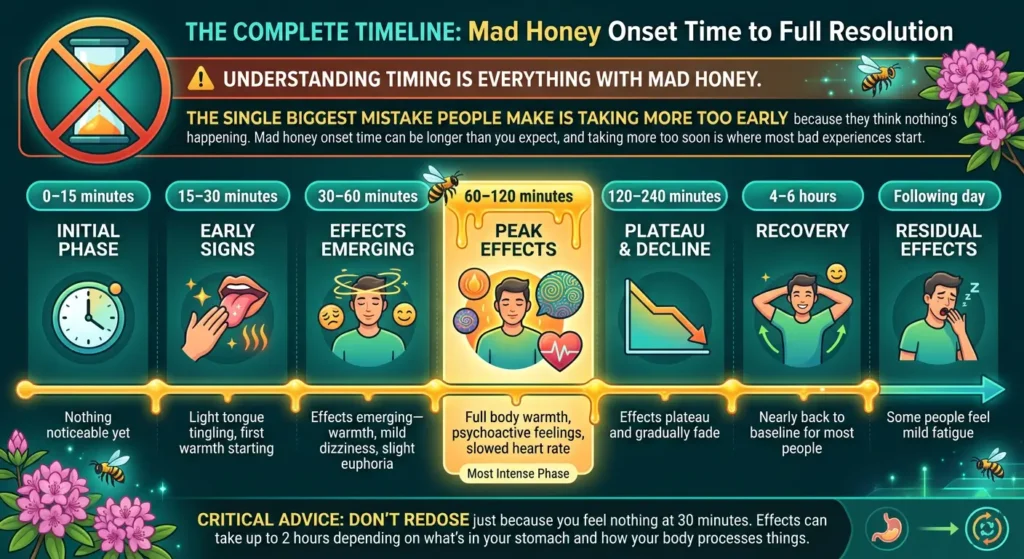
Understanding timing is everything with mad honey. The single biggest mistake people make is taking more too early because they think nothing’s happening. Mad honey onset time can be longer than you expect, and taking more too soon is where most bad experiences start.
| Time After Taking It | What You Experience | Important Notes |
| 0–15 minutes | Nothing noticeable yet | Don’t take more—this is totally normal |
| 15–30 minutes | Light tongue tingling, first warmth starting | Early signals it’s beginning to work |
| 30–60 minutes | Effects emerging—warmth, mild dizziness, slight euphoria | Onset phase; still building in intensity |
| 60–120 minutes | Peak effects—full body warmth, psychoactive feelings, slowed heart rate | Strongest phase; how intense depends on dose |
| 120–240 minutes | Effects plateau and gradually fade | Body starting to return to normal |
| 4–6 hours | Nearly back to baseline for most people | Residual effects usually minimal |
| Following day | Some people feel mild fatigue | Not a hangover, but you might need rest |
Don’t redose just because you feel nothing at 30 minutes. This is the most common mistake—effects can take up to 2 hours depending on what’s in your stomach and how your body processes things.
Empty stomach = faster onset and stronger effects. Full stomach = slower absorption and delayed timeline.
Dose-Dependent Effects — How Much Changes Everything
Mad honey’s effects are completely dose-dependent. The difference between a calm, controlled experience and being physically overwhelmed is measured in teaspoons—not tablespoons. This is especially true with Himalayan Giant’s Spring Harvest, which is naturally more potent because of the high-altitude Rhododendron arboreum nectar found between 2,500 and 4,000 meters.
| Dose Level | Amount | What to Expect | Who It’s For |
| Micro | ¼ tsp (2–3g) | Subtle warmth, light tongue tingling, mild relaxation without obvious heart effects | First-timers and cautious explorers |
| Low | ½ tsp (4–5g) | Noticeable warmth, gentle euphoria, slight light-headedness, physical effects becoming clear | After your first experience |
| Moderate | 1 tsp (8–10g) | Clear psychoactive effects, pronounced body relaxation, slowed heart rate, deeper mental quietness | Experienced users only |
| Strong | 1–2 tsp | Strong physical and mental effects, heavy limbs, significant heart impact, possible nausea | Experienced users with someone present |
| Maximum | 1 tablespoon | High-risk zone—severe dizziness, very low heart rate, potential toxicity | Never exceed—overdose territory |
Everyone responds differently to mad honey dose levels. Your body weight, whether you take it on an empty or full stomach, personal sensitivity, and whether it’s spring or autumn harvest all affect how strong the effects are.
This article is educational only—it’s not medical advice. Talk to a healthcare provider before trying mad honey, especially if you have heart issues, blood pressure concerns, or take medications.
Mad Honey Side Effects: What to Expect vs. What to Worry About
Normal Side Effects at Responsible Doses
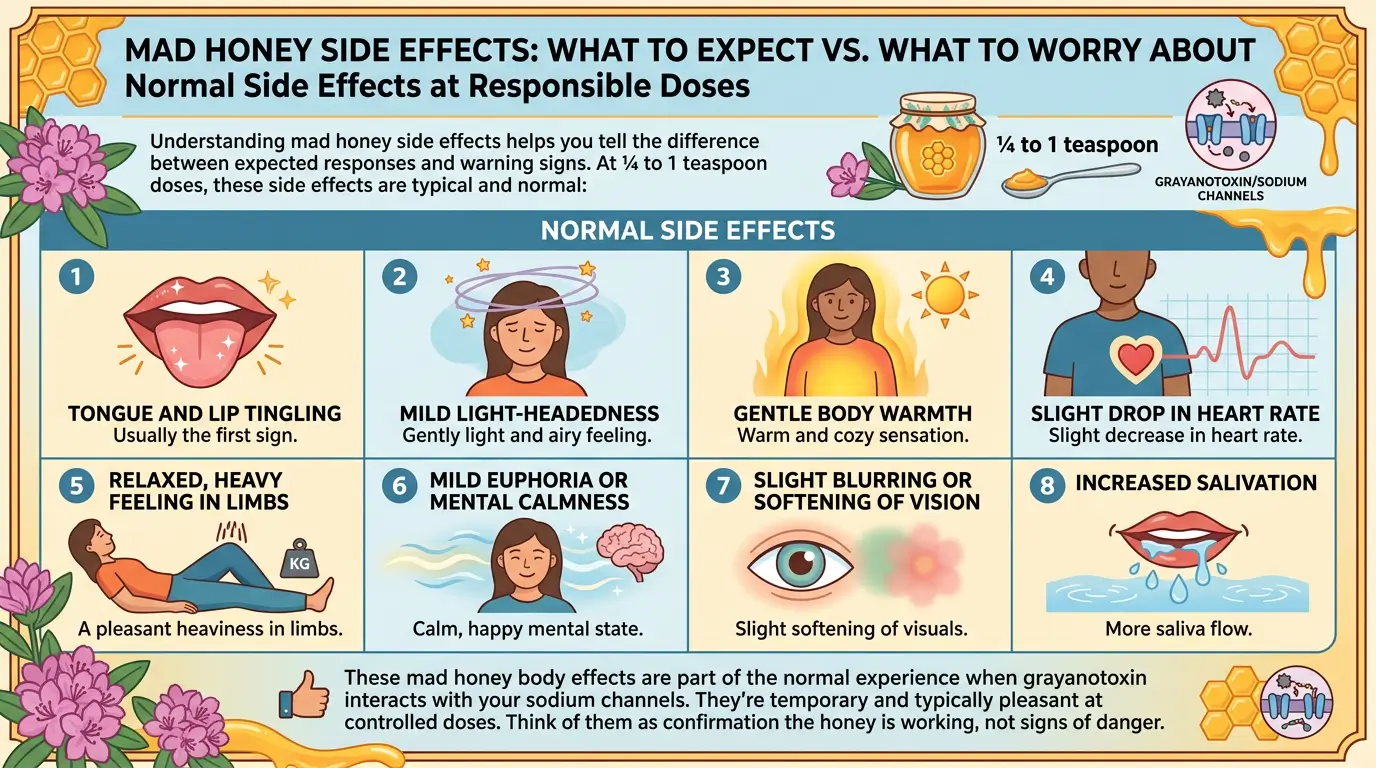
Understanding mad honey side effects helps you tell the difference between expected responses and warning signs. At ¼ to 1 teaspoon doses, these side effects are typical and normal:
Common and expected:
- Tongue and lip tingling (usually the first sign)
- Mild light-headedness
- Gentle body warmth
- Slight drop in heart rate
- Relaxed, heavy feeling in limbs
- Mild euphoria or mental calmness
- Slight blurring or softening of vision
- Increased salivation
These mad honey body effects are part of the normal experience when grayanotoxin interacts with your sodium channels. They’re temporary and typically pleasant at controlled doses. Think of them as confirmation the honey is working, not signs of danger.
Side Effects That Signal You’ve Taken Too Much
More concerning side effects indicate you’ve crossed from therapeutic to toxic territory:
- Severe nausea or vomiting
- Extreme dizziness or inability to stand without support
- Very slow heart rate (below 50 beats per minute)
- Blurred vision beyond slight softening
- Profuse sweating
- Chest discomfort or pressure
- Extreme weakness
- Difficulty coordinating movements
- Mental confusion or disorientation
If you experience these mad honey overdose symptoms, follow the emergency protocol in the next section immediately.
The difference between normal side effects and dangerous ones is usually obvious. Normal effects are mild and even pleasant. Dangerous effects make you think “something is wrong” rather than “this feels interesting.”
Warning Signs — When Effects Become Dangerous
Signs of Overconsumption
Mad honey isn’t something to mess around with. When you take too much, effects shift from manageable to medically serious. The warning signs are clear and you should never ignore them.
Severe dizziness or being unable to stand upright is often the first red flag. This can quickly turn into pronounced nausea and repeated vomiting. As blood pressure drops further, you might feel faint or like you’re about to black out. Heart rate can get extremely slow—well below normal resting levels—which might feel like weakness or pressure in your chest.
Vision can become significantly blurred, not just softened. Coordination might break down, making even simple movements difficult. In more serious cases, symptoms escalate to chest pain, difficulty breathing, or complete loss of consciousness.
These aren’t “strong effects.” These are signs of overconsumption and need immediate attention.
What to Do If You Take Too Much
If you or someone with you experiences these symptoms, act quickly and calmly:
- Stop taking mad honey immediately.
- Lie down somewhere safe—preferably flat on your back to prevent fainting.
- Drink water to stay hydrated.
- Don’t take anything else—no alcohol, no stimulants, nothing.
- If symptoms are severe—especially chest pain, trouble breathing, or loss of consciousness—get emergency medical help immediately.
In hospitals, atropine is the standard treatment and works very well to reverse mad honey’s cardiovascular effects. In many moderate cases, symptoms resolve within 24 hours even without medical intervention, but you should never count on this in advance.
For immediate guidance in the United States, contact Poison Control at 1-800-222-1222.
This section exists because informed users are safe users. Himalayan Giant includes full dosage guidelines with every order for exactly this reason.
This article is educational and doesn’t constitute medical advice—consult a healthcare provider for any concerns.
Traditional and Potential Wellness Uses — What History Tells Us
Long before mad honey became known outside the Himalayas, it had a place in local traditions. In Nepal, particularly among Gurung communities in places like Lamjung, people have consumed small amounts for specific purposes. Local knowledge passed down through generations suggests it was used in measured doses for managing blood pressure, easing joint discomfort, and supporting digestion. These practices were never about taking a lot—they were rooted in restraint and familiarity with the substance.
Similar traditions exist far beyond Nepal. In Turkey, people have used mad honey for centuries as a daily wellness tonic. Historical accounts describe taking it in small spoonfuls, sometimes mixed into warm milk, as part of routine life. It’s also been traditionally associated with use as an aphrodisiac and digestive aid. These practices carried into the Ottoman era, where mad honey was valued not for its intensity, but for its subtle effects when used carefully.
Mad honey even appears in ancient texts. The Greek geographer Strabo documented its effects as early as the first century BCE, describing how soldiers encountered its properties in regions near the Black Sea. Roman accounts later echoed similar observations, showing that humans have known about its unique effects for thousands of years.
Important: These are documented traditional uses from ethnobotanical and historical sources. They’re not medical claims. Mad honey is not a medicine. Consult a healthcare provider for any health condition.
Frequently Asked Questions About Mad Honey Effects
What are the effects of mad honey?
Mad honey effects usually include tongue tingling, warmth spreading through your body, mild euphoria, light-headedness, and deep physical relaxation. These come from grayanotoxin, which affects sodium channels and slows your heart rate and blood pressure. At higher doses, you might experience nausea, blurred vision, dizziness, and more serious cardiovascular symptoms.
What does mad honey do to you?
Mad honey affects your nervous system by binding to sodium channels, causing physical relaxation, slowed heart rate, lowered blood pressure, and mild psychoactive effects including euphoria and mental calmness. Effects are dose-dependent and begin within 30-60 minutes. At responsible doses, it creates a unique combination of bodily heaviness and mental quietness.
How long does it take for mad honey to work?
Mad honey typically starts working within 30 to 60 minutes, though some people notice early tongue tingling or warmth sooner. How fast it hits depends on dose, what’s in your stomach, your metabolism, and personal sensitivity. A full stomach often delays effects, while an empty stomach can make them appear faster and feel noticeably stronger.
How long do the effects of mad honey last?
Mad honey effects usually last 2 to 4 hours, with the strongest phase happening around 60 to 120 minutes after you take it. Most people return close to normal within 4 to 6 hours. Some users report mild fatigue the next day, especially after stronger doses, but it’s not typically like an alcohol hangover.
Is mad honey a hallucinogen?
No, mad honey isn’t a hallucinogen in the psychedelic sense. It doesn’t normally cause visual or auditory hallucinations like LSD or psilocybin. Instead, it produces mild euphoria, mental quietness, body warmth, and slight perceptual softening. If confusion happens at high doses, that’s toxicity, not a psychedelic experience.
What does a mad honey high feel like?
A mad honey high usually feels calm, warm, and slightly dreamlike rather than intense or chaotic. Most people describe mild euphoria, relaxed muscles, quieter thoughts, and stronger awareness of their body. It’s sometimes compared to the early stages of drinking alcohol, but without the same loss of inhibition or obvious loss of control at low doses.
What are the side effects of mad honey?
Normal mad honey side effects at responsible doses include tongue tingling, mild light-headedness, body warmth, and gentle euphoria. More serious side effects from overconsumption include severe nausea, very slow heart rate, extreme dizziness, blurred vision, and potential loss of consciousness requiring medical attention. Understanding the difference between normal effects and dangerous side effects is critical for safe use.
Can mad honey make you sick?
Yes, mad honey can make you sick if you take too much or if you’re especially sensitive to grayanotoxin. Warning signs include severe dizziness, nausea, vomiting, blurred vision, weakness, faintness, and an unusually slow heart rate. In more serious cases, chest pain, breathing difficulty, or loss of consciousness require immediate medical attention.
Does spring harvest mad honey have stronger effects than autumn?
Yes, spring harvest mad honey is generally stronger than autumn harvest because it comes from peak Rhododendron bloom, when grayanotoxin levels are typically higher. That’s why spring honey is usually more psychoactive and more dose-sensitive. Himalayan Giant’s Spring Harvest is sourced specifically for this higher-potency profile.
Note: You can explore Himalayan Giant’s Spring Harvest here: Mad Honey Rare Spring Harvest
What factors affect how strong mad honey effects are?
Mad honey effects vary based on dose, body weight, empty versus full stomach, personal sensitivity, and the potency of the specific batch. Spring harvests are often stronger than autumn harvests, and even small increases in amount can change the experience significantly. That’s why responsible use starts with measuring carefully, not guessing.
This FAQ is educational only and doesn’t constitute medical advice. Consult a healthcare provider before consuming mad honey, especially if you have any heart, blood pressure, or medication-related concerns.
Final Thoughts
Mad honey effects are real, biologically active, and unlike anything you’ll get from regular honey. Caused by grayanotoxin acting on sodium channels, they’re entirely dose-dependent—when used responsibly in the ¼ to 1 teaspoon range, mad honey can produce one of nature’s most distinctive combinations of warmth, relaxation, and mental quietness.
If you’re ready to experience authentic Himalayan mad honey for yourself, our Spring Harvest from the cliffs of Lamjung is harvested once a year, rigorously sourced, and available now.
By the Himalayan Giant Team