
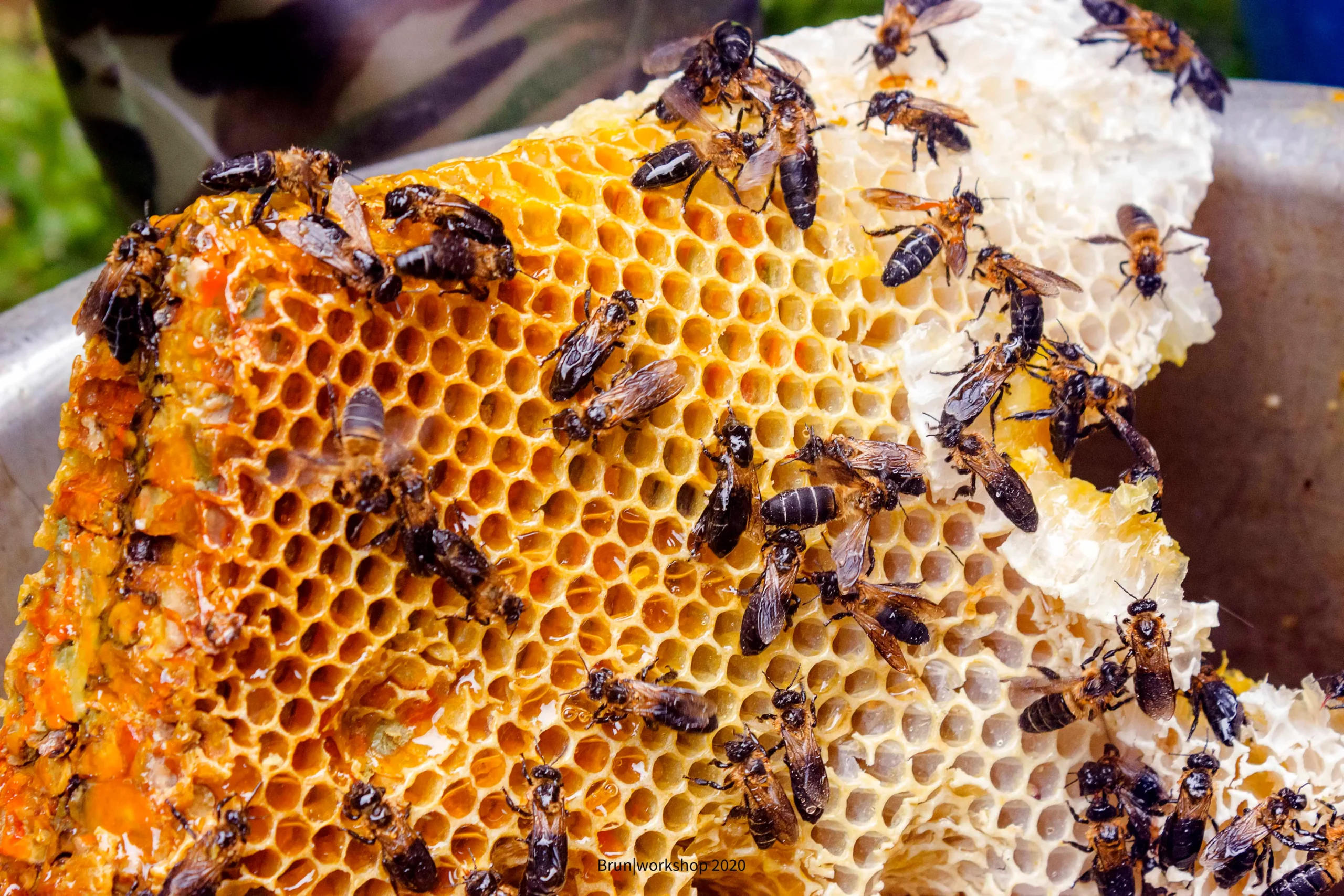
The bee that makes it — Apis laboriosa — is wild. It cannot be kept in a box. It cannot be moved to a farm. It builds its nest in the open air, on exposed cliff faces hundreds of feet above the ground, in mountains that most humans will never visit.
Harvest
UNDERSTAND FIRST
Why This Honey Cannot Be Farmed
Every honey you have ever tasted came from domesticated bees living in wooden boxes, managed by beekeepers, harvested by machines.
This honey is different in every way.
The bee that makes it — Apis laboriosa — is wild. It cannot be kept in a box. It cannot be moved to a farm. It builds its nest in the open air, on exposed cliff faces hundreds of feet above the ground, in mountains that most humans will never visit.
The flower it feeds on — wild Rhododendron — blooms above 10,000 feet for a few weeks each spring. It cannot be cultivated at scale. It grows where it grows, when it chooses to grow.
The honey it produces contains grayanotoxin — a compound that exists only because of this specific bee, this specific flower, and this specific altitude.
No farm can replicate this.
No factory can produce this.
No shortcut exists.
The only way to get this honey is to go to the cliff and take it from the rock — the way it has been done for a thousand years.
THE SEASON
One Window. Once a Year.
The harvest depends entirely on the Rhododendron bloom — and the bloom depends on the mountain.
The mountain rests. Bees cluster in their nests. No harvest is possible.
Rhododendron blooms. Bees forage at high altitude. Nectar flows. The hunters prepare and climb.
Monsoon rains. Cliffs are too dangerous. The mountain is closed.
Flowers are gone. Bees prepare for winter. The honey from spring is all there is.
The harvest window is roughly 4–6 weeks. If the bloom is late, the harvest is late. If the bloom is poor, the yield is small. If the weather turns, the hunters cannot climb.
We do not control any of this. The mountain does.
STEP 1
The Preparation
Days before the climb, the hunters begin preparing.
Rope ladders are woven by hand from local plant fibers and bamboo — the same way they have been made for generations. Each rung is tested. Each knot is checked.
Long bamboo poles are cut and shaped — these are used to reach the nests and cut the comb from the rock face while hanging mid-air.
Smoke torches are prepared from green vegetation — the smoke is used to calm the giant bees before the hunters approach the nest.
Woven baskets are readied to carry the harvested comb down the cliff.
There is no equipment store. No supply chain. Everything is made from what the forest and the village provide.
Nothing is rushed. The hunters have learned that preparation is the difference between coming home and not coming home.
STEP 2
The Climb
The rope ladder is secured at the top of the cliff and dropped over the edge. It unrolls down the rock face — sometimes a hundred feet or more — swaying in the wind against bare stone.
One hunter descends.
There is no harness. No safety rope. No backup system. Just the ladder, his hands, his feet, and the knowledge passed down from his father and his father’s father.
Above him, team members hold the support ropes. Below him, nothing but air and rock.
The bees know he is coming. As he approaches the nest, the swarm intensifies — thousands of giant Apis laboriosa bees, each one nearly the length of a human thumb, circling and defending what they built.
The smoke bearers below light their torches. Thick clouds of smoke rise along the cliff face. The bees slow. The window opens.
It will not stay open long.
STEP 3
The Cut
Hanging from the rope ladder with one hand, the hunter uses a long bamboo pole with the other to slice into the honeycomb attached to the cliff overhang.
The comb is massive — sometimes several feet across, heavy with honey, wax, and brood. It must be cut carefully to avoid dropping it entirely.
Pieces of comb fall into the basket held below by another team member, or are lowered by rope in a container.
The honey drips down the rock face. Some of it is lost to the cliff. Some of it is lost to the bees. What remains is what the mountain has given.
The bees do not give up easily. Even through the smoke, stings are constant. The hunter works through the pain because stopping is not an option when you are a hundred feet in the air on a rope ladder with no way to rush.
There is no second attempt. Each nest is visited once per season. The hunters take only what the bees can recover from — leaving enough for the colony to survive and rebuild.
STEP 4
The Descent
The hunter climbs back up the ladder. Slowly. Carefully. Covered in stings and sweat. The team pulls the rope ladder and the harvested comb back to the cliff top.
Then the walk begins.
The harvest site is deep in the mountains — hours from any road, sometimes a full day’s walk from the nearest village. The comb is carried by hand in woven baskets, through forest trails and mountain paths, back to the village where the honey will be separated.
Nothing about this process is fast.
Nothing about this process is easy.
Nothing about this process can be automated.
This is why this honey costs what it costs.
STEP 5
From Comb to Jar
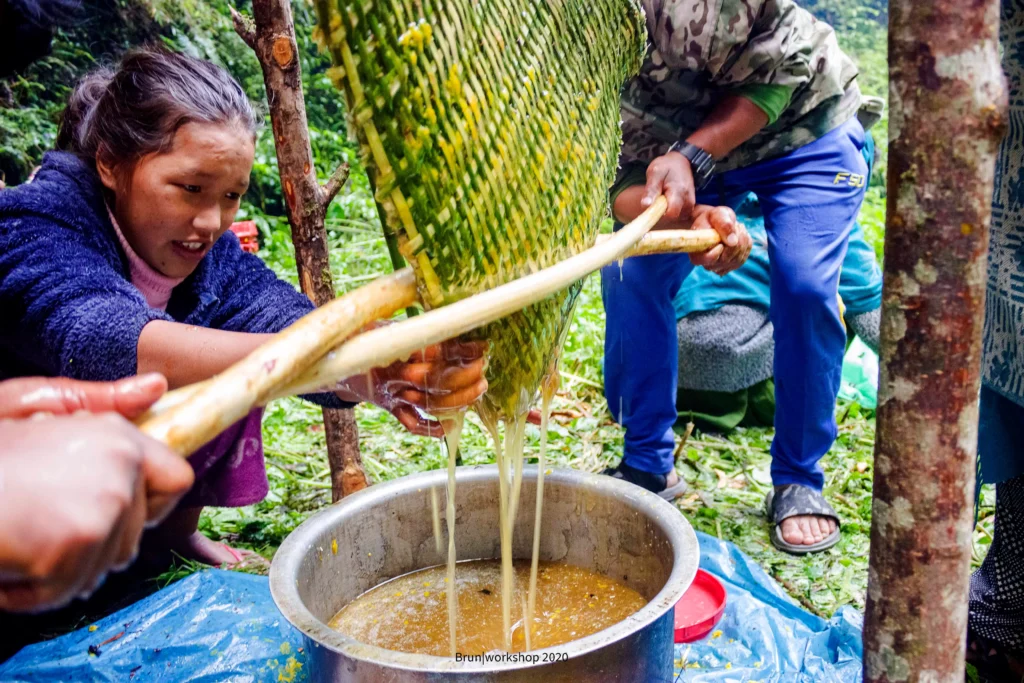
Once the honeycomb reaches the village, the honey is extracted by hand.
01—
SEPARATION
The honey is carefully separated from the wax comb by hand. No machines. No heat processing. No industrial extraction.
02—
NATURAL FILTERING
Filtered only through cloth to remove wax particles and debris. Nothing else is done to it. No pasteurization. No blending. No additives.
03—
WHAT IT IS
The honey that goes into your jar is exactly what came out of the comb. Same color. Same texture. Same compound profile. Nothing added. Nothing removed.
04—
PACKING
Each jar is hand-filled, sealed, and assigned a unique batch code. A QR code is prepared linking to the harvest video footage.
05—
READY
The jar is packaged for international transit and shipped directly from Nepal to your door.
WITNESS THE HARVEST
Don't Take Our Word for It. Watch It Happen.
We film every harvest. Not for marketing — for proof. Below is raw footage from the cliffs of Lamjung. No studio. No script. No edits for your comfort.
This is what it takes to bring you one jar of mad honey.
THE REALITY
What One Harvest Looks Like
1
Harvest
Per Year
4–6
Weeks
Window
Safety
Harnesses
100+
Feet
of Cliff
1,000s
of Bee
Stings
Hours
of Walking
to Reach
∞
Generations
of Knowledge
Every
Jar
Hand-Packed
Machines
Used
Now You Know What It Takes. Will You Listen?
Spring 2026 Harvest — Available until sold out