
Mad Honey Book vs. Real Mad Honey: Summary, Review & Facts
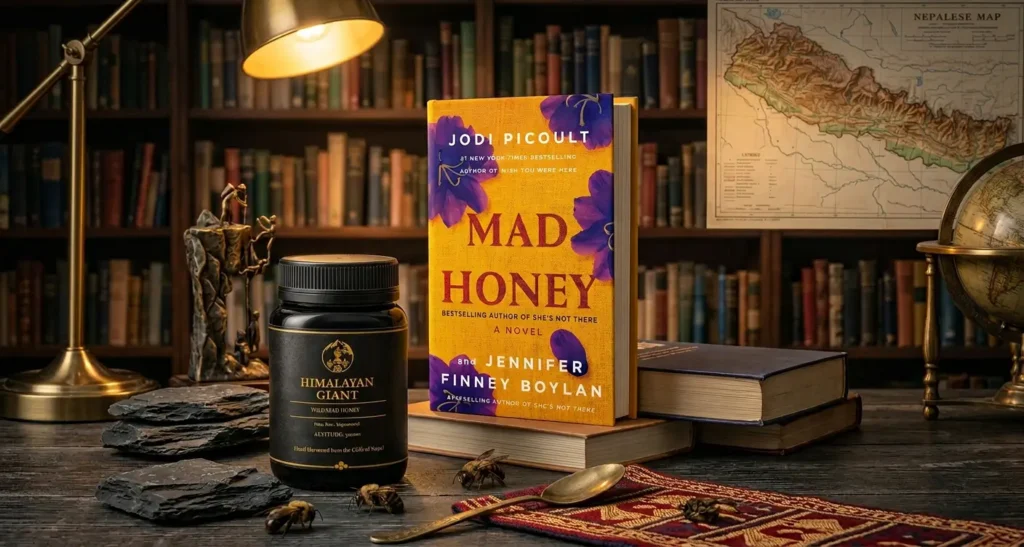
Ever heard of the “Mad Honey” book by Jodi Picoult? Read a spoiler-light summary and review, then learn the real story behind mad honey from Nepal.
Jodi Picoult and Jennifer Finney Boylan chose a title that sticks with you. Mad Honey, the New York Times bestselling novel, sounds like pure metaphor at first—something beautiful with danger folded into it—until you realize it’s pointing to something real. That’s part of what makes the story work. The book functions as a courtroom drama, a family story, and a meditation on truth. It also leaves a lot of readers wondering about the actual substance behind the name.
Whether you landed here after finishing the last page of Picoult’s novel, or you’ve been chasing the legend of Himalayan mad honey down an internet rabbit hole at 2am—you’re in the right place. This guide covers both kinds of curiosity: the literary kind and the obsessive kind.
You’ll find a clear, spoiler-light look at the mad honey book, including its themes, collaboration, and reception. Then we’ll shift from Mad Honey the novel to mad honey as a real, rare honey traditionally harvested in Nepal and other rhododendron-rich regions. Along the way, we’ll separate fact from fiction, explain the science without jargon, and share why this unusual honey has fascinated readers, historians, and honey hunters for centuries.
About “Mad Honey” the Novel by Jodi Picoult and Jennifer Finney Boylan
The Story Behind the Collaboration
Published on October 4, 2022, by Ballantine Books, Mad Honey brought together two writers whose voices fit the story in unusually thoughtful ways. Jodi Picoult, known for novels like My Sister’s Keeper and Small Great Things, teamed up with Jennifer Finney Boylan, author of She’s Not There and a longtime voice in conversations around transgender identity. The two had been friends for years, and that history shows up on the page.
In this Jodi Picoult Mad Honey collaboration, Picoult wrote Olivia’s chapters while Boylan wrote Lily’s, creating a structure built on alternating perspectives and partial truths. That design suits the Mad Honey novel perfectly: one story, two lenses, and a steady reminder that what you think you know is rarely the whole thing.
Mad Honey Book Summary (No Major Spoilers)
Set in the small New Hampshire town of Adams, the novel follows two families whose lives become painfully entangled. Olivia McAllister has returned to her hometown with her teenage son, Asher, after leaving an abusive marriage. She keeps bees, rebuilds a life that feels more stable than happy, and tries to protect the boy she loves without losing sight of the truth about him.
Then Lily Campanello arrives—bright, thoughtful, and new to town—and she and Asher fall hard for each other.
That setup might sound straightforward, but the novel quickly turns. When Lily is found dead, Asher becomes the prime suspect, and the story opens outward into grief, memory, secrecy, and fear. Olivia’s sections move through the present, while Lily’s voice reaches back through flashback, slowly reshaping what you think happened.
This mad honey book summary only scratches the surface, because the novel’s real force lies in how it reveals information. The book takes on domestic abuse, identity, perception, and the transgender experience with unusual care. Beekeeping isn’t decorative here—it’s central to Olivia’s work, her healing, and the novel’s title metaphor: sweetness with danger close behind.
Mad Honey Book Reviews: What Readers and Critics Are Saying
A fair mad honey book review has to admit two things at once: the novel is emotionally effective, and it follows some familiar Picoult courtroom-drama patterns. Critical reception has been largely positive, with reviewers praising its treatment of domestic abuse and transgender identity with care, empathy, and narrative clarity.
Many readers single out Jennifer Finney Boylan’s chapters as especially affecting and authentic. On Goodreads, the book holds a strong rating of around 4.1 out of 5 from thousands of readers. For a broader range of reactions—from deeply enthusiastic to thoughtfully mixed—Goodreads is still the best place to browse deeper reviews.
Disclosure: HimalayanGiant sells authentic mad honey from Nepal. This article is designed to help readers understand both the novel and the real substance behind its title.
The Real Inspiration: What Exactly Is Mad Honey?
From the Pages of Fiction to the Cliffs of Nepal
The title of Picoult’s novel may be literary, but the honey itself is real. Mad honey Nepal usually refers to rare honey gathered in highland regions like Annapurna and Langtang, where giant cliff-dwelling bees—Apis dorsata laboriosa—build hives on sheer rock faces. The honey gets its unusual character from nectar collected from grayanotoxin-containing rhododendron species growing in the Himalayas.
In Turkey’s Black Sea region, a related tradition produces what’s often called deli bal, associated with species like Rhododendron ponticum and Rhododendron luteum. In Nepal, the harvest is closely tied to Gurung communities, whose ancestral honey-hunting methods remain rooted in hand-built ladders, smoke, and deep local knowledge.
That’s the real landscape behind Himalayan mad honey—not a symbol, but a substance shaped by altitude, flowers, bees, and tradition.
The Science Behind the “Mad”—Grayanotoxins Explained Simply
So, what is mad honey in scientific terms? It’s honey that contains naturally occurring compounds called grayanotoxins, found in certain rhododendron plants. These toxins affect sodium channels in your body’s cells, making it harder for those channels to return to their resting state.
That sounds technical, but the basic idea is simple: the honey can change how your nervous system and cardiovascular system respond for a period of time.
In small amounts, some people report warmth, tingling, light-headedness, and a deeply relaxed feeling. In larger amounts, mad honey effects can become unpleasant or even risky, including nausea, vomiting, dizziness, low blood pressure, and bradycardia (slowed heart rate). This is why dosage matters.
Mad honey is not considered addictive, and it’s not a classic psychedelic. Its effects come from plant toxins, not the same pathways associated with serotonin-based hallucinogens.
Historical references to this phenomenon go back at least to Xenophon in 401 BC, when Greek soldiers near the Black Sea reportedly became incapacitated after eating toxic honey. Today, the same chemistry still explains both the intrigue and the caution around real mad honey.
Safety note: Mad honey can affect blood pressure and heart rate, especially in higher amounts. This article is for educational purposes only and should not be taken as medical advice.
What “Mad Honey” the Novel Gets Right (and Where It Takes Creative License)
The first thing the mad honey book gets right is the simplest: mad honey is real. It wasn’t invented as a dramatic metaphor, even though the novel uses it beautifully as one. Real mad honey does come from rhododendron-rich regions, and the book is also right to place beekeeping at the heart of its emotional world. Olivia’s relationship with bees feels grounded, not decorative.
More importantly, the Mad Honey novel understands the honey’s strange middle ground. In both literal and symbolic terms, it sits between comfort and danger, remedy and risk.
Where the story shifts into mad honey fiction is mostly a matter of setting and scale. The novel takes place in New Hampshire, while authentic mad honey is associated with specific regions like parts of Nepal and Turkey, where grayanotoxin-containing rhododendron nectar shapes the honey’s chemistry. New England honey traditions are real, of course, but not quite in that form.
The other creative leap is dramatic intensity. Fiction heightens cause and consequence because that’s part of the job. Real mad honey is generally approached with much more caution, and its grayanotoxin effects are usually subtler than novels make them seem. That gap between fiction and reality is exactly what makes real mad honey worth understanding.
The Real Mad Honey Experience: Stories from the Himalayas
The Gurung Honey Hunters—The Real Story Behind the Legend
In the highlands of Nepal, honey hunting isn’t a stunt or a tourist fantasy. It’s an ancestral practice tied to land, season, skill, and community. Among Gurung communities in the Annapurna region, cliff harvesting has been preserved across generations using hand-woven ladders, smoke, and long tools often referred to as tangos to cut honeycomb from hives fixed to sheer rock faces.
The spring harvest is the one most closely associated with mad honey, when rhododendrons are in bloom and grayanotoxin levels are highest. An autumn harvest follows, usually yielding a different kind of honey.
The work is dangerous, precise, and deeply cultural. It asks for nerve, but also for local knowledge that can’t be improvised. Eric Valli’s 1987 National Geographic documentation helped introduce the Gurung honey hunters to the wider world, and his Honey Hunters of Nepal documentary is still one of the best places to begin if you want to see the tradition with the respect it deserves.
What Does Real Mad Honey Actually Feel Like?
A responsible mad honey experience is often described in quiet terms rather than dramatic ones. For some people, the first signs are warmth that begins in the chest, then a faint tingling in the lips or fingertips. A light head rush can follow—not usually intense, more like a gentle shift in balance and awareness. Some also notice a sense of physical ease or a slightly heightened sensitivity to sound, taste, or touch.
That said, mad honey effects vary from person to person. Body size, sensitivity, recent meals, and the potency of the honey itself all matter. Effects typically begin around 30 to 45 minutes after consumption and may last anywhere from 2 to 6 hours.
A small starting amount—often about 1 teaspoon—is the safest place to begin. This is not a honey you eat by the spoonful. Anyone with heart conditions, low blood pressure, or relevant medications should speak with a medical professional before trying it.
Cultural and Medicinal Heritage of Mad Honey
In Nepal, mad honey has long held a place in folk practice as well as food culture. Gurung and other hill communities have traditionally used it in small amounts in relation to digestion, blood pressure, wound care, and general wellness. Honey also appears in broader Ayurvedic traditions across the region. In some communities, it’s shared at weddings and celebrations as a symbol of health and prosperity.
These are mad honey traditional use histories, not modern medical claims. The cultural importance is real; the medical interpretation should remain careful, current, and evidence-based.
For Your Book Club: Real Mad Honey Facts That Make the Novel Even Better
One of the best mad honey book club talking points is that the honey in the title has real historical weight. In 401 BC, Xenophon wrote about Greek soldiers near the Black Sea who became disoriented and incapacitated after eating toxic honey. That means the substance behind the novel isn’t modern literary invention—it’s been part of military and medical history for centuries.
Then there’s Nepal. The mad honey discussion questions almost write themselves once you see Eric Valli’s images of cliff honey hunting for National Geographic. The Gurung harvest from near-vertical rock faces using ladders, smoke, and nerve. Showing those photographs at book club changes the scale of the story immediately.
Another rich thread is legality. Real mad honey is natural, but because potency and regulation vary, it sits in an awkward space in some markets—lawful in many places, watched more carefully in others. That mirrors one of the novel’s recurring ideas: not everything dangerous announces itself clearly.
And Olivia’s beekeeping life isn’t there by accident. Jodi Picoult researched beekeeping for the novel, which helps explain why those scenes feel lived-in rather than decorative. You can also bring in deli bal, the Turkish name for mad honey, and its long association with battlefield confusion and political intrigue.
For extra texture, end your mad honey book club questions with Eric Valli’s Honey Hunters of Nepal documentary.
Frequently Asked Questions About “Mad Honey” the Book and Real Mad Honey
Is mad honey real, or was it invented for the Jodi Picoult novel?
Yes. Is mad honey real? Absolutely—and it long predates the novel. Jodi Picoult and Jennifer Finney Boylan used a real substance as the title and metaphor for their story. Historically, real mad honey is most closely associated with parts of Nepal and Turkey, where grayanotoxin-containing rhododendron nectar gives it unusual properties.
Where does real mad honey come from?
Real mad honey comes primarily from the Himalayan region of Nepal and the Black Sea region of Turkey, with smaller amounts found in other rhododendron-rich areas. In Nepal, the tradition is closely tied to Gurung honey hunters. The giant Himalayan honey bee, Apis dorsata laboriosa, is central to that harvest.
Is “Mad Honey” the novel appropriate for young adults?
Mad Honey is generally marketed as adult fiction and is best approached that way. It deals with domestic abuse, violence, identity, grief, and other mature themes. Many older teen readers may find it meaningful, but for younger teens, parental discretion is wise. It’s not a light or casual YA read.
Is real mad honey legal to buy?
In many places, yes—real mad honey is sold as a natural food product. That said, import rules, labeling standards, and marketplace restrictions can vary by country and platform, especially across the US and Europe. Buy only from trusted sources that are transparent about origin, potency, and responsible use, including sellers like HimalayanGiant.
What should I read or watch if I loved “Mad Honey” the novel?
Start with Eric Valli’s Honey Hunters of Nepal for the real-world backdrop behind the title. Then try other Jodi Picoult novels if you liked the courtroom-and-family structure, or Jennifer Finney Boylan’s memoir She’s Not There for her voice outside fiction. For the honey side of the story, explore the HimalayanGiant blog.
Ready to Experience the Real Thing?
Part of what makes Mad Honey such a good title is that it holds two truths at once. The phrase sounds symbolic, and it is, but it also points to something tangible, ancient, and a little hard to categorize. Real mad honey carries that same tension. It’s sweet, but not simple. Natural, but not ordinary. The novel uses that duality to talk about truth, perception, and harm; the honey itself has inspired centuries of fascination for much the same reason.
If Picoult’s novel sent you looking for the substance behind the name, you’re among the right people here. At HimalayanGiant, we’re transparent about the fact that we sell real mad honey, and our interest in it goes beyond novelty. We focus on Himalayan mad honey sourced through direct relationships in Nepal, with respect for the Gurung honey-hunting tradition behind it. It’s rare, seasonal, and unlike standard table honey in both story and character.
If you want more background before you buy mad honey, our guides on what mad honey is and its history are good places to keep reading.
If you’re ready to try the real thing, our Himalayan mad honey is here whenever you are.