Buy Mad Honey Online: The Only Guide You Need
Buying Mad Honey: Quick Reference
- Legal in USA: Generally sold as a food product
- Legal in Europe: Typically treated as food; country rules may vary
- Main authentic source: Nepal, high-altitude Himalayan regions
- What to verify: Source district, harvest season, supply chain transparency
- What to avoid: Vague marketplace listings, no sourcing detail
- Ships to: USA, Europe and Worlwide
- Product: Explore spring harvest mad honey →
✓ Direct Nepal Source | ✓ Spring Harvest | ✓ Ships USA, Europe & worldwide | ✓ Satisfaction Guarantee
Why Buying Mad Honey Online Is Harder Than It Looks
The surge in interest around mad honey has made one thing clear: it is now much easier to find listings than it is to verify what is actually in the jar. If you are ready to buy mad honey, you have probably already noticed how inconsistent the market feels. One seller emphasizes rarity, another focuses on origin, and a third offers mad honey for sale with almost no sourcing detail at all. For buyers, the real challenge is not finding options. It is knowing which ones deserve trust.
That confusion is exactly why this guide exists. Himalayan Giant does sell mad honey, and it is important to say that plainly from the start. But we are also writing this as a genuine buying resource because real mad honey should be evaluated by clear standards, not by bold claims or attractive packaging. If buyers do not know what to look for, authentic products and questionable ones can appear almost identical online.
So this page is designed to help you make an informed decision before you order from anyone, including us. We will explain what authentic sourcing actually looks like, what details a legitimate seller should be able to provide, how to think about harvest season, and what practical questions matter most before you buy. By the end, you should have a much clearer sense of where to buy mad honey with confidence — and how to recognize a seller that is transparent enough to earn it.
What You Are Actually Buying: Mad Honey in Plain Terms
The Geographic Reality: Why Mad Honey Only Comes from Specific Places
If you are still asking what is mad honey before placing an order, the shortest answer is this: it is a rare type of honey produced only in a few specific mountain ecosystems where the right bees, flowers, and altitude come together. Mad honey Nepal is the best-known modern source for many buyers, especially from Himalayan regions where traditional cliff harvesting still survives. That geographic detail matters more than most product labels suggest.
So where does mad honey come from in practical terms? Authentic Himalayan mad honey is associated with high-altitude zones, often above roughly 2,500 meters, where certain rhododendron species grow in abundance and giant cliff-dwelling bees forage seasonally. In Nepal, this is closely tied to communities such as the Gurung people, who have harvested honey in mountain regions for generations. If a seller uses terms like “Himalayan” or “wild mountain honey” but cannot tell you where is mad honey from beyond the country name, that should raise questions. Real sourcing starts with a real place.
The Botanical Source: Rhododendrons and Grayanotoxin Explained Simply
The reason rhododendron mad honey differs from ordinary honey comes down to nectar. In certain high-altitude environments, bees collect nectar from specific rhododendron species that naturally contain grayanotoxins. As that nectar is gathered and concentrated into honey, trace amounts of those compounds can remain in the final product. That is the basic botanical explanation behind grayanotoxin mad honey.
Mad honey is produced when Apis laboriosa bees collect nectar from certain rhododendron species in high-altitude Himalayan regions, primarily in Nepal. In the Himalayan context, this process is often linked to Apis laboriosa, the giant Himalayan honey bee, which nests on exposed cliff faces and forages in rugged mountain terrain. What is in mad honey, then, is still honey first — but honey shaped by a very unusual ecological setting. Traditionally, this is what has given it its distinctive reputation and cultural interest. For buyers, one practical rule matters: if a seller cannot explain which flowers, region, or harvesting conditions define their product, that is your first serious red flag.
For a complete guide to mad honey, visit our full mad honey guide →
The Uncomfortable Truth About the Mad Honey Market
Why Mad Honey Counterfeiting Is a Real Problem
The market for mad honey has grown much faster than the supply of genuinely harvestable product. Increased visibility through social media, travel content, and documentaries has created strong demand, but authentic supply remains limited by geography, season, and harvesting difficulty. That gap is exactly where confusion enters the market. When demand rises faster than traceable production, substitution, dilution, and vague origin claims become much more likely.
That does not mean every questionable listing is intentionally deceptive. In many cases, the problem is simpler: buyers cannot easily verify real mad honey on their own. Color, thickness, and taste can vary from batch to batch, and none of those factors alone prove authenticity. Even price is unreliable. Expensive jars are not automatically authentic mad honey, and low prices are not the only warning sign. The real issue is that most consumers are being asked to trust claims they have no practical way to confirm without clear sourcing information.
The Specific Problem with Buying Mad Honey on Amazon
The issue with mad honey Amazon listings is not that every seller on the platform is dishonest. The issue is that the marketplace structure makes meaningful verification very difficult. On large third-party marketplaces, sellers can create product listings with broad claims, minimal origin detail, and limited accountability. In food categories, that often leaves buyers relying on photos, short descriptions, and review patterns rather than a transparent sourcing chain.
That matters even more when the product is rare and poorly understood by the average customer. If you want to buy mad honey online with confidence, you need more than a generic title and a handful of star ratings. Marketplace systems are not built to explain district-level sourcing, harvest season, or direct relationships with harvesting communities. They also make it harder to know who is actually responsible for the product if something is unclear. So the question is not simply whether mad honey Amazon options exist. It is whether the platform gives you enough information to evaluate them properly.
What “Authentic” Actually Means — And What It Does Not
For buyers, authentic mad honey should mean something practical and verifiable. It should point to a specific source region, not just a country name. It should connect the honey to the right ecological conditions and, ideally, to the traditional harvesting communities or supply chain involved. It should also include basic harvest information, because season matters in this category far more than it does for ordinary commercial honey.
Just as importantly, real mad honey does not need luxury packaging, dramatic branding, or inflated pricing to be legitimate. A polished label may help presentation, but it is not proof of origin. Celebrity mentions are not proof either. If you are trying to decide on the best mad honey to buy, the strongest indicators are always the least glamorous ones: source specificity, seasonal transparency, and a seller who can explain exactly how the honey got from the mountain to the jar. These are the standards we hold ourselves to at Himalayan Giant — and the same standards you should apply to anyone you buy from, including us.
6 Things to Verify Before You Purchase Mad Honey from Anyone
Before deciding where to buy mad honey, it helps to use the same checklist for every seller, not just the one with the best-looking website. If you are trying to purchase mad honey with confidence, these are the questions that matter most. They are simple, practical, and useful whether you are comparing direct importers, niche wellness stores, or marketplace listings. If you have ever wondered, can you buy mad honey online without guessing, this is the framework that makes that possible. Finding the best mad honey to buy starts with knowing what questions separate transparent sellers from vague ones.
Source Specificity: Ask for the District, Not Just the Country
“Nepal” is a start, but it is not enough. Mad honey Nepal products should be tied to a specific district, altitude range, or harvesting community, because that is how origin becomes meaningful. Ask: What district is this honey from, and where is mad honey from within that region?
Red flag: vague phrases like “from the Himalayas” with no details.
Green flag: a named district, approximate altitude, and community-level sourcing information.
Harvest Season Disclosure: Spring vs. Autumn and Why It Matters
Harvest timing affects how Himalayan mad honey is described, priced, and understood. In mad honey Nepal sourcing, spring and autumn are not interchangeable labels; they reflect different flowering conditions and different harvest windows. Ask: Was this harvested in spring or autumn, and what months does that mean?
Red flag: no season mentioned anywhere.
Green flag: a seller clearly states the harvest window, such as May to June.
Supply Chain Transparency: How Many Steps Between Hive and Jar?
The more intermediaries involved, the harder it becomes to verify real mad honey. Authentic mad honey does not require a perfect supply chain, but it should come with a clear explanation of how it moved from harvesters to exporter to customer. Ask: Do you source directly, through a named importer, or from wholesale brokers?
Red flag: the seller cannot explain how they obtain it.
Green flag: a documented relationship with a harvesting community or direct regional supplier.
Company Accountability: Can You Actually Reach a Human?
A serious specialty seller should be reachable, responsive, and able to answer basic sourcing questions. If you want to buy mad honey from a trustworthy company, customer support matters more than polished branding. Ask: If I have a question before or after ordering, how do I contact you and when should I expect a response?
Red flag: only a generic form and no clear contact details.
Green flag: direct email, contact page, and a visible response commitment.
Return and Satisfaction Policy: What Happens If You Are Unhappy?
Before you purchase mad honey, read the policy page. Rare products can still be sold responsibly, and any company offering mad honey for sale should explain what happens if an order arrives damaged, delayed, or not as described. Ask: What is your satisfaction or replacement policy if there is a problem with my order?
Red flag: “all sales final” with no context.
Green flag: a clear, specific policy written in plain language.
Community and Ethical Sourcing: The Question Most Buyers Forget
Mad honey Nepal sourcing is not only about geography. It is also about people. The Gurung honey hunters and other traditional harvesting communities carry knowledge that makes this product possible, so buyers should ask how sellers talk about that relationship. Ask: How do you work with or support the harvesting community behind this honey?
Red flag: no mention of harvester relationships at all.
Green flag: specific, respectful sourcing details and evidence of long-term community-minded purchasing.
If a seller can answer all six clearly, you are already much closer to identifying the best mad honey to buy — and far less likely to rely on guesswork alone.
Want a seller that can answer all six? Explore our spring harvest mad honey →
Spring Harvest vs. Autumn Harvest: Does the Season Actually Matter?
Why Rhododendron Bloom Season Changes Everything
In the Himalayas, season is not a minor detail. It is one of the main reasons one batch of honey differs from another. Spring, typically from March to May, is the peak bloom period for the high-altitude rhododendron species most closely associated with rhododendron mad honey. During this window, nectar flow is at its fullest, and the mountain ecosystem is at its most active. This is why many harvesting communities in mad honey Nepal regions traditionally regard spring as the most important season.
Autumn harvests, usually from August to October, come from a different ecological moment. Flowers may still be available, but bloom volume is lower and nectar conditions are not the same as they are during the main mad honey flower season. In himalaya mad honey sourcing, this matters because the surrounding forage environment shapes the character of the honey itself. That is why experienced harvesters and buyers pay close attention to season, not just origin.
What This Means Practically for What You Buy
For buyers, the most important point is simple: both spring and autumn honey can be authentic, but they are not identical categories. Spring harvest usually commands higher pricing because it is more limited, more traditionally prized, and tied to the most active rhododendron bloom period. That does not mean every buyer will experience the same mad honey effects from every spring batch, and it should never be treated as a guaranteed shortcut to a stronger mad honey high. Season is a sourcing distinction, not a promise.
If you are trying to identify the best mad honey to buy, check whether the seller clearly discloses the harvest window. If you want to purchase mad honey and the listing says nothing about season, ask directly. A serious seller should be able to explain whether the jar comes from spring or autumn and why that matters. When mad honey for sale is presented without that basic context, buyers are missing one of the most useful quality signals available. Himalayan Giant specializes in spring harvest honey from Nepal, and you can explore those details in the product section below.
Is It Legal to Buy Mad Honey in the USA and Europe?
Legal Status in the United States: The Clear Answer
Yes, mad honey is legal to buy in the USA. It is generally treated as a food product and is not classified as a controlled substance under federal law. Honey itself is not a controlled substance, and grayanotoxin is not listed as a controlled substance under U.S. federal drug schedules. In practical terms, that means the answer to both is mad honey legal in us and is mad honey legal in the us is generally yes.
Mad honey is treated as honey, not as a drug, which is why the key compliance issue is food import documentation rather than narcotics law. Buyers in the U.S. can purchase it online, and importers can ship it with the proper customs and food paperwork. So if your question is can you buy mad honey legally in the United States, the answer is generally yes. That said, regulations, customs practices, and food import guidance can change, which is why buyers should still verify current rules if they have any specific legal or compliance concerns.
Legal Status in Europe: Country-by-Country Overview
Across most of Europe, mad honey is generally treated as a food product rather than a controlled substance, which means the legal position is broadly similar to the United States. In the UK, it is also generally understood as a honey product for sale and import purposes. So if you are asking is mad honey legal in Europe, the broad answer is usually yes — but with an important caveat.
European food regulation can be more nuanced at the country level, especially when unusual imported foods are involved. One issue worth mentioning honestly is the EU Novel Foods Regulation (EU) 2015/2283. In some contexts, unusual honey products may raise novel food questions depending on how they are marketed, described, or introduced into the market. That does not automatically make mad honey illegal, but it does mean compliance should be handled carefully. For European customers, proper documentation matters, especially where mad honey for sale Europe searches reflect cross-border ordering concerns.
Importing Mad Honey: What Customs Actually Involves
From a customs perspective, mad honey is generally handled as a food import, not as a controlled substance import. That means the process usually centers on shipment declarations, product identification, and standard supporting documents for imported honey. If you purchase mad honey from an international seller, the main issue is whether the exporter handles food shipping documentation properly.
When you buy mad honey online, you should expect routine customs processing similar to other specialty food imports. Himalayan Giant provides shipment documentation to support that process. For readers who want more detail, we recommend reviewing our [full legal guide] as well.
This information reflects our understanding of current regulations as of 2025. Food import regulations can change. We recommend verifying current rules with your country’s food safety authority before purchasing if you have specific concerns.
What to Know About Safe Consumption Before You Buy
⚠️ IMPORTANT SAFETY NOTICE
Mad honey contains grayanotoxin, a naturally occurring compound that affects the body at sufficient doses. The information below is general educational guidance based on traditional use and available research. It is not medical advice. Consult a qualified healthcare provider before using mad honey, particularly if you have any medical conditions or take any medications.
How Mad Honey Works: The Basics Every Buyer Should Understand
If you are wondering what does mad honey do, the answer starts with what is in mad honey. Mad honey contains grayanotoxin, a natural compound found in nectar from certain rhododendron species. In grayanotoxin mad honey, that compound can affect sodium channels in cell membranes, which in turn can influence neuromuscular and cardiac function at sufficient doses.
The key point is dose dependence: small amounts may produce mild effects, while larger amounts can cause much more serious reactions. Those effects are temporary and generally resolve as the body metabolizes the compound, but that does not make careless use safe. Traditional Gurung use involved very small amounts and informed familiarity built over generations. Understanding the mechanism helps people approach mad honey more responsibly, whether they are curious about the traditional mad honey high some users describe or simply want to understand the product before purchase.
Starting Dose Guidance: The Most Important Thing to Know
The single most important principle with mad honey dose guidance is to start with the smallest possible amount. Traditional use and common buyer guidance often suggest beginning with about 1/2 teaspoon, and at most 1 teaspoon, for a healthy adult trying it for the first time. Even then, that is not a prescription. It is only a cautious general reference point. Wait at least two hours before considering any additional amount, because mad honey dosage responses can take time and vary widely between individuals.
Do not use it on an empty stomach the first time. Do not combine it with alcohol. Do not combine it with blood pressure medication, heart medication, or anything that may affect heart rate or circulation. This is general guidance only. Individual responses vary significantly.
Who Should Not Use Mad Honey
A balanced answer to is mad honey dangerous is this: it can be, especially for the wrong person or at the wrong dose. Avoid mad honey if you:
- have any cardiovascular condition
- have low or high blood pressure
- take medication for blood pressure or heart rhythm
- have a heart rhythm disorder
- are pregnant or breastfeeding
- are under 18
- have known bee product allergies
- have diabetes or blood sugar disorders
- take any medication that affects heart rate or circulation
- have not spoken with a doctor about your specific situation
Some people search can mad honey kill you. At excessive doses, grayanotoxin can cause serious cardiovascular effects and should be treated with respect. If you are unsure whether mad honey is appropriate for you, please speak with your doctor before purchasing. Many reported mad honey side effects occur when people underestimate dose or ignore contraindications.
What to Do If You Experience Adverse Effects
Mild mad honey side effects such as dizziness, nausea, or lightheadedness can occur and may pass as the compound is metabolized. If symptoms are severe, worsening, or feel unusual, seek medical attention immediately. Tell medical personnel exactly what was consumed: grayanotoxin-containing mad honey from Nepal. In the USA call 911; in much of Europe call 112. When in doubt, seek medical attention. Do not wait and hope symptoms resolve on their own.
For more detail, read our full effects and safety guide →
Our Source: The Gurung Honey Hunters of Nepal’s Annapurna Region
The Gurung Community: Who Actually Makes This Honey
Behind genuine mad honey Nepal sourcing are the harvesting communities whose knowledge makes this product possible. The Gurung people are an Indigenous ethnic community of Nepal’s mountain regions, especially in and around Gandaki Province, and their honey-hunting tradition is widely recognized as one of the most distinctive in the Himalayas. Harvesting is not simply a matter of collecting honey. It requires cliff navigation, rope work, smoke control, an understanding of seasonal bee behavior, and the use of traditional tools in difficult terrain.
That knowledge has been passed down across generations, and for many families it carries cultural meaning beyond income alone. Honey hunting is tied to identity, local knowledge, and continuity with older mountain lifeways. At the same time, this tradition exists under pressure from migration, economic change, and the physical risks of the harvest itself. That is why direct, respectful purchasing relationships matter. When people talk about himalayan mad honey, the real story begins with the communities who still know how to harvest it.
Lamjung District: Why This Specific Location Matters
When buyers ask where does mad honey come from, “Nepal” is only part of the answer. Our honey comes from Lamjung District, a mountainous region often described as a gateway to the Annapurna area. Lamjung matters because its varied elevation, steep terrain, and rhododendron-rich forest zones create the right ecological conditions for the kind of honey most people mean when they talk about mad honey from Nepal.
In higher-altitude bands, especially in rugged cliff environments, Apis laboriosa — the giant Himalayan honey bee — builds exposed colonies on rock faces and forages across mountain flowering zones. Those landscapes are influenced by the broader ecology of the Annapurna region and nearby conservation areas, where elevation and seasonal bloom patterns shape what nectar is available. This is what we know about our source region, and it is why place matters so much. Authentic origin is not just a country label. It is a specific ecological setting with a specific harvesting tradition behind it.
How Our Direct Sourcing Works
Himalayan Giant sources mad honey from Lamjung District, Nepal, through direct relationships with Gurung honey hunting communities in the Annapurna region. For us, direct sourcing means working through a traceable relationship tied to the harvesting region rather than buying anonymous wholesale stock with minimal background. That does not mean a perfectly simple chain. Honey still has to move from harvesters in Nepal through packaging, export logistics, and international shipping before it reaches the customer. But that process is still meaningfully more accountable than buying from a reseller who cannot explain where the jar came from.
Our goal is to offer authentic mad honey with as much source clarity as we can genuinely provide. Each shipment is supported with the practical documentation required for export and international delivery, and we try to be transparent about what we know, what we can verify, and what we cannot overstate. Direct sourcing has real logistical challenges, but it remains one of the strongest answers to the question of where to buy mad honey if traceability matters to you. In a market full of vague claims, that is one of the clearest ways to identify real mad honey.

What We Sell: Rare Spring Harvest Mad Honey from Nepal
Product Description: What Is in the Jar
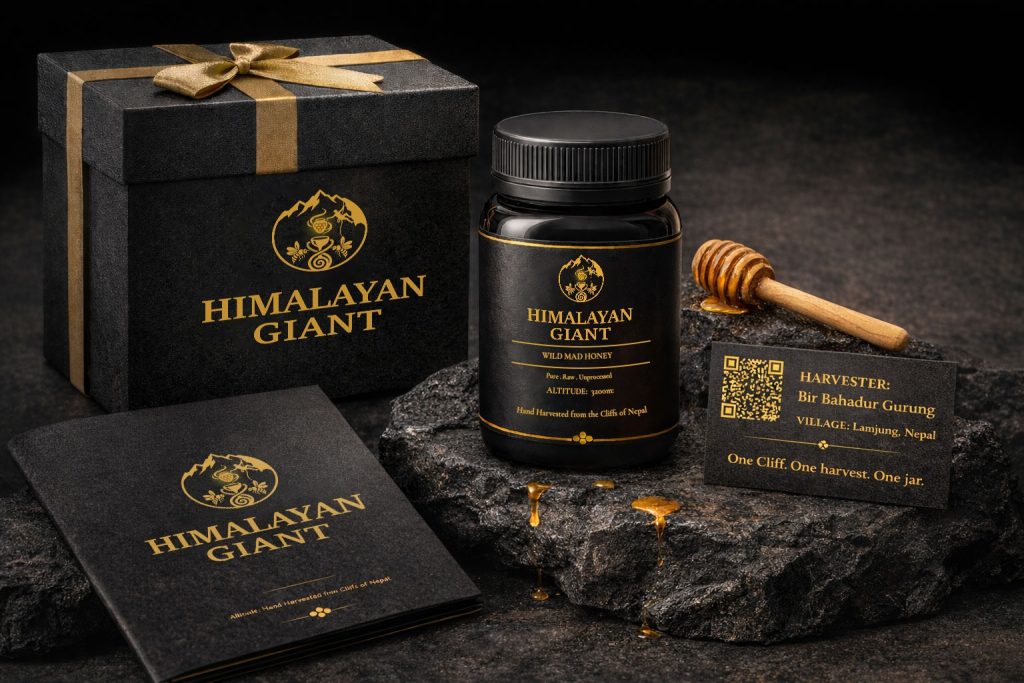
Our product is raw, unprocessed spring harvest mad honey Nepal sourced from Lamjung District through Gurung harvesting communities in the Annapurna region. “Raw and unprocessed” means it is not heat-treated to standardize texture and not heavily filtered into a uniform commercial finish. We keep it as close as possible to its natural harvested state while preparing it for safe packaging and shipment.
In the jar, the honey is typically darker than conventional supermarket honey, with color and consistency that can vary slightly by batch and season. That variation is normal in traditionally harvested honey and should be expected in real mad honey. The flavor is also different from ordinary table honey: floral, earthy, and complex, with the distinctive bitter undertone buyers often associate with this category.
Each order includes the product information needed to understand origin and harvest context. Available sizes include 200g, 400g and 600g jars. If you are ready to buy mad honey, you can review the full listing here:
View product details and purchase →
Pricing Context: Why Authentic Mad Honey Costs What It Costs
If you compare listings online, you will quickly notice that mad honey for sale is often priced well above ordinary honey. That is not just branding. Genuine spring harvest mad honey carries real sourcing costs: difficult cliff harvesting in remote mountain terrain, limited seasonal availability, small yields from wild colonies, export logistics from Nepal, and the documentation needed for international delivery. When sellers work more directly with source communities, fair payment is also part of the cost structure.
Spring harvest availability is limited to one main collection window per year, which is why inventory can be seasonal rather than year-round. In that sense, the category is closer to other premium specialty imports — such as high-grade saffron, rare single-origin coffee, or artisan truffle products — than to mass-market honey. If you plan to purchase mad honey, very low prices should be treated cautiously, because they often signal weak traceability or questionable authenticity. At the same time, a very high mad honey price does not automatically prove quality. In general, fair market pricing for authentic imported mad honey tends to sit in the premium specialty-food range rather than the standard honey aisle.
Shipping Mad Honey to the USA and Europe: What to Expect
Ordering from abroad should feel straightforward, especially when you are ready to buy mad honey online and want clear expectations before checkout. We offer free worldwide shipping, and we package every order with international delivery in mind. For the most current shipping details, policies, and updates, please see our full Shipping & Delivery page.
| Region | Estimated Delivery Time | Tracking | Shipping Cost |
| USA | 7-14 business days | Yes | Free |
| Europe | 10-18 business days | Yes | Free |
USA Shipping: Timelines, Packaging, and What to Expect
For U.S. orders, we currently ship to all 50 states. If you are ready to buy mad honey, your order is packed for long-distance transit using protective materials appropriate for packaging, with a discreet outer box and product documentation included. Jars are shipped in secure packaging designed to help preserve quality during transport. Tracking is provided with every order, and delivery usually takes 7-14 business days depending on destination and carrier processing.
From a customs perspective, mad honey for sale USA orders are generally handled as food imports rather than restricted goods. That means standard customs processing may still apply, but there are no special narcotics-style import procedures involved. Occasional delays can happen during customs review, and that is normal for international food shipments.
European Shipping: Countries We Serve and Import Process
For Europe, we ship to all EU member states and the UK, and provide the documentation needed for international food delivery. If you plan to purchase mad honey Europe orders, estimated transit time is typically 10-18 business days, although local customs review can occasionally extend delivery slightly. Tracking is provided, and packaging is the same secure format used for U.S. orders.
Because mad honey for sale in Europe is generally treated as a food product, the key issue is proper declaration and shipment documentation rather than controlled-substance compliance. We handle that process as part of fulfillment. If you are comparing sellers and deciding where to buy mad honey, shipping clarity matters — and we believe that should include honest expectations about timing, customs, and packaging from the start.
What Customers Say About Buying from Himalayan Giant
The experiences customers share with us reflect what we care about most: whether the honey was authentic, whether it arrived as described, and whether people felt they purchased from a company they can trust. Real mad honey reviews help future buyers understand what to expect, and honest feedback — positive or critical — helps us continue to improve.
Frequently Asked Questions About Buying Mad Honey
Is mad honey legal to buy in the USA?
Yes, mad honey is generally legal to buy in the USA as a food product. Based on current understanding, it is not scheduled as a controlled substance, and honey is not regulated as a drug in the usual sense. Regulations can change, so if you have specific compliance concerns, check current guidance.
Where can I actually buy mad honey online?
You can buy mad honey online from legitimate specialty sellers who provide clear origin, harvest season, and supply chain details. The important question is not whether it exists, but whether the seller provides transparency about sourcing. If you are comparing where to buy mad honey, look for district-level origin information, harvest season disclosure, and direct community relationships. You can also explore our spring harvest product page for a direct-source option.
How do I know if mad honey is authentic without lab testing?
Without lab testing, verifying real mad honey with complete certainty is difficult. The best indicators are source transparency, district-level origin, harvest season disclosure, and a clear explanation of how the honey moved from harvesters to seller. Authentic sellers should answer those questions directly. Testing offers stronger confirmation, but in its absence, traceable sourcing is your best practical filter.
Is mad honey on Amazon worth buying?
Mad honey Amazon listings are not automatically bad, but they are harder to verify. Large marketplaces often provide limited sourcing detail, and that makes it difficult to judge authenticity, harvest season, or accountability. If you do buy there, ask the seller for source region, harvest timing, and supply chain information before ordering. Platform convenience is not the same as product transparency.
Does mad honey show up on a drug test?
No, standard drug tests do not typically test for grayanotoxin, so mad honey does not usually show up on a drug test. Grayanotoxin is not a controlled substance, and standard employment panels are designed to screen for other substances. That said, no one can guarantee the scope of every specialized test in every context, so this should not be treated as a legal assurance.
How much should I expect to pay for genuine mad honey?
A genuine mad honey price usually falls into the premium specialty-food range, not the ordinary honey range. Authentic sourcing involves seasonal scarcity, difficult harvesting, international shipping, and documentation costs. Very low prices are a red flag, but very high prices do not automatically mean better quality. Look for fair pricing backed by traceable source information.
Is mad honey safe?
Mad honey can be used carefully by healthy adults in small amounts, but it is genuinely risky in excess or for people with certain medical conditions. Dose matters, and responses vary significantly. People with heart conditions, blood pressure issues, medication interactions, pregnancy, diabetes, or bee product allergies should avoid it unless cleared by a healthcare provider. [Read our full safety guide] before use.
What is the difference between mad honey and regular honey?
The main difference is that mad honey can contain grayanotoxin from certain rhododendron nectar sources. It is also associated with specific high-altitude regions and with bees such as Apis laboriosa, rather than standard commercial honey production. Traditional knowledge links it with distinctive effects, but those are not guaranteed outcomes. In every other sense, it is still honey shaped by unusual ecology.
Ready to Purchase Authentic Mad Honey from Nepal?
If you have made it this far, you already know more than most people who search for mad honey online. You know what authentic sourcing looks like, which questions a serious seller should be able to answer, how harvest season affects quality, and what legal and safety considerations matter before ordering. That matters, because the decision to buy mad honey should be based on traceability and transparency, not guesswork or hype.
We have tried to hold ourselves to the same standards described throughout this guide. Himalayan Giant sources from Lamjung District in Nepal, works to be clear about harvest context and shipping, and aims to present real mad honey honestly rather than dramatically. We are transparent about what we know, careful not to promise what we cannot guarantee, and committed to standing behind every order. If that is what you want from a supplier when you purchase mad honey, we would be honored to be your source.
Have Questions First? Contact Us
Why buyers choose Himalayan Giant:
- ✓ Direct Nepal source
- ✓ Spring harvest
- ✓ Satisfaction guarantee
- ✓ Ships USA and Europe
If you are ready to move from research to decision, our mad honey for sale is presented with the same clarity and care this guide was written to provide.For questions about sourcing, shipping, or product details, visit our Contact Page or email info@himalayangiant.com
By the Himalayan Giant Team