Mad Honey from Nepal: The Source, The Tradition, The Gurung Harvesters
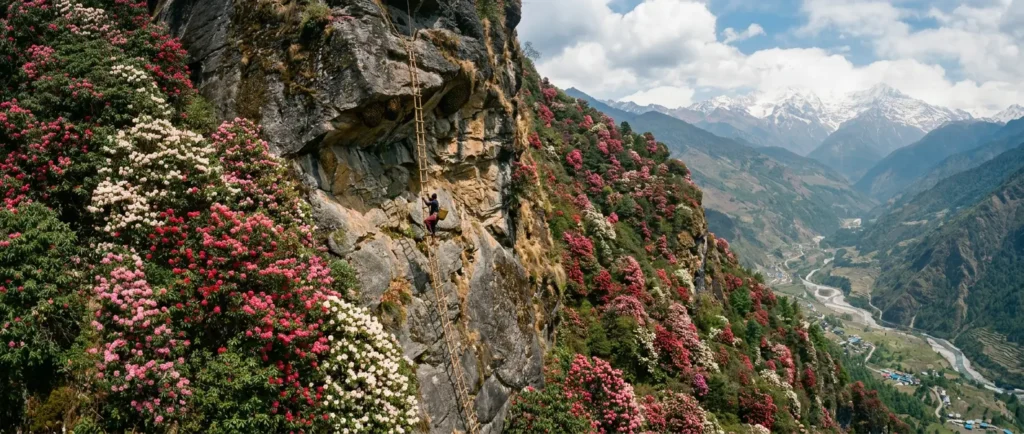
At 2,800 meters above sea level in Nepal’s Annapurna region, as the spring rhododendron forests burst into crimson bloom across the slopes of Lamjung district, a tradition older than recorded history begins again. This is where mad honey Nepal originates — not in farms or factories, but on sheer Himalayan cliff faces shaped by wind, altitude, and time.
The air is thin and cool, carrying the sharp scent of rhododendron — Nepal’s national flower since 1962 — mixed with smoke rising slowly from smoldering bundles of green leaves. Below towering rock faces, the sound of wind moves through the forest canopy, while above, massive honeycombs cling to vertical stone like something the mountain itself decided to hold. This is the natural home of the world’s most unusual honey.
The Gurung honey hunters gather quietly before the climb. There is no rush. A small puja ceremony is performed first — offerings of rice, flowers, and burning juniper incense to the cliff spirits and mountain deities. Only after this moment of respect do the hunters begin preparing the handwoven rope ladders that will carry them hundreds of feet down sheer rock faces. What follows is not simply harvesting. It is skill, risk, and inherited knowledge passed from father to son across generations.
Mad honey from Nepal is not a product that can be manufactured or scaled. It is the result of a rare convergence of geography, biology, and culture — high-altitude rhododendron forests, wild Himalayan bees that cannot be domesticated, and communities whose harvesting methods have remained unchanged for centuries. No other place on Earth brings all of these elements together in the same way. This is why Nepal mad honey occupies a position unlike anything else in the world of wild-harvested foods.
At Himalayan Giant, we have witnessed this harvest firsthand — standing at the base of 300-foot cliff faces in Lamjung and Myagdi districts while our partner hunters descended into dense clouds of defensive giant bees. The process, from rope ladder to bamboo basket, has been documented through our video verification system to ensure complete transparency from source to jar.
Honey hunting in this region is rooted deep in history. Rock art discovered in Nepal’s Mustang district depicts honey hunting practices estimated to be approximately 8,000 years old, suggesting this tradition predates written records in this part of the Himalayas. Today, it continues within the Annapurna Conservation Area — Nepal’s largest protected region, covering 7,629 square kilometers — where nature still dictates every harvest.
This is the complete story of where mad honey comes from, who harvests it, why Nepal produces the world’s most potent variety, and how it travels from a remote Himalayan cliff to your door.
Mad Honey from Nepal: Key Facts at a Glance
| Fact | Detail |
| What is mad honey? | Honey containing grayanotoxin, produced from the nectar of specific Rhododendron species |
| Where does it come from? | Primarily Nepal (Himalayan region) and Turkey (Black Sea region) |
| Which bees produce it? | Apis laboriosa — the giant Himalayan cliff bee, world’s largest honeybee |
| Which flowers create it? | R. arboreum, R. ponticum, R. luteum, and related species |
| Harvest altitude | 9,000–14,000 ft (2,700–4,300m) in Nepal |
| Peak harvest season | Spring (May–June) for highest potency |
| Who harvests it? | Gurung people (Lamjung district) and Magar people (Myagdi district) |
| Can it be farmed? | No — Apis laboriosa cannot be domesticated; all honey is wild-harvested |
| Active compound | Grayanotoxin (C₂₂H₃₆O₇), a naturally occurring diterpene polyol |
| Historical references | Xenophon (401 BC), Strabo (1st century BC), Ottoman trade records (18th century) |
| 2026 availability | Limited to 350 jars — Himalayan Giant spring harvest |
Why Nepal? The Geography That Creates the World’s Most Potent Mad Honey
The Rhododendron Belt: Nepal’s Mad Honey Flower
Mad honey comes from the nectar of specific Rhododendron species — primarily Rhododendron arboreum, Rhododendron ponticum, and Rhododendron luteum — that contain a naturally occurring compound called grayanotoxin. Nepal’s Himalayan geography creates the ideal conditions for these rhododendron species to produce exceptionally high concentrations of grayanotoxin in their nectar.
When people ask where does mad honey come from or where is mad honey from, the precise answer is this: it originates in high-altitude rhododendron forests where specific plant species naturally produce defensive compounds in their nectar. This is what gives rhododendron mad honey its distinctive character — and why not all honey from Nepal qualifies.
Nepal holds a remarkable botanical advantage. The country is home to more than 30 species of rhododendron — one of the richest concentrations of this genus anywhere on Earth. These species span a wide elevation range, particularly across the mid-hill and high-Himalayan zones where Himalaya mad honey is produced. The “mad honey flower” is not a single plant but an entire genus, with grayanotoxin potency varying by species, altitude, and growing conditions.
Rhododendron Species Responsible for Mad Honey
| Species | Altitude Range | Grayanotoxin Level | Primary Region | Bloom Period |
| R. arboreum | 1,500–3,600m (4,900–11,800 ft) | High | Central Nepal — Lamjung, Myagdi | March–May |
| R. ponticum | 600–2,100m (2,000–6,900 ft) | Moderate–High | Turkey and parts of Nepal | April–June |
| R. luteum | 500–2,000m (1,600–6,500 ft) | Moderate | Turkey and Caucasus region | May–June |
| R. campanulatum | 3,000–4,500m (9,800–14,700 ft) | Moderate | High-altitude Nepal | May–July |
- arboreumis Nepal’s national flower, officially declared in 1962, and the primary contributor to the grayanotoxin concentration that defines Himalayan mad honey.
Why Altitude Matters: The Grayanotoxin Concentration Factor
Not all mad honey is equally potent, and altitude is a significant reason why. At higher elevations, plants are exposed to ultraviolet (UV) radiation approximately 30–40% more intense than at sea level. In response, many alpine plants produce elevated concentrations of secondary metabolites — protective compounds that help them survive harsh conditions. Grayanotoxin is one of these compounds.
Nepal’s primary harvest zones sit between 9,000 and 14,000 feet above sea level — at or near the upper boundary of rhododendron distribution. At these elevations, the plants are under greater environmental stress, and the nectar they produce tends to carry higher grayanotoxin concentrations as a result. This is a key reason why altitude mad honey from Nepal is consistently more potent than honey from lower-altitude sources elsewhere.
Our sourcing team has mapped rhododendron bloom progression across both Lamjung and Myagdi districts over multiple harvest seasons, identifying specific elevation bands and bloom windows where nectar concentration is at its peak.
Lamjung and Myagdi Districts: The Specific Source
The most consistent, highest-quality mad honey from Nepal comes from two specific districts in Gandaki Province.
Lamjung district covers approximately 1,692 square kilometers along the southern slopes of the Annapurna and Manaslu ranges, with a population of roughly 167,724. Its dense rhododendron forests thrive between 2,500 and 3,500 meters, making it one of the most productive zones for wild honey production in the country.
Myagdi district covers approximately 2,297 square kilometers in the shadow of Dhaulagiri — the world’s seventh-highest mountain at 8,167 meters. The district’s deeply cut gorges, including the Kali Gandaki valley, create sheer cliff systems that serve as ideal nesting habitat for Apis laboriosa.
Both districts fall within or immediately adjacent to the Annapurna Conservation Area, a 7,629-square-kilometer protected zone established in 1986. This protected status means minimal industrial agriculture, no pesticide exposure, and an environment that remains largely undisturbed — factors that directly influence honey purity.
Why Nepal’s geography produces superior mad honey:
| Factor | Why It Matters |
| Altitude of 9,000–14,000 ft | Creates the highest grayanotoxin-producing rhododendron belt in the world |
| 30+ native Rhododendron species | Unmatched botanical diversity in a single harvest region |
| Protected, pesticide-free ecosystems | No chemical contamination; pure, wild-environment honey |
| Sheer cliff terrain | The only habitat where Apis laboriosa builds nests — guaranteeing wild-only harvest |
| Short, concentrated bloom season | Bees forage intensely on one dominant source — less dilution |
| Monsoon-regulated climate | Wet season drives explosive rhododendron growth; dry spring concentrates bloom |
All of these factors working together explain why Nepal remains the definitive answer when the question is where does mad honey truly come from.
The Gurung People: Ancient Honey Hunters of Lamjung
Who Are the Gurung People?
The Gurung (also spelled Tamu) are an indigenous Tibeto-Burman ethnic group native to the central Himalayan region of Nepal, primarily concentrated in districts including Lamjung, Kaski, Gorkha, and Manang. With a population of approximately 543,571 (Nepal 2011 census), they are one of Nepal’s most recognized mountain communities — known worldwide for their tradition of Himalayan cliff honey hunting.
Living along the southern slopes of the Annapurna and Manaslu ranges, the Gurung have adapted to steep terrain and high-altitude life across generations. Their language belongs to the Tibeto-Burman family, and their cultural identity weaves together Buddhist beliefs with older animist traditions closely tied to mountains, forests, and natural cycles.
The Gurung are also historically known as one of the backbone communities of the Gurkha regiments — recruited into both British and Indian armies since the early 19th century, following the Anglo-Nepalese War of 1814–1816. That history of physical endurance, courage in demanding environments, and disciplined skill directly mirrors what the honey hunt requires.
In Gurung villages, daily life centers on rice terracing, millet farming, and livestock — but seasonal practices like traditional honey hunting carry a deeper cultural weight than any agricultural calendar. This is where the story of mad honey Nepal truly begins.
Centuries of Honey Hunting Tradition
The cliff honey hunting practiced by Gurung hunters is not a recent tradition. While precise dates are difficult to establish, anthropological records and Himalayan rock art suggest that honey hunting practices in this region extend back centuries, with some researchers linking them to a broader pattern of ancient wild honey harvesting documented across Asia.
For the Gurung, honey hunting is ritual before it is commerce. Before any climb begins, a puja ceremony is performed at the base of the cliff. Offerings of rice, flowers, and burning juniper incense are made to honor the cliff spirits and mountain deities. This act is not ceremonial in a symbolic sense — for the hunters, it is an essential part of the process. The mountain gives. Respect must come first.
Leadership in the hunt is not assigned by rank — it is earned through decades of experience and earned trust within the community. Our lead partner in Lamjung, whose story is featured through Himalayan Giant, has over 35 years of climbing experience and began learning alongside his father as a young boy. Knowledge passes through a father-to-son apprenticeship: boys begin observing at ages 10 to 12, participate under supervision in their mid-teens, and take on full roles only when they have demonstrated the skill and judgment the cliff demands.
This tradition gained international recognition through Eric Valli’s 1988 photographic essay and documentary The Honey Hunters of Nepal, published in National Geographic, and later through Raphael Treza’s The Last Honey Hunter (2017). Both works document the same communities and methods that continue today — and that Himalayan Giant partners with directly.
How Gurung Hunters Harvest Mad Honey
The process of cliff honey hunting is primitive in its tools and extreme in its execution. There is no modern safety equipment. Every technique has been refined across generations without modification.
Equipment used by Gurung honey hunters:
- Handwoven rope ladders crafted from bamboo and natural fiber — some exceeding 60 meters (200 feet) in length
- Smoke bundles made from green vegetation, used to calm the bee colonies before approach
- Bamboo baskets lowered on ropes to receive cut honeycomb sections
- Long bamboo poles with sharpened tips used to slice comb from the cliff face while suspended
- No harnesses, no protective suits, no modern safety gear of any kind
The step-by-step harvest sequence:
- The team scouts the cliff face to identify active Apis laboriosa colonies — visible as large, single combs hanging from rock overhangs
- A rope ladder is secured at the cliff top by team members stationed above
- Smoke bundles are lowered near the nest and ignited — the pacification process takes 15 to 30 minutes
- One primary hunter descends the ladder — often 100 to 300 feet down a vertical or overhanging face
- Using the long bamboo pole, the hunter carefully cuts the honeycomb away from the rock
- The comb is guided into the bamboo basket suspended below
- The hunter ascends, and the honey is processed on-site at base camp
It is physically demanding and genuinely dangerous work. For the honey hunters Nepal is known for, it is not a job they inherited reluctantly — it is a responsibility carried with pride and passed on deliberately.
Cultural and Spiritual Significance
In Gurung belief, honey is not harvested — it is received. It is understood as a gift from the mountain, and the process must honor that relationship at every step.
Harvest timing is influenced not only by rhododendron bloom cycles but by community consensus and, in some cases, spiritual guidance from community elders. A typical hunting group includes 5 to 15 members, each with defined roles assigned according to skill, seniority, and community standing.
After every successful harvest, the first portion of honey is shared among the hunting party and village elders before any quantity is prepared for sale. This practice reinforces that the act is communal — not a private transaction between a hunter and a market.
Economic Importance and Fair Partnership
Honey hunting is deeply cultural, but it is also economically important. In rural Lamjung, where annual income remains significantly below Nepal’s national average, seasonal harvest of Lamjung honey provides a meaningful source of cash income for families who have few other market-connected opportunities.
At Himalayan Giant, our approach is straightforward. We work with specific Gurung hunting families — not brokers, not aggregators, not exporters who buy from villages in bulk. Hunters are paid directly and fairly for every harvest. This creates a transparent relationship where the real value of nepal mad honey flows back to the people who risk their lives to collect it.
This connection between land, tradition, and livelihood is what keeps the practice alive — and what makes mad honey from Nepal something fundamentally different from any commercially produced honey.
The Magar People: Cliff Harvesters of Myagdi District
Who Are the Magar People?
The Magar are Nepal’s third-largest ethnic group, with a population of approximately 1,887,733 (Nepal 2011 census). An indigenous Tibeto-Burman people, the Magar are concentrated across the western and central hills of Nepal — including Myagdi district, which sits in the shadow of Dhaulagiri, the world’s seventh-highest mountain at 8,167 meters (26,795 feet).
The Magar community is widely distributed across Nepal’s mid-hills and has long been known for adaptability to rugged terrain. Like the Gurung, the Magar have a strong presence in the Gurkha regiments, with a tradition of military service dating to the Anglo-Nepalese War of 1814–1816. Agriculture remains the foundation of daily life, but in Myagdi, the practice that defines the community’s relationship with the landscape is cliff honey hunting.
Myagdi district covers approximately 2,297 square kilometers of steep slopes, dense forest, and dramatic river gorges. The Kali Gandaki valley — often cited as the deepest gorge on Earth, with a vertical relief of over 5,571 meters measured between the summits of Dhaulagiri and Annapurna I — cuts through this landscape and creates sheer cliff systems that serve as prime nesting habitat for wild bee colonies. This terrain makes Myagdi a defining source of mad honey from Nepal, sometimes referred to as Dhaulagiri mad honey by those who know the region.
The Magar Honey Hunting Tradition
When people ask which tribes harvest mad honey in Nepal, the answer is not singular — both the Gurung and the Magar maintain active traditions. While the Gurung of Lamjung have received more international media attention, the Magar honey hunters of Myagdi operate an equally skilled and deeply rooted practice.
There are genuine similarities between the two traditions, but geography and culture shape meaningful differences.
Gurung vs. Magar Honey Hunting: A Comparison
| Aspect | Gurung (Lamjung) | Magar (Myagdi) |
| Primary district | Lamjung | Myagdi |
| Mountain context | Annapurna and Manaslu range slopes | Dhaulagiri range slopes |
| Typical cliff height | 100–300 ft | 150–400 ft (steeper gorge terrain) |
| Ladder construction | Bamboo and natural fiber rope | Bamboo and natural fiber rope (similar) |
| Pre-harvest ritual | Buddhist-influenced puja ceremony | Shamanic and animist — dhami-jhankri tradition |
| Hunting party size | 5–15 individuals | 5–12 individuals |
| Primary season | Spring (May–June) | Spring (May–June) |
| Community population | ~543,571 (2011) | ~1,887,733 (2011) |
The terrain in Myagdi demands specific adaptations. The gorge systems here create cliff faces that are not only taller but more exposed and vertical than the slope-based formations in Lamjung. This influences ladder positioning, anchor placement, and the physical approach to each nest. Hunters develop their technique relative to the specific geology they work with — and in Myagdi, that geology is among the most demanding in the Himalayas.
Knowledge transmission follows a similar path to the Gurung tradition: young members observe elders before participating, and full involvement in a hunt is treated as a rite of passage and a mark of community standing.
Cultural and Spiritual Practices Unique to Magar Honey Hunting
The Magar spiritual tradition blends Buddhist elements with older animist practices. Central to pre-harvest ritual is the dhami-jhankri — a shaman figure whose role in the community includes determining whether timing is spiritually favorable for major activities, including honey hunting.
Before a hunt, offerings are made and the dhami-jhankri may be consulted. The specific offerings vary by village and family tradition — some include plant-based items and incense, while others may include animal sacrifice such as chicken or goat. These practices are part of long-standing cultural systems and are observed respectfully as expressions of Magar spiritual life.
The hunt itself is communal in character. While men carry out the climbing, women in Magar villages often take a more visible role in post-harvest processing — cleaning, straining, and organizing the honey before it is prepared for sale or distribution. This broader participation reflects the reality that honey hunting Nepal traditions are never individual achievements — they are community endeavors from ritual to final jar.
Why Himalayan Giant Sources from Both Communities
Himalayan Giant’s decision to source from both Gurung families in Lamjung and Magar families in Myagdi is not marketing strategy — it is operational logic grounded in geography, cultural responsibility, and product quality.
Sourcing from both districts provides:
- Geographic diversification — two distinct Himalayan valley systems with different rhododendron species compositions, creating subtle micro-terroir variation between batches
- Cultural support for two traditions — equal partnership with two indigenous communities, not one
- Harvest reliability — if one region has a weaker bloom season due to weather variation, the other may compensate
- Richer product understanding — working across both regions gives our team deeper knowledge of how location, elevation, and local ecology shape each batch
Both communities receive direct payment at equal rates, with no intermediaries. This is a non-negotiable part of how we operate.
The experience of working across these two regions has given us a firsthand understanding of mad honey that no laboratory analysis alone could provide. Every batch tells us something about where it came from — and who brought it down from the cliff.
The Bees: Apis Laboriosa — The Giant Himalayan Cliff Bee
Meet Apis Laboriosa: The Only Bee That Produces Mad Honey
Mad honey is produced exclusively by Apis laboriosa, the giant Himalayan cliff bee — the world’s largest honeybee species, measuring up to 3.0 cm (1.2 inches) in length. Unlike commercially managed honeybees (Apis mellifera), Apis laboriosa cannot be domesticated, farmed, or relocated. This single biological fact is why mad honey will never be mass-produced.
First described formally by entomologist Frederick Smith in 1871, Apis laboriosa is native to the Himalayan belt, with Nepal considered its primary stronghold. These bees do not build hives in trees, wooden boxes, or any enclosed structure. They construct massive, single-comb nests suspended on open, vertical cliff faces — exposed to wind, weather, and altitude — and they will accept no other arrangement.
Apis Laboriosa: Key Species Facts
| Attribute | Detail |
| Common name | Giant Himalayan cliff bee |
| Scientific name | Apis laboriosa (Smith, 1871) |
| Body size | Up to 3.0 cm (1.2 in) — world’s largest honeybee |
| Nesting behavior | Single exposed comb on vertical cliff faces and rock overhangs only |
| Comb dimensions | Up to 1.5 meters (5 ft) wide; some colonies hold 20–60 kg of honey |
| Colony size | 20,000–50,000 individual bees per nest |
| Foraging altitude | Nests at 2,500–3,500m; forages up to 4,300m (14,100 ft) |
| Geographic range | Nepal, Bhutan, Northeast India, Yunnan (China) |
| Seasonal behavior | Migratory — moves between altitude bands following rhododendron bloom |
| Defensive behavior | Highly aggressive when nest is threatened |
| Domestication status | Impossible — no successful domestication has ever been achieved |
| Conservation | Populations declining due to habitat loss and climate change |
We have seen these nests firsthand in both Lamjung and Myagdi — some weighing over 40 kilograms — suspended from rock overhangs at around 10,000 feet, surrounded by tens of thousands of bees moving in dense defensive formations. There is nothing comparable in commercial beekeeping.
Why Apis Laboriosa Cannot Be Farmed
Cliff-nesting is not a preference for Apis laboriosa — it is an absolute behavioral requirement. The species depends on open-air rock faces, specific wind patterns, and high-altitude microclimates that cannot be recreated in any artificial environment.
Attempts to introduce this Himalayan cliff bee into traditional hive systems have consistently failed. The bees abandon enclosed structures without exception. Beyond that, colonies migrate seasonally — moving to lower altitudes in winter and ascending again in spring to follow rhododendron bloom cycles. This migratory behavior is tied to survival and cannot be interrupted or managed.
This is why wild honeybee Nepal production is genuinely limited by biological reality, not by choice. There is no scaling this process. Every jar of mad bees honey exists because hunters climbed a cliff and cut it by hand.
How These Bees Create Mad Honey
The process begins with foraging. Worker bees collect nectar from high-altitude rhododendron blossoms — flowers that naturally contain grayanotoxin as a secondary metabolite. Unlike some other compounds in honey, grayanotoxin is not neutralized or broken down during the bees’ honey-making process. It remains present and concentrated in the finished product.
Each colony produces between 20 and 60 kilograms of honey per season, but not all of it qualifies as potent mad honey. The final grayanotoxin concentration depends on the proportion of rhododendron nectar relative to other forage sources collected at the same time. This is precisely why spring harvesting — when rhododendron is the dominant or near-exclusive bloom — yields the most consistently potent batches.
Why Apis laboriosa is irreplaceable:
- The only honeybee species that nests exclusively on exposed open cliff faces
- Cannot be domesticated — all attempts throughout recorded history have failed
- Migrates seasonally to follow rhododendron bloom — the pattern that creates mad honey
- Builds the largest single-comb nests of any bee species on Earth
- Highly defensive response makes wild harvesting genuinely dangerous
- Native range limited to the Himalayan region and immediately adjacent areas
Without Apis laboriosa, mad honey Nepal simply does not exist. The bee is not incidental to the story — it is the story.
Spring Harvest: Why May–June Produces Nepal’s Most Potent Mad Honey
Two Harvests, One Clear Winner
In Nepal, mad honey is harvested twice per year — once in spring (May–June) and once in autumn (October–November). The spring harvest consistently produces significantly more potent mad honey because it coincides with the peak rhododendron bloom, when Apis laboriosa forages almost exclusively on grayanotoxin-rich rhododendron nectar.
This is the direct answer to questions like when is mad honey harvested and what is the best season for mad honey. Both seasons yield honey, but only the spring harvest mad honey delivers the highest grayanotoxin concentration and the most distinctive sensory profile. The difference is not subtle — it is measurable and significant.
Spring vs. Autumn Mad Honey: A Direct Comparison
| Factor | Spring Harvest (May–June) | Autumn Harvest (Oct–Nov) |
| Rhododendron bloom | Peak — dominant nectar source | Post-bloom — minimal presence |
| Grayanotoxin concentration | High — estimated 2–5x greater | Low to moderate |
| Competing floral sources | Minimal — rhododendron dominates | Multiple — wildflowers, buckwheat, mustard dilute the honey |
| Honey color | Darker amber with reddish tones | Lighter golden |
| Taste profile | Pronounced bitter undertone, complex floral | Milder, sweeter, less distinctive |
| Market value | Premium | Standard |
| Himalayan Giant sourcing | ✅ Primary harvest season | ❌ Not used for premium product |
The Science Behind Spring Potency
The reason spring produces the most potent rhododendron mad honey comes down to one ecological factor: dominance of a single nectar source.
At harvest altitudes between 9,000 and 14,000 feet, rhododendron forests produce an intense, concentrated bloom over a relatively short window — approximately 3 to 6 weeks between March and May, with timing advancing upward as spring progresses through the elevation bands. During this window, rhododendron becomes the primary or near-exclusive flowering plant accessible to foraging bees at those altitudes. There is simply very little else available.
As a result, the nectar collected during spring is overwhelmingly rhododendron-based. Since grayanotoxin originates in rhododendron nectar, a higher percentage of that nectar in the bees’ forage translates directly into higher grayanotoxin concentration in the finished honey — with the spring differential estimated at approximately 2 to 5 times the potency of autumn batches.
By autumn, dozens of other plants are flowering across lower-altitude zones where bees also forage. The resulting honey becomes a blend of many nectar sources, and the grayanotoxin concentration is proportionally reduced. This is the core reason why spring mad honey vs autumn comparisons consistently favor the earlier season — the grayanotoxin concentration season is spring, and there is no substitute for it.
Our Harvest Window: May–June 2026
Himalayan Giant’s harvest window is tightly aligned with these natural cycles. For 2026, collection runs from May through June — the period when rhododendron bloom peaks at harvest altitude and before the monsoon season arrives, typically in mid-June to early July.
Timing this window correctly requires precision. After peak bloom, the bees need 2 to 4 weeks to convert rhododendron nectar into capped, mature honeycomb. Harvesting too early yields unripe honey with high moisture content and inconsistent potency. Harvesting after the monsoon begins means difficult and dangerous conditions on exposed cliff faces.
Production from this window is naturally constrained. For the 2026 season, only 350 jars are available — a limitation determined by:
- The number of active Apis laboriosa colonies within our harvest zones in Lamjung and Myagdi
- Sustainable harvesting practice: only 60–70% of a colony’s honey is ever taken, ensuring the colony survives and rebuilds
- Our quality threshold: only batches that meet our grayanotoxin potency standard are selected for bottling
Why we harvest only in spring:
- Peak rhododendron bloom ensures maximum grayanotoxin concentration
- Minimal competing nectar sources create a purer, more consistent honey composition
- Pre-monsoon conditions provide safer climbing windows for our partner hunters
- Timing aligns with traditional Gurung and Magar cultural harvest calendars
- The resulting quality justifies the premium nature of the product
This alignment of biology, timing, and tradition is what makes mad honey Nepal most valuable when sourced in spring — the exact moment when everything converges.
From Cliff to Jar: How Mad Honey Reaches You
The Complete Journey: Step by Step
Mad honey from Nepal passes through a precise, multi-stage process before it reaches your door. From the moment honeycomb is cut from a Himalayan cliff face to the moment a jar is sealed, every step determines whether the product remains real mad honey — or becomes something compromised along the way.
Here is exactly how authentic mad honey moves from source to customer:
Step 1 — Cliff Harvest (Day 1)
The process begins with Gurung or Magar hunting parties collecting raw honeycomb directly from cliff faces using the traditional methods described earlier in this article. The comb is placed into bamboo baskets and carried down to base camp by the team.
Step 2 — On-Site Extraction (Day 1–2)
Honey is extracted from the comb manually using traditional pressing and straining methods. There is no heat applied, no pasteurization, and no additives introduced at this stage. This is true wild harvested honey in the most literal sense. Experienced hunters assess each batch immediately based on color, aroma, and the characteristic bitter taste note.
Step 3 — First Quality Testing (Day 2–3)
Our Himalayan Giant sourcing team evaluates each batch directly in the village, before anything is transported. We assess deep amber color, the slight bitter profile, and the low-level tingling sensation that indicates grayanotoxin presence. Any batch that does not meet our threshold is not selected — regardless of volume or cost.
Step 4 — Transport to District Center (Day 3–5)
Approved honey is transported from remote mountain villages to district collection points in Lamjung or Myagdi. Temperature-controlled handling protects mad honey quality during transport through varying altitude zones. Every transfer point is documented to maintain a complete chain of custody.
Step 5 — Testing (Day 5–10)
Each batch undergoes third-party laboratory testing covering:
- Purity analysis — confirming no blending with commercial honey
- Moisture content — must fall below 20% (the Codex Alimentarius standard for honey shelf stability)
- Microbial safety — full pathogen screening
Only batches that pass every criterion advance to bottling. This step is the critical filter that separates real mad honey from the mislabeled and diluted products that circulate in the broader market.
Step 6 — Bottling and Batch Documentation (Day 10–14)
The honey is hand-bottled into food-grade jars. Every jar receives:
- A unique batch number
- Harvest date and district of origin (Lamjung or Myagdi — never blended between sources)
- A QR code linked directly to the actual harvest video footage
Step 7 — International Shipping (Day 14–21)
Orders ship with full export documentation and compliance with international food safety standards. Mad honey shipping is temperature-monitored throughout transit, ensuring the product arrives intact whether you are ordering from the United States or Europe.
Video-Verified Authenticity: The QR Code System
The global mad honey market has a documented adulteration problem. Products labeled as “mad honey” have been found to contain ordinary commercial honey spiked with grayanotoxin extract, or lower-potency autumn honey sold at premium spring prices. Lab certificates, in this environment, can be replicated or fabricated.
This is why every Himalayan Giant jar carries a QR code that opens uncut, raw footage of the actual harvest — the specific climb, the specific cliff, the specific comb your honey came from.
You can watch the hunter descend. You can see the comb cut from the rock. You can trace your jar back to the mountain it came from. A real harvest video cannot be faked, and this level of traceability is unique in the authentic mad honey market.
What “Raw and Unprocessed” Actually Means
When we describe our honey as raw, the word carries specific meaning:
- No heat treatment — preserves the full spectrum of natural compounds, including grayanotoxin and natural enzymes
- No pasteurization — nothing in the honey’s composition is altered after extraction
- No blending — each batch comes from a single location and a single harvest (Lamjung or Myagdi, never mixed)
- No additives — no preservatives, no color enhancement, no artificial ingredients of any kind
From harvest to delivery, the full process takes approximately 14 to 21 days. Every step exists to protect authenticity, safety, and traceability — so when you open your jar, you are holding a fully verified, fully traceable piece of the Himalayas.
Other Regions That Produce Mad Honey — And Why Nepal Is Considered Superior
Mad Honey Around the World
Mad honey is produced in several regions worldwide where Rhododendron species containing grayanotoxin grow within the foraging range of local bee populations. The two primary sources are Nepal (Himalayan region) and Turkey (Black Sea/Karadeniz region). Smaller quantities are documented in Bhutan, Northeast India, Yunnan province in China, and historically in the Caucasus region.
So when people ask where is mad honey from or where does mad honey come from, the honest answer acknowledges that it is not exclusive to Nepal. But origin geography is only the beginning of the comparison — production method, bee species, altitude, and potency differ significantly across these sources.
Global Mad Honey Sources: A Full Comparison
| Factor | Nepal (Himalayan) | Turkey (Karadeniz/Black Sea) | Other Regions |
| Primary bee species | Apis laboriosa — giant wild cliff bee | Apis mellifera caucasica — managed Caucasian honeybee | Mixed — Apis laboriosa in Bhutan; Apis cerana in parts of India and China |
| Key rhododendron species | R. arboreum, R. campanulatum | R. ponticum, R. luteum | R. arboreum and various local species |
| Harvest altitude | 9,000–14,000 ft | 3,000–6,500 ft | 6,000–12,000 ft (varies) |
| Grayanotoxin concentration | Highest — altitude and foraging concentration | Moderate | Variable and generally lower |
| Harvest method | Wild cliff harvesting — entirely manual, traditional | Managed hives placed near rhododendron forests | Mixed — cliff and managed depending on region |
| Annual production volume | Very limited — wild harvest only | Larger — managed bee colonies | Minimal commercial export |
| Cultural heritage | Gurung and Magar cliff hunting traditions | Ottoman deli bal trade tradition | Varies by community |
| Commercial availability | Limited — premium market | Widely available | Rare outside local markets |
| Known locally as | Mad honey, Himalayan mad honey | Deli bal (“crazy honey” in Turkish) | Regional names |
Turkey’s Black Sea region — known as Karadeniz — produces an estimated 80 to 90 percent of the world’s commercially available mad honey. Known as deli bal Turkey or Black Sea honey, its history in trade dates to at least the 18th century. Historians including Strabo documented accounts of intoxicating honey from the Pontic region (modern northeastern Turkey) as far back as the 1st century BC — among the earliest written records of grayanotoxin effects in human history. Xenophon recorded the disorienting effects of this honey on Greek soldiers in 401 BC.
Why Nepal Is Considered Superior
When comparing Nepal mad honey vs Turkey, several factors consistently emerge.
Altitude is the first. Nepal’s honey is harvested between 9,000 and 14,000 feet, where plants experience significantly higher UV stress — approximately 30 to 40 percent more intense than at sea level. This environmental pressure drives higher secondary metabolite production, including grayanotoxin, in rhododendron nectar. Turkey’s primary harvest zones sit at 3,000 to 6,500 feet — well below Nepal’s elevation range — and the altitude differential corresponds to a measurable difference in grayanotoxin concentration.
The bee species is the second factor. Nepal’s honey comes from Apis laboriosa — a wild, cliff-nesting bee that cannot be managed or farmed. Turkish mad honey origin is primarily from managed Apis mellifera caucasica colonies placed near rhododendron forests. These bees forage across multiple plant species simultaneously, which dilutes the final grayanotoxin concentration compared to Apis laboriosa foraging at altitude where rhododendron dominates.
Purity is the third. Remote Himalayan locations in Lamjung and Myagdi have minimal proximity to industrial agriculture or pesticide use. Parts of Turkey’s Black Sea region have greater agricultural activity in nearby lowland areas, which can introduce chemical exposure risks that simply do not exist in protected Himalayan zones.
Method is the fourth. Nepal’s honey is still harvested using traditional cliff techniques that have remained unchanged for generations — an unbroken chain of practice that contributes to both cultural authenticity and product integrity.
Our Sourcing Decision
Himalayan Giant sources exclusively from Nepal — specifically from Lamjung and Myagdi districts — based on direct, on-the-ground comparative evaluation across multiple seasons.
Our decision rests on:
- Verified higher grayanotoxin concentration relative to other sources
- 100% wild harvest from Apis laboriosa cliff nests — no managed hives
- Direct partnerships with Gurung and Magar indigenous communities
- Full traceability through our QR code video verification system
That said, Turkish deli bal is a legitimate product with a long and respected cultural history. We do not dismiss it. But for those seeking the most potent, most transparently sourced, and most traditionally harvested form of mad honey, Nepal — and specifically these two districts — remains the benchmark.
How to Experience Authentic Mad Honey from Nepal
What “Authentic” Mad Honey Actually Means
Authentic mad honey from Nepal means honey that is: (1) wild-harvested from Apis laboriosa cliff nests, (2) sourced from verified Himalayan rhododendron foraging zones, (3) raw and unprocessed with no heat treatment or additives, (4) independently tested for grayanotoxin content, and (5) fully traceable to a specific harvest location, season, and harvesting community.
This is the complete answer to questions like how to buy real mad honey from Nepal or how do I know if mad honey is authentic. Without all five elements present and verifiable, it becomes very difficult to confirm whether what you are purchasing is genuine — or a diluted, mislabeled, or commercially processed substitute.
How to Verify Authentic Mad Honey: A Buyer’s Checklist
What to look for:
- Source transparency — Can the seller identify the specific district, community, and harvest season? Vague “from Nepal” labeling is a gap, not a standard
- Bee species — Is the honey from Apis laboriosa (wild cliff bee) or managed Apis mellifera colonies? This is a fundamental difference
- Real harvest verification — Authentic photographs or video of the actual harvest. Not stock imagery. Not generic “mountain” branding
- Raw processing confirmation — No heat treatment, no pasteurization, no additives, no blending between sources
- Seasonal specification — Is the seller able to confirm spring harvest? This distinction directly correlates to potency
Red flags that suggest inauthenticity:
- Unusually low prices that do not reflect the reality of wild cliff harvesting costs
- Origin labeled as “from Nepal” without district-level or community-level specifics
- Generic or stock photography instead of real, documented harvest images and footage
The Himalayan Giant Authenticity Standard
Every jar from Himalayan Giant is built around all criteria above — not as a marketing claim, but as an operational standard.
Our Himalayan Giant mad honey is:
- Sourced directly from Gurung families in Lamjung and Magar families in Myagdi — no intermediaries, no brokers
- Fully traceable via QR code linking to raw, uncut harvest video footage
- Raw, unprocessed, and bottled as a single-source batch — never blended between districts or seasons
- Priced to reflect direct-from-source supply chain transparency
For the 2026 season, 350 jars are available from the May–June spring harvest — the window when rhododendron bloom peaks and grayanotoxin concentration is at its highest across both harvest districts.
Ready to Experience It?
Our Spring 2026 harvest from Lamjung and Myagdi districts is now available for pre-order. This allocation — 350 jars — reflects the natural limits of wild harvesting done responsibly.
Read Our Safety and Dosage Guide
Every jar of real mad honey we offer is traceable, tested, and directly connected to the mountains and the communities it came from. That is not a promise we added to a label. It is the way we built the supply chain from the beginning.
Frequently Asked Questions About Mad Honey from Nepal
What is mad honey from Nepal?
Mad honey from Nepal is wild-harvested honey produced by Apis laboriosa — the world’s largest honeybee — from the nectar of high-altitude Rhododendron species in the Himalayan mountains. It contains a naturally occurring compound called grayanotoxin, which gives it distinctive properties not found in ordinary honey. The primary harvest regions are Lamjung and Myagdi districts in Nepal’s Gandaki Province.
Where does mad honey come from?
Mad honey originates from regions where Rhododendron species containing grayanotoxin grow within bee foraging range. The two primary global sources are Nepal (Himalayan region) and Turkey (Black Sea/Karadeniz region). Nepal’s harvest, conducted at altitudes between 9,000 and 14,000 feet, is widely considered to produce the highest grayanotoxin concentration due to altitude-driven botanical potency.
Who harvests mad honey in Nepal?
Mad honey in Nepal is harvested by two primary indigenous communities: the Gurung people of Lamjung district and the Magar people of Myagdi district. Both groups use traditional cliff-harvesting techniques — handwoven rope ladders, smoke bundles, and bamboo tools — unchanged across generations. Himalayan Giant partners directly with hunting families from both communities.
What bees make mad honey?
Mad honey is produced exclusively by Apis laboriosa, the giant Himalayan cliff bee — the world’s largest honeybee at up to 3.0 cm in length. This species builds single exposed combs on open cliff faces and cannot be domesticated or commercially farmed. In Turkey, a smaller amount of mad honey comes from managed Apis mellifera caucasica colonies near rhododendron forests.
When is mad honey harvested in Nepal?
Nepal has two honey harvesting seasons: spring (May–June) and autumn (October–November). The spring harvest produces significantly more potent mad honey because it coincides with peak rhododendron bloom, when bees forage predominantly on grayanotoxin-rich nectar with minimal dilution from other floral sources.
Is mad honey only from Nepal?
No — mad honey is produced in several regions, including Turkey (Black Sea region), Bhutan, parts of Northeast India, and Yunnan, China. However, Nepal is regarded as the source of the most potent variety due to higher harvest altitudes, the exclusive use of wild Apis laboriosa, and pristine, pesticide-free harvesting environments.
How can I verify that mad honey is authentic?
Authentic mad honey should be: sourced from a named district and community, harvested from wild Apis laboriosa colonies, raw and unprocessed, supported by third-party laboratory testing for grayanotoxin, and traceable through real photographic or video evidence of the harvest. Himalayan Giant provides all of these through batch documentation and QR-linked harvest footage.
Why can’t mad honey be mass-produced?
Apis laboriosa cannot be domesticated or placed in managed hives — all attempts have failed. The species nests exclusively on open cliff faces and migrates seasonally between altitude bands. This makes wild harvesting the only method of obtaining its honey, which limits annual production to what each wild colony naturally produces across a short seasonal window.
This article was produced by the Himalayan Giant editorial team based on firsthand sourcing experience in Lamjung and Myagdi districts of Nepal, combined with published ethnographic, entomological, and botanical research. All geographic, cultural, and scientific references have been verified against independent sources.