Grayanotoxin Explained – The Science Behind Mad Honey’s Unique Effects
Introduction – What Makes Mad Honey Scientifically Unique?
Mad honey is a special type of natural honey that comes from certain mountain regions, especially in the Himalayas. Unlike regular honey that you find in markets, this honey has a unique chemical nature that makes it different in taste, effect, and scientific interest. Many people first hear about it and think it is just a stronger or unusual honey, but the reality is more connected to nature, plants, and chemistry.
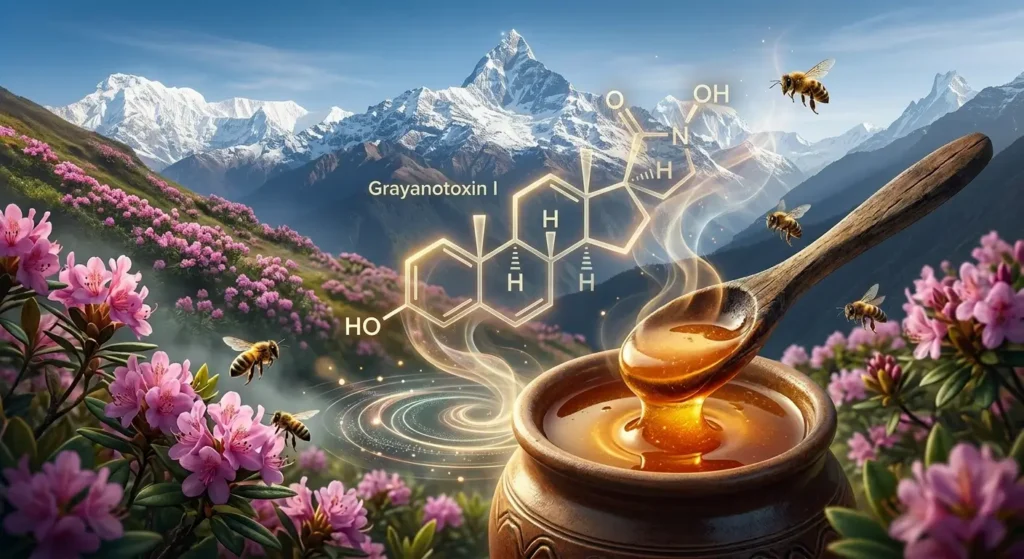
The main reason mad honey is different is because of a natural compound called Grayanotoxin. This compound comes from rhododendron plants, which grow in high-altitude regions. Bees collect nectar from these flowers and bring it back to the hive. During this process, the compound enters the honey naturally. Because of this, mad honey becomes a bioactive food, meaning it can interact with the human body in a noticeable way.
When people search for what is in mad honey, the answer is not about artificial ingredients or processing. It is simply honey mixed with natural plant chemicals, mainly Grayanotoxin. This is why it has been studied in mad honey science, because it shows how plants and insects together can create something with strong biological effects.
It is important to understand that Grayanotoxin is not something created in a laboratory. It is a natural defense chemical made by rhododendron plants to protect themselves from insects and animals. In small amounts, this compound enters honey and becomes part of its natural structure. This is also why the strength of mad honey can change depending on season, altitude, and flower type.
A common misunderstanding is that mad honey is a hallucinogenic substance or a psychedelic drug. This is not scientifically correct. While some people may feel dizziness, warmth, or light-headed sensations after consuming it, these effects are not the same as hallucinations caused by drugs that affect the brain directly. The effects are mainly physical and related to how Grayanotoxin interacts with the body’s nerve and heart systems.
The term Grayanotoxin mad honey is often used when discussing this natural relationship between the compound and the honey. However, it is important to separate myth from science. There is no special “mad honey strain” like people sometimes believe. Instead, the difference comes from the natural environment where the bees collect nectar. In Himalayan regions, rhododendron flowers are more common, which increases the chance of Grayanotoxin being present in honey.
From a scientific point of view, this honey has become interesting because it connects ecology, botany, and human biology. The study of how Grayanotoxin affects the body is part of ongoing research in natural toxicology. It helps scientists understand how certain plant compounds can influence heart rate, blood pressure, and nerve signals even in small doses.
In simple terms, mad honey science is about understanding how a natural honey becomes biologically active due to its plant source. It is not about artificial modification, but about how nature itself creates chemical diversity in food. This makes mad honey a unique example of how environment and biology work together in high mountain ecosystems.
In Himalayan trekking regions, especially where rhododendron forests are dense, locals have known about this honey for generations. It is part of traditional knowledge, passed down carefully with respect for its strength and effects. This cultural background adds another layer of meaning when studying Grayanotoxin and its presence in natural honey.
As we go deeper into this topic, the focus will move toward understanding what Grayanotoxin actually is, how it works inside the human body, and why its effects depend heavily on dose and source conditions.
What is Grayanotoxin?
Grayanotoxin is a natural chemical found in certain plants, especially in the rhododendron family. In simple terms, it is a plant-made toxin that can affect the body when it enters the human system through food like honey. This compound is one of the main reasons behind the unique properties of mad honey, and it plays a key role in understanding Grayanotoxin mad honey and its effects.
Scientifically, Grayanotoxin belongs to a group called diterpene polyols. This may sound complex, but it simply means it is a natural organic compound made by plants. It is not man-made and it is not added during processing. It exists naturally in certain flowers, leaves, and nectar of rhododendron plants. When bees collect nectar from these flowers, small amounts of Grayanotoxin can enter the honey.
There are different types of this compound, mainly known as GTX I, GTX II, GTX III, and GTX IV. Each type has a slightly different structure, but they all work in a similar way inside the body. These variations are important in scientific studies because they help researchers understand how Grayanotoxin behaves under different natural conditions. Some types are stronger than others, depending on the plant species and environment.
The main role of Grayanotoxin in nature is to protect plants. It acts as a defense chemical that helps rhododendron plants survive. When insects or animals try to eat the plant, this toxin makes the plant less attractive or harmful to consume. This is a natural survival strategy used by many plants in the wild. In high mountain regions like the Himalayas, rhododendron plants use this chemical as part of their natural ecosystem balance.
One important point to understand in mad honey science is that Grayanotoxin is not created by bees. Bees only collect nectar from flowers. They do not produce or change this chemical in a harmful way. The toxin is already present in the plant before the honey is made. This is a key concept when learning what is in mad honey, because many people mistakenly believe bees are responsible for its special effects. In reality, it is the plant chemistry that defines it.
Grayanotoxin is found in different parts of the rhododendron plant, including flowers, leaves, and nectar. However, nectar is the most important source for honey production. This is why honey collected from rhododendron-rich areas can sometimes contain measurable amounts of Grayanotoxin. The concentration depends on the species of rhododendron, altitude, climate, and blooming season. In Himalayan trekking regions, where rhododendron forests are common, the natural environment supports this unique honey formation.
Historically, Grayanotoxin has been known for centuries. One of the earliest recorded cases comes from ancient Anatolia, now part of modern-day Turkey. Soldiers and travelers reportedly experienced unusual physical effects after consuming local honey. Later scientific studies identified the presence of Grayanotoxin as the cause. This discovery helped connect traditional stories with modern chemistry, forming the foundation of mad honey science as a field of study.
It is also important to clarify that Grayanotoxin is not a result of fermentation. It is not created during honey storage or processing. It is also not a byproduct of bees or environmental spoilage. The compound already exists in the natural plant source and simply transfers into honey through nectar collection. This makes it different from many other food-related chemical changes that happen during fermentation or aging.
In scientific research, Grayanotoxin continues to be studied for its interaction with the human nervous and cardiovascular systems. However, its presence in honey remains a natural ecological phenomenon rather than a manufactured process. The study of this compound helps researchers understand how plant chemistry can influence natural food products in unexpected ways.
How Grayanotoxin Works in the Human Body
When a person consumes mad honey, the effects come mainly from a natural compound called Grayanotoxin. To understand how it works, it is important to first know how the human body communicates. Our nerves and muscles work like an electrical system. Small signals travel through nerves using sodium channels, which act like tiny gates. These gates open and close to control the flow of signals that keep the heart, brain, and body working normally.
Grayanotoxin affects this system by changing how these sodium channels work. Instead of opening and closing properly, the channels stay open for longer than normal. This disrupts the normal flow of signals in the body. Because of this action, Grayanotoxin can create noticeable physical effects even in small amounts. This is a key topic in mad honey science, where researchers study how natural plant chemicals interact with human biology.
One of the main effects of Grayanotoxin is on the heart. It can slow down the heart rate because the electrical signals that control heartbeat become weaker or irregular. This can make a person feel light-headed or weak. Blood pressure may also drop because the heart is not pumping as strongly as usual. These changes are not permanent in most cases, but they can feel strong depending on the amount consumed.
The nervous system is also affected by Grayanotoxin. People may feel dizziness, warmth in the body, sweating, or a sense of calm heaviness. These sensations happen because nerve signals are not passing normally. When studying what is in mad honey, this is one of the most important scientific explanations. It is not about added chemicals or artificial substances, but about how a natural compound changes nerve communication.
A very important concept in understanding Grayanotoxin mad honey is dose dependency. The effect of this compound depends completely on how much is consumed. A very small amount of Grayanotoxin may cause mild sensations such as warmth or relaxation. A larger amount can lead to stronger effects like dizziness, low blood pressure, or nausea. In high doses, it can become toxic and require medical attention. This is why the same honey can have very different effects depending on quantity.
To understand this better, it helps to compare Grayanotoxin with other natural compounds found in food. For example, caffeine in coffee stimulates the nervous system, making a person feel more awake. Capsaicin in chili peppers creates a burning sensation in the mouth. In the same way, Grayanotoxin interacts with the body’s system, but it affects nerve and heart signals instead of taste or alertness. These comparisons are often used in mad honey science to explain how natural chemicals behave in the human body.
It is also important to clarify that the effects of Grayanotoxin are not the same as a psychedelic drug. It does not directly alter the mind or create hallucinations in the way substances like LSD or psilocybin do. The sensations are mainly physical, related to blood pressure, heart rhythm, and nerve activity. This is why scientists clearly state that it is “not hallucination in a true psychedelic sense.” The experience comes from physiological changes in the body, not from mind-altering chemical action in the brain.
Another important part of what is in mad honey is understanding that the human response varies from person to person. Factors such as body weight, health condition, and sensitivity to natural compounds can change how Grayanotoxin affects someone. Some people may feel only mild effects, while others may experience stronger reactions even with small amounts.
In research and field observations, especially in regions where rhododendron forests are common, scientists continue to study how Grayanotoxin interacts with human biology. These studies help explain why certain natural foods can have strong physiological effects without being synthetic or processed chemicals.
Rhododendron: The Natural Source of Grayanotoxin
The main natural source of Grayanotoxin is a group of plants called rhododendrons. These plants belong to a large family of flowering shrubs and trees that grow in mountain regions around the world. In the Himalayas, rhododendrons are very common and can be seen during trekking routes in Nepal, especially in spring when the hills turn red, pink, and white with flowers.
Rhododendrons are not just beautiful plants. They are also scientifically important because they naturally produce Grayanotoxin, a chemical that helps protect them from insects and animals. This is why these plants are closely studied in relation to Grayanotoxin mad honey, as bees collect nectar from these flowers and bring the compound into honey.
These plants are found in many parts of Asia, including Nepal, India, Turkey, and surrounding mountainous regions. In Turkey, rhododendron forests are also known for producing similar types of honey. This shows that Grayanotoxin is not limited to one country, but is part of a wider natural ecosystem across high-altitude regions.
A common misunderstanding is the idea of a “mad honey flower.” Some people think there is a special single flower called this. In reality, there is no such flower. The correct source is the rhododendron plant family. The term “mad honey flower” is often used informally, but scientifically it refers to rhododendron species that contain Grayanotoxin in their nectar and pollen. This is an important clarification when studying what is in mad honey, because the chemical comes from many rhododendron species, not one specific flower.
Different parts of the rhododendron plant contain Grayanotoxin. The highest concentration is usually found in the nectar, which bees collect to make honey. Pollen and leaves may also contain the compound, but nectar is the most important source for honey production. When bees gather nectar, small amounts of Grayanotoxin enter the honey naturally, creating the unique properties seen in certain types of wild honey.
Seasonal changes also play a big role in how much Grayanotoxin is present in honey. In the spring season, rhododendron plants bloom widely. During this time, nectar production is high, and bees have more access to fresh flowers. Because of this, honey collected in spring often has a higher chance of containing stronger levels of Grayanotoxin. In other seasons, when flowers are fewer, the concentration can be much lower.
Environmental conditions also influence how much Grayanotoxin is present in rhododendron plants. Altitude is one of the most important factors. In higher mountain regions of Nepal, where air is cooler and cleaner, rhododendron plants grow differently compared to lower areas. Climate, rainfall, soil type, and biodiversity all affect how these plants produce natural chemicals. This is why rhododendron mad honey from different regions can vary in strength and effect.
In the Himalayas, especially during trekking routes, rhododendron forests create a unique ecological system. These forests support bees, plants, and wildlife together in a balanced environment. The presence of Grayanotoxin in these plants is part of this natural balance. It is not something artificial or added, but a result of long-term adaptation in mountain ecosystems.
From an ecological point of view, studying Grayanotoxin in rhododendron plants helps scientists understand how altitude and climate shape plant chemistry. This is also why mad honey science often focuses on Himalayan and Anatolian regions, where these conditions are ideal for natural toxin production in plants.
For trekkers in Nepal, rhododendron forests are not only visually beautiful but also scientifically interesting. They show how nature can create complex chemical interactions that connect plants, insects, and even human food products like honey.
From Plant to Honey: How Grayanotoxin Enters Honey
The journey of Grayanotoxin into honey begins in the high mountain forests where rhododendron plants grow. These forests are common in Himalayan trekking regions of Nepal, where bees, flowers, and climate work together in a natural cycle. To understand Grayanotoxin mad honey, it is important to follow each simple step of how nectar turns into honey and how the plant chemical becomes part of it.
The first step starts when bees collect nectar from rhododendron flowers. These flowers naturally contain Grayanotoxin, which is present in the nectar itself. Bees are not aware of this chemical. They simply visit flowers to collect food. During this process, small amounts of Grayanotoxin enter the bee’s nectar pouch and are carried back to the hive.
At this stage, it is important to understand that bees do not create or change Grayanotoxin. The nectar already contains it before collection. This is a key point in mad honey science, because many people wrongly believe that bees produce the special effect of mad honey. In reality, the source is entirely the rhododendron plant and its natural chemistry.
Once the nectar reaches the hive, bees begin the process of turning it into honey. They remove water from the nectar and mix it with natural enzymes. This transforms nectar into thick honey. Even during this process, Grayanotoxin remains inside the honey. It does not break down easily, which is why it becomes part of the final product. This is how honey becomes a natural carrier of plant chemistry.
This is also where the idea of what is in mad honey becomes important. There is nothing artificial added to it. The only special element is the natural presence of Grayanotoxin that came from rhododendron nectar. This makes mad honey different from normal honey, which is usually made from flowers that do not contain this compound.
Normal honey does not have Grayanotoxin because most flowers used by bees do not produce this chemical. Bees collect nectar from many types of plants, but only specific rhododendron species contain the toxin. This is why mad honey is geographically rare. It only appears in regions where rhododendron forests are dense enough to influence bee activity. The Himalayas and parts of Turkey are well-known examples of such regions.
The strength of Grayanotoxin mad honey depends on several natural factors. One of the most important is the season. During spring, rhododendron flowers bloom widely, and bees have more access to fresh nectar. This often leads to higher levels of Grayanotoxin in honey collected during this time.
Altitude is another key factor. In higher mountain areas, rhododendron plants grow in different environmental conditions. Cooler temperatures, soil type, and oxygen levels can influence how much Grayanotoxin is produced in the plant. This is why honey from different elevations can vary in strength even within the same region.
Flower density also plays an important role. In areas where rhododendron forests are thick, bees collect more nectar from these plants compared to other flowers. This increases the chance of Grayanotoxin entering the honey in higher amounts. In contrast, mixed-flower areas produce weaker or no effects.
From a simple point of view, honey acts like a natural carrier of plant chemistry. Just like water carries minerals from soil, honey carries natural compounds from flowers. In the case of Grayanotoxin, this process becomes more noticeable because the compound remains active even after honey is formed.
For trekkers in Nepal, especially in rhododendron-rich trails, this natural process is part of the mountain ecosystem. It shows how bees, plants, and climate are connected in a delicate balance. Through mad honey science, researchers continue to study how these natural interactions create unique food products that are deeply linked with geography and environment.
Mad Honey vs. Grayanotoxin Poisoning
Understanding Grayanotoxin is not only about science, but also about safety. One important part of mad honey science is knowing the difference between controlled traditional use and accidental overdose. In Himalayan and some other mountain cultures, mad honey has been used in very small, careful amounts for generations. However, problems can occur when too much is consumed. This condition is known in medical terms as mad honey disease, which is directly linked to Grayanotoxin poisoning.
In small quantities, Grayanotoxin can create mild physical effects such as warmth, light dizziness, or relaxation. These effects are usually short-lived and depend on the natural concentration of the honey. This is why in traditional practices, people use very small measured amounts. However, when the intake becomes higher than the body can handle, the same compound can cause stronger and unwanted effects.
The main symptoms of Grayanotoxin poisoning are related to the heart and nervous system. A person may feel dizziness, nausea, or weakness. One of the most important effects is low blood pressure. This happens because Grayanotoxin slows down the normal electrical signals in the heart. In some cases, the heartbeat can also become slower than normal, which may make a person feel tired or faint. These symptoms are usually temporary but can feel intense depending on the amount consumed.
In some historical cases reported from regions like Turkey and Nepal, people experienced mad honey disease after consuming large quantities of wild honey. These cases helped doctors and scientists understand how Grayanotoxin affects the human body. Most of these incidents were not life-threatening, but they required medical attention. Such reports are an important part of mad honey science, as they provide real-world data on how natural compounds behave in humans.
Medical treatment for Grayanotoxin poisoning is usually simple but must be done carefully. In most cases, doctors monitor the patient and keep them under observation until the symptoms reduce. Since the main issue is low blood pressure and slow heart rate, the body often recovers naturally with rest and fluids. In some moderate or severe cases, intravenous (IV) fluids are given to stabilize blood pressure and help recovery faster.
In rare situations where the heartbeat becomes too slow, doctors may use a medication called atropine. This helps restore normal heart rhythm by blocking the effect of Grayanotoxin on the nervous system. These treatments are effective, and most patients recover fully without long-term problems. This shows that while Grayanotoxin poisoning can cause strong symptoms, it is usually manageable with proper medical care.
A very important point in understanding what is in mad honey is that the compound itself is not dangerous in all situations. The key factor is the amount consumed. Grayanotoxin does not become harmful by nature alone. It becomes a risk only when intake exceeds the body’s tolerance level. This is why experts always emphasize that dose is everything when dealing with Grayanotoxin mad honey.
Another important clarification is that mad honey is not inherently toxic like industrial chemicals or synthetic poisons. It is a natural product that contains a plant-based compound. The difference between a safe experience and mad honey disease is simply the quantity consumed and the strength of the honey. This is why traditional knowledge in Himalayan regions often focuses on careful use and small servings.
From a scientific point of view, mad honey science continues to study how Grayanotoxin interacts with the human body. These studies help explain why some people experience mild effects while others develop stronger symptoms. It also helps medical professionals better understand and treat Grayanotoxin poisoning when it occurs.
In trekking regions of Nepal, where rhododendron forests are part of the natural landscape, awareness about safe consumption is important. Local knowledge has always played a role in preventing overuse, showing how traditional practices and modern science can work together in understanding this natural compound.
Scientific Research on Grayanotoxin
Scientific interest in Grayanotoxin has grown because it is a rare natural compound that directly affects the human nervous and cardiovascular systems. Researchers study it carefully to understand how a plant chemical can change heart function, blood pressure, and nerve signaling in such a noticeable way. This is an important part of mad honey science, especially for understanding how natural foods can interact with the human body.
One of the main research areas is the effect of Grayanotoxin on the cardiovascular system. Scientists have observed that this compound can slow down heart rate and reduce blood pressure by affecting the electrical signals that control heart muscles. These findings are important because they help explain why people experience dizziness or weakness after consuming Grayanotoxin mad honey in larger amounts. Studies in controlled environments show that even small changes in sodium channel activity can create clear physical effects.
Another major focus is how Grayanotoxin interacts with sodium channels in nerve cells. Sodium channels are like tiny gates that control electrical signals in the body. When these gates stay open longer than normal due to Grayanotoxin, nerve communication becomes disrupted. This is one of the key explanations used in mad honey science to describe how a natural plant toxin can influence both the brain and heart without being a synthetic drug. Researchers use laboratory models to study this process in detail, helping them understand how natural compounds affect human biology at a cellular level.
Toxicology studies are also an important part of research on Grayanotoxin. These studies focus on how much of the compound is safe and how the body responds to different doses. Scientists look at both mild exposure and higher exposure levels to understand the boundary between safe traditional use and Grayanotoxin poisoning. This research is essential because it provides real data for medical professionals who may treat cases of mad honey disease in regions where this honey is consumed.
Medical interest in Grayanotoxin is not about using it as a medicine, but about understanding its effects. Some researchers study whether its action on sodium channels could offer insights for future drug development. For example, understanding how it slows down heart signals might help scientists design new treatments for heart rhythm conditions. However, it is very important to note that Grayanotoxin is not an approved drug and is not used in modern medical treatment. Its role is mainly scientific, not therapeutic in practice.
Most early and well-known studies on Grayanotoxin come from Turkey, where mad honey cases have been reported for centuries. Turkish researchers have documented many clinical cases of Grayanotoxin poisoning, which helped establish the connection between rhododendron nectar and honey toxicity. These studies are often referenced in international medical journals and are considered foundational in understanding the compound.
In recent years, Nepal has also gained attention in mad honey science research. The Himalayan region has rich rhododendron forests, making it an important area for studying natural honey variations. Researchers are increasingly interested in how altitude, climate, and plant diversity affect Grayanotoxin levels in honey produced in different parts of Nepal. This adds valuable data to global research because Himalayan ecosystems are very different from other regions where mad honey is found.
Many of these studies are published in scientific databases like PubMed, where peer-reviewed research on Grayanotoxin can be found. These papers often focus on its chemical structure, biological effects, and case studies of human exposure. The growing body of research helps build a clearer picture of how what is in mad honey connects to natural plant chemistry and human health responses.
Overall, scientific research on Grayanotoxin is still developing, but it already provides strong evidence of how a natural plant toxin can interact with the human body in predictable ways. This makes it an important subject in both toxicology and natural product science, especially in regions where rhododendron honey is part of traditional culture and trekking landscapes.
Molecular Insight – How Grayanotoxin Works
To understand how Grayanotoxin affects the human body at a deeper level, it helps to look at what is happening at the molecular scale. Even though the topic sounds complex, it can be explained in a very simple way. This section is an important part of mad honey science, because it connects chemistry with how nerves and cells work inside the body.
At the molecular level, Grayanotoxin has a structure called a diterpene skeleton. In simple words, this means it is built from a complex arrangement of carbon-based rings and chemical groups. This structure is important because it allows Grayanotoxin to interact directly with sodium channels in nerve and muscle cells. These sodium channels are like small gates that control electrical signals in the body.
Normally, these sodium channels open and close very quickly. This movement allows signals to travel properly through nerves, helping the heart beat regularly and the body respond normally. However, when Grayanotoxin enters the system, it binds to these channels and changes how they behave. Instead of closing after opening, the channels stay open for longer than they should. This is a key scientific explanation in Grayanotoxin mad honey research.
When sodium channels remain open, the electrical system of the body becomes disrupted. Signals do not travel in the normal pattern, and this leads to changes in heart rate, blood pressure, and nerve responses. This is why people may feel dizziness or unusual body sensations after consuming honey that contains Grayanotoxin. These effects are not random. They are directly linked to how the molecule interacts with cell membranes.
In simple terms, scientists often describe this process like a lock and key system. Sodium channels act like locks that open and close at the right time. Grayanotoxin acts like a key that fits into the lock but prevents it from closing properly. Because of this, the channel stays “locked in the open position.” This is a useful way to understand how Grayanotoxin changes normal cell function without needing advanced chemistry knowledge.
From a learning point of view, this molecular interaction is important because it connects chemistry with real human experience. When Grayanotoxin binds to sodium channels, it does not destroy them. Instead, it changes how they function for a short time. This temporary change is enough to create noticeable physical effects, which is why the strength of Grayanotoxin mad honey depends on how much is consumed.
Understanding this mechanism also helps researchers in toxicology and natural product science. By studying how Grayanotoxin interacts with sodium channels, scientists can better understand how natural compounds influence electrical systems in living organisms. This is one of the key reasons why mad honey science continues to study this molecule in detail.
Even though the structure and process may seem complicated at first, the main idea is simple. Grayanotoxin changes the normal opening and closing of sodium channels, which affects how signals move in the body. This small molecular change is what leads to all the noticeable effects associated with Grayanotoxin-containing honey.
Science Behind the Mystery
The story of Grayanotoxin and mad honey brings together nature, science, and traditional knowledge in a very interesting way. After understanding all the parts, from plant source to human effects, it becomes clear that this honey is not ordinary. It is shaped by natural chemistry that begins in rhododendron forests and ends in a jar of honey collected by bees in mountain regions.
The main point to remember is that Grayanotoxin is a natural toxin produced by rhododendron plants. It is not added by humans and it is not created during honey processing. Bees collect nectar from these flowers, and during this natural process, Grayanotoxin enters the honey. This simple connection between plant and bee is what creates Grayanotoxin mad honey. It is a natural result of ecological interaction, not a manufactured product.
When people ask what is in mad honey, the answer is not complicated chemicals or artificial ingredients. It is honey that contains a small amount of Grayanotoxin from specific rhododendron species. This is why mad honey is rare and only found in certain geographical regions like the Himalayas and parts of Turkey. The environment plays a major role in shaping its natural composition.
One of the most important lessons in mad honey science is that the effect of this honey depends completely on dose. A small amount of Grayanotoxin may produce mild physical sensations such as warmth or light dizziness. However, a larger amount can lead to stronger effects like low blood pressure or nausea. This shows that the compound itself is not good or bad by nature. It is the quantity that determines how the body responds.
It is also important to clearly understand that Grayanotoxin does not act like a hallucination drug. It does not directly change thoughts or create dream-like visions in the mind. The effects are mainly physical, related to how the heart and nervous system function. This makes it different from substances that are classified as psychedelic. The experience is based on physiological changes in the body, not mental alteration.
Another key point is that Grayanotoxin is not a synthetic or man-made substance. It is completely natural and comes from plant defense systems. Rhododendron plants produce it to protect themselves in the wild. Bees simply transfer it into honey while collecting nectar. This natural cycle is an important part of mountain ecosystems where plants, insects, and climate all work together.
Understanding Grayanotoxin mad honey also means understanding respect for nature’s chemistry. Nature creates many compounds that interact with living organisms in different ways. Some are harmless, some are beneficial, and some require careful use. Mad honey falls into a special category where traditional use, scientific study, and natural variation all come together.
Scientific understanding is important before using or studying such natural products. Through research and observation, mad honey science helps explain how Grayanotoxin works, how it enters honey, and how it affects the human body in different doses. This knowledge allows people to appreciate the product without misunderstanding its nature.
FAQ Section – Grayanotoxin and Mad Honey Explained
This FAQ section helps answer common questions about Grayanotoxin and mad honey in a simple way. Many people search for clear answers about safety, effects, and nature of this special honey. Understanding these questions is an important part of mad honey science, especially for readers who want to know what is in mad honey before learning or trying it.
Is Grayanotoxin dangerous?
Grayanotoxin is a natural plant compound found in rhododendron flowers. In small amounts, it can cause mild effects like warmth or light dizziness. However, in larger amounts, it can lead to stronger physical reactions such as low blood pressure or slow heart rate.
So, is it dangerous? The answer depends on the dose. Grayanotoxin is not always harmful by itself, but too much can cause Grayanotoxin poisoning. This is why understanding Grayanotoxin mad honey is important. It helps people know that the effect is based on quantity, not just the substance itself.
In simple terms, Grayanotoxin should always be respected, and its effects should never be ignored when consumed in natural honey products.
Is mad honey hallucinogenic?
Many people think mad honey is a hallucinogenic substance, but this is not scientifically correct. The effects of Grayanotoxin are physical, not mental. It does not directly change thoughts or create visual hallucinations like psychedelic drugs.
When studying what is in mad honey, scientists explain that the main compound affects the heart and nervous system, not the imagination or brain perception. This is why mad honey science clearly states that it is not a true hallucinogen.
Instead, Grayanotoxin can cause symptoms like dizziness, warmth, or light-headedness. These are the result of changes in blood pressure and nerve signals, not changes in the mind.
Where is Grayanotoxin found?
Grayanotoxin is naturally found in rhododendron plants. These plants grow in mountainous regions, especially in the Himalayas and parts of Turkey. The compound is present in different parts of the plant, including flowers, nectar, leaves, and pollen.
When bees collect nectar from these flowers, small amounts of Grayanotoxin enter honey. This is how Grayanotoxin mad honey is formed in nature. It is not created by bees or during processing.
Can you overdose on mad honey?
Yes, it is possible to consume too much mad honey. Since it contains Grayanotoxin, taking a large amount can lead to Grayanotoxin poisoning. This condition is sometimes known as mad honey disease.
Symptoms of overdose may include dizziness, nausea, low blood pressure, and slow heart rate. These effects happen because Grayanotoxin disrupts the normal electrical signals in the body.
However, it is important to understand that what is in mad honey is not harmful in all cases. The risk comes only from high intake. Small amounts may cause mild effects, but overdose happens when the dose is too strong for the body.
In mad honey science, this is a key principle: dose determines effect.
Is mad honey legal?
In most countries, mad honey is legal because it is a natural product. However, regulations can vary depending on location and food safety rules. Since it contains Grayanotoxin, some regions may monitor or control its sale to ensure safe consumption.
There is no global ban on mad honey, but responsible handling and labeling are important. In areas where it is traditionally used, it is treated as a natural specialty product rather than a restricted substance.
Understanding Grayanotoxin mad honey helps explain why awareness is important even when the product is legal. Safety depends on knowledge, dosage, and responsible use.
Grayanotoxin & Mad Honey Science Summary Table
| Topic | Simple Explanation | Scientific Insight |
| Source of Grayanotoxin | Comes from rhododendron plants | Natural plant defense chemical |
| Entry into honey | Bees collect nectar from flowers | Nectar already contains Grayanotoxin |
| What is in mad honey | Honey + natural plant toxin | No artificial or added chemicals |
| Main action in body | Affects nerves and heart | Alters sodium channel function |
| Body system impact | Heart rate and blood pressure change | Blocks normal electrical signaling |
| Small dose effect | Mild warmth, dizziness | Temporary physiological response |
| High dose effect | Nausea, low BP, slow heartbeat | Grayanotoxin poisoning risk |
| Hallucination myth | Not a psychedelic substance | No direct brain hallucination effect |
| Scientific field | Mad honey science | Toxicology + natural product chemistry |
| Safety factor | Dose dependent | Controlled exposure is key |
Grayanotoxin Journey in Nature Summary Table
| Stage | What Happens in Nature | Role of Grayanotoxin | Simple Explanation |
| 1. Rhododendron growth | Flowers grow in Himalayan forests | Plant produces Grayanotoxin | Plant creates natural defense chemical |
| 2. Flower blooming | Spring season brings full bloom | Highest toxin level in nectar | More flowers = more chemical in nectar |
| 3. Bee collection | Bees collect nectar from flowers | Grayanotoxin enters honey source | Bees unknowingly collect the compound |
| 4. Hive processing | Nectar turned into honey | Toxin remains stable | Chemical does not disappear |
| 5. Honey formation | Raw honey is produced | Becomes “Grayanotoxin mad honey” | Natural bioactive honey is formed |
| 6. Human consumption | People consume small amounts | Affects body depending on dose | Small dose = mild effect |
| 7. Scientific study | Researchers analyze honey | Used in mad honey science | Helps understand natural toxin behavior |