Rhododendron & Mad Honey: The Flower Behind the World’s Most Unusual Honey
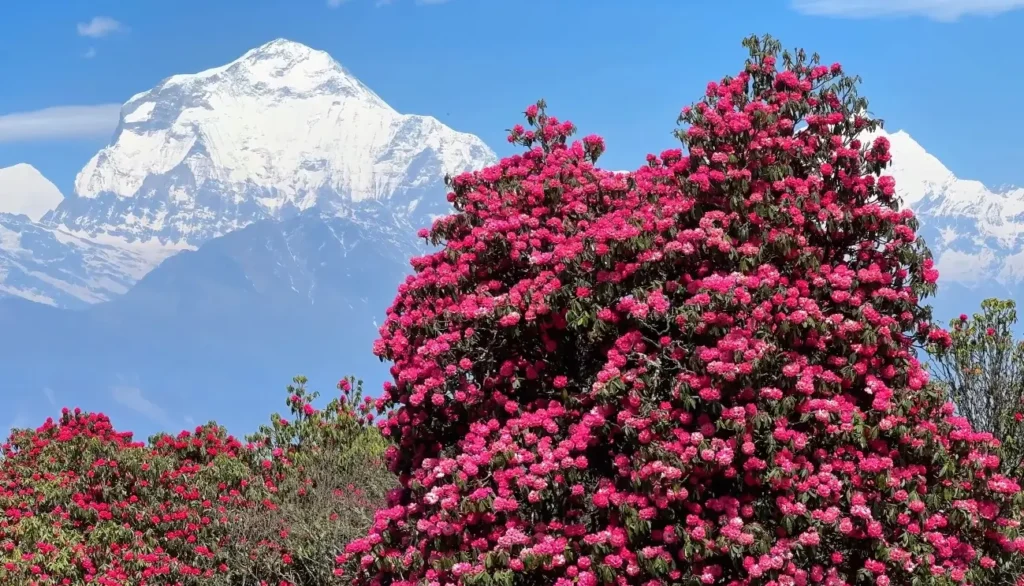
Every spring, between March and May, at altitudes above 8,000 feet across the Himalayan highlands and Black Sea coastlines, certain rhododendron species burst into bloom — painting mountainsides in crimson, pink, and gold. Hidden within their nectar is a compound called grayanotoxin (C₂₂H₃₆O₇), a naturally occurring diterpene that the plant produces as a chemical defense mechanism. When wild honeybees — particularly the giant Himalayan cliff bee (Apis laboriosa), the world’s largest honeybee — collect this nectar, the grayanotoxin transfers into the honey they produce. The result is mad honey: a rare, psychoactive honey that has been documented in human history for over 2,400 years, dating back to 401 BC.
This connection between rhododendron and mad honey is not theoretical — it is something we witness firsthand each spring in Nepal’s high-altitude forests. Working directly with Gurung honey hunting communities in districts like Lamjung and Myagdi, we track the bloom of Rhododendron arboreum as it climbs the mountainsides, signaling the narrow window when Apis laboriosa begins foraging intensively on these flowers. The honey harvested from cliff-face hives during this period carries the unmistakable chemical signature of those blooms.
What makes rhododendron mad honey unique is not simply the presence of grayanotoxin, but the specific ecological conditions under which it forms: high-altitude environments, wild bee foraging patterns, and precise seasonal bloom timing. These variables determine whether rhododendron nectar becomes ordinary honey — or something far more unusual.
But not all rhododendrons produce mad honey. Of the 1,000+ known species in the genus, only a handful contain grayanotoxin in concentrations high enough to create this effect. Understanding which species, where they grow, and why they produce this compound is essential to understanding mad honey itself.
What Is Rhododendron? — The World’s Largest Genus of Woody Flowering Plants
Rhododendron is a genus of over 1,000 species within the family Ericaceae (the heath family), making it one of the largest genera of woody flowering plants on Earth. The name derives from the Greek rhodon (rose) and dendron (tree). These plants range from low-growing alpine shrubs just a few centimeters tall to towering evergreen trees exceeding 30 meters in height. Found across multiple continents, rhododendrons are especially concentrated in mountainous regions with acidic soils and cool, moist climates.
Key Botanical Facts
| Attribute | Detail |
| Genus | Rhododendron |
| Family | Ericaceae (Heath family) |
| Number of Species | 1,000+ described species |
| Subgenera | 8 (Rhododendron, Hymenanthes, Pentanthera, Tsutsusi, Azaleastrum, Candidastrum, Mumeazalea, Therorhodion) |
| Native Range | Asia (highest diversity), Europe, North America, Northern Australia |
| Habitat Range | Sea level to 5,500 m (18,000 ft) |
| Growth Forms | Evergreen/deciduous shrubs, small trees, epiphytes |
| Flower Structure | 5-lobed corolla, typically in terminal clusters (trusses) |
| Toxin-Producing Species | Approximately 25+ species contain significant grayanotoxin |
| Most Relevant to Mad Honey | R. ponticum, R. luteum, R. arboreum, R. campanulatum |
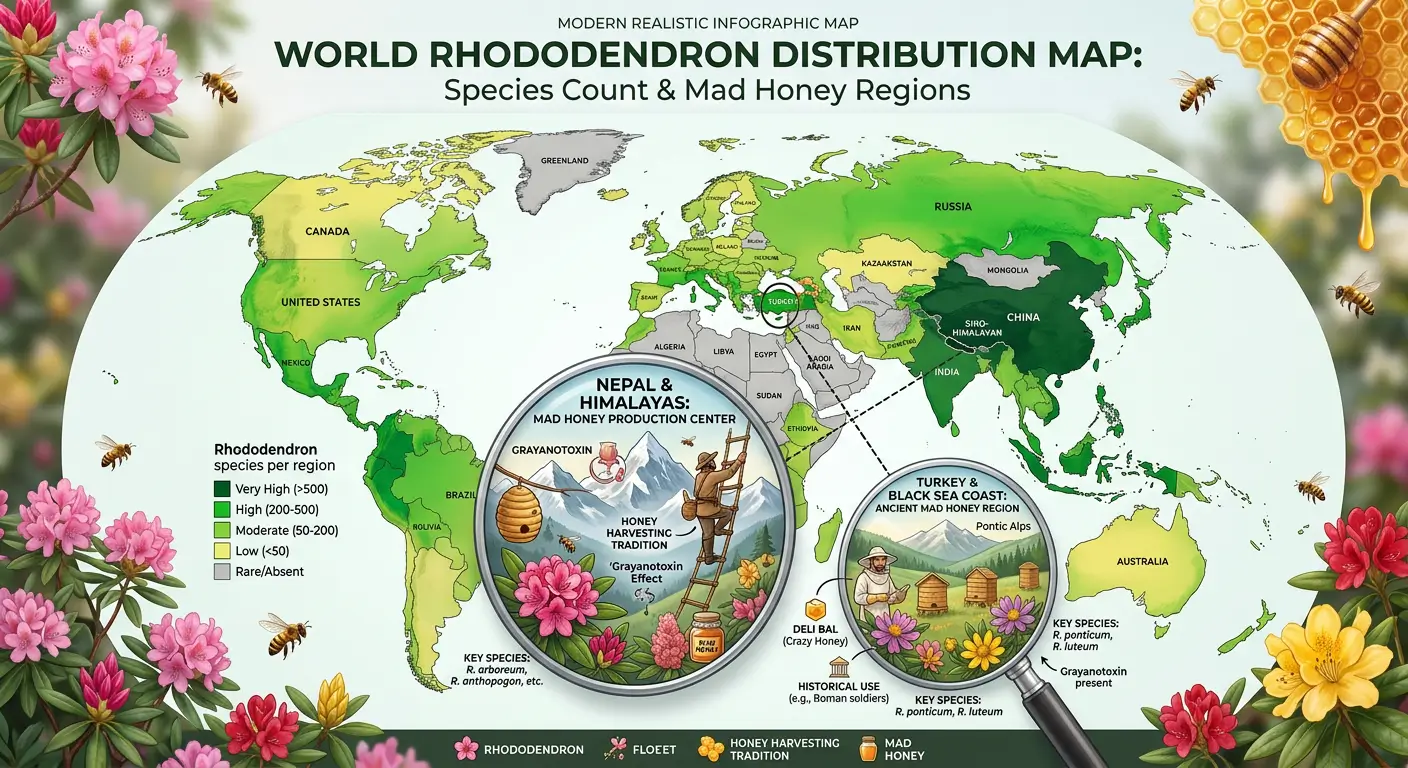
Globally, rhododendron distribution follows clear ecological patterns:
- Himalayas and Southeast Asia: The global center of diversity, with over 300 species recorded in China and more than 30 confirmed species in Nepal (Flora of Nepal; Royal Botanic Garden Edinburgh)
- Turkey and the Black Sea coast: Dominated by Rhododendron ponticum and R. luteum — the original botanical source of Turkish “deli bal”
- Europe: R. ponticum introduced and now aggressively invasive across parts of the UK and Ireland
- North America: Native species including R. maximum and R. catawbiense, some containing mild grayanotoxin levels
- Australasia: Limited presence, including R. lochiae in Queensland
In our work across Nepal’s highland rhododendron forests, we consistently encounter the small subset of species tied to mad honey production — primarily R. arboreum and R. campanulatum. This reflects an important reality: although the genus is vast, only around 2–3% of rhododendron species produce nectar with meaningful grayanotoxin concentrations. Most ornamental rhododendron shrubs in temperate gardens have no meaningful connection to mad honey production and should not be confused with wild highland species.
Which Rhododendron Species Produce Mad Honey? — The Definitive Species Guide
The primary rhododendron species responsible for mad honey production are:
- Rhododendron ponticum — the original source of Turkish deli bal
- Rhododendron luteum — a secondary but significant contributor across the Black Sea region
- Rhododendron arboreum — the dominant source of Himalayan mad honey
A handful of additional high-altitude Himalayan species contribute in smaller amounts, but these three form the core of the global rhododendron mad honey ecosystem.
Rhododendron ponticum — The Original Mad Honey Source (Black Sea, Turkey)
| Attribute | Detail |
| Common Names | Common rhododendron, Pontic rhododendron |
| Native Range | Black Sea coast (Turkey, Georgia), Iberian Peninsula, Lebanon |
| Invasive Range | UK, Ireland, Belgium, New Zealand |
| Growth Habit | Evergreen shrub/small tree, 2–8 m tall |
| Flower Color | Purple to pink, spotted |
| Bloom Period | May–June |
| Altitude (Native) | Sea level to 2,100 m (6,900 ft) |
| Grayanotoxin Level | HIGH — primary source of Turkish “deli bal” |
| Key Grayanotoxins | Grayanotoxin I and III predominant |
| Historical Significance | Source of honey in Xenophon’s 401 BC account and the Pontic trap of 67 BC |
| Conservation Status | Least Concern (native range); Invasive (introduced range) |
- R. ponticum is the species most frequently cited in ancient mad honey accounts, including Xenophon’s Anabasis (401 BC) and Strabo’s Geographica (67 BC)
- It thrives in the humid, acidic soils of Turkey’s eastern Black Sea region — particularly the provinces of Trabzon, Rize, and Artvin
- Turkish “deli bal” continues to be produced from this plant under regional regulation with centuries of documented trade history
- Grayanotoxin concentration in R. ponticum nectar varies significantly by altitude and microclimate — higher elevations consistently correlate with stronger nectar
- Notably, invasive populations growing in the British Isles produce far less potent honey due to fundamentally different environmental conditions — demonstrating that the plant alone does not guarantee high grayanotoxin levels
- Primary pollinator: Apis mellifera caucasica (Caucasian honeybee)
Rhododendron luteum — The Yellow Azalea of the Black Sea
| Attribute | Detail |
| Common Names | Yellow azalea, Pontic azalea, honeysuckle azalea |
| Native Range | Eastern Europe, Caucasus, Turkey |
| Growth Habit | Deciduous shrub, 2–4 m tall |
| Flower Color | Bright yellow, intensely fragrant |
| Bloom Period | April–May (slightly earlier than R. ponticum) |
| Altitude | 200–2,000 m |
| Grayanotoxin Level | Moderate to High |
| Key Distinction | Frequently co-occurs with R. ponticum; combined nectar may amplify grayanotoxin concentration |
| Conservation Status | Least Concern |
- R. luteum blooms slightly earlier than R. ponticum, creating a sequential and sometimes overlapping nectar flow window
- Honey collected during late spring often carries nectar from both species simultaneously — a “double exposure” that increases total grayanotoxin levels in Turkish deli bal
- Historically, crushed R. luteum flowers were used to stun fish in streams — evidence of long-standing local awareness of the plant’s toxicity, well before scientific classification
- The combination of R. ponticum and R. luteum flowering in the same foraging range is widely considered the primary driver of the most potent Turkish mad honey
Rhododendron arboreum — Nepal’s National Flower and the Source of Himalayan Mad Honey
| Attribute | Detail |
| Common Names | Tree rhododendron, Burans (Hindi), Lali Gurans (Nepali — “red flower”) |
| Native Range | Himalayas (Nepal, India, Bhutan, SW China), Sri Lanka |
| Growth Habit | Evergreen tree, 7–14 m tall (can reach 20 m) |
| Flower Color | Deep crimson red (lower altitudes); pink and white at higher elevations |
| Bloom Period | March–May (altitude-dependent — lower elevations bloom first) |
| Altitude Range | 1,500–3,600 m (4,900–11,800 ft) |
| Grayanotoxin Level | HIGH — primary source of Nepali mad honey |
| Key Pollinators | Apis laboriosa (primary at altitude); Apis cerana (lower elevations) |
| Cultural Significance | National flower of Nepal since 1962 |
| Conservation Status | Widespread; locally pressured by climate change and deforestation |
| Unique Distinction | First rhododendron species scientifically described (1796, by James Edward Smith) |
- R. arboreum is the cornerstone species of Himalayan mad honey — its nectar, collected by Apis laboriosa at extreme altitudes, produces the most sought-after mad honey in the world
- Flower color shifts with altitude: deep red at 1,500–2,500 m, transitioning to pink and white above 3,000 m — a visual signal of changing environmental conditions
- Higher-altitude white and pink varieties produce nectar with measurably stronger grayanotoxin signatures — which is precisely why our harvests target nests between 9,000 and 14,000 feet
- Nepal is home to 30+ rhododendron species, but R. arboreum dominates mad honey production due to its abundance, altitude range, and bloom timing
- Known locally as Lali Gurans (लालीगुराँस), it was designated Nepal’s national flower in 1962 and remains central to both ecological and cultural life across the Himalayan mid-hills
During our spring harvests in Lamjung and Myagdi, entire mountainsides turn crimson as R. arboreum comes into full bloom. Our Gurung hunting partners track this bloom progression upward through altitude bands — reading the flowering lines like a moving calendar. When the red flowers reach the cliff zones above 9,000 feet where Apis laboriosa builds its nests, the harvest window opens. That window lasts just three to six weeks.
Other Contributing Species — R. campanulatum, R. barbatum, and R. cinnabarinum
All Mad Honey Rhododendron Species — Full Comparison:
| Species | Region | Altitude Range | Grayanotoxin Level | Bloom Period | Flower Color | Primary Pollinator | Mad Honey Contribution |
| R. ponticum | Turkey/Black Sea, Caucasus | 0–2,100 m | High | May–Jun | Purple-pink | A. mellifera caucasica | Primary (Turkish deli bal) |
| R. luteum | Turkey/Caucasus, E. Europe | 200–2,000 m | Moderate–High | Apr–May | Yellow | A. mellifera | Supporting (Turkish deli bal) |
| R. arboreum | Nepal, Himalayas | 1,500–3,600 m | High | Mar–May | Red/pink/white | A. laboriosa, A. cerana | Primary (Himalayan mad honey) |
| R. campanulatum | Nepal, Himalayas | 3,000–4,500 m | Moderate | Apr–Jun | Pale purple/white | A. laboriosa | Supporting |
| R. barbatum | Nepal, Himalayas | 2,500–3,800 m | Moderate | Mar–Apr | Blood red | Various | Minor |
| R. cinnabarinum | E. Himalayas, Bhutan | 2,700–4,000 m | Low–Moderate | Apr–Jun | Orange-red | Various | Minor |
| R. ferrugineum | European Alps | 1,500–3,000 m | Low | Jun–Aug | Pink | A. mellifera | Negligible |
| R. maximum | E. North America | 0–1,800 m | Very Low | Jun–Jul | Pink-white | A. mellifera | Negligible |
- R. campanulatum grows at even higher elevations than R. arboreum — up to 4,500 m (14,800 ft) — contributing supplementary grayanotoxin to Himalayan mad honey where the two species’ ranges overlap
- In mixed rhododendron forests, Apis laboriosa forages across multiple species simultaneously, creating a composite chemical profile in the resulting honey
- North American and European rhododendrons rarely produce honey with any noticeable grayanotoxin effect — the specific combination of species, altitude, climate, and bee species found in the Himalayas and Black Sea regions is essentially irreplaceable
- This ecological specificity is precisely why mad honey cannot be reproduced outside these regions — and why any claim to the contrary should be treated with skepticism
Why Do Rhododendrons Produce Grayanotoxin? — The Evolutionary Defense Mechanism
Rhododendrons produce grayanotoxin as a chemical defense mechanism against herbivores. This diterpene compound — found across the leaves, stems, pollen, flowers, and nectar — acts as a built-in deterrent, protecting the plant from being consumed. Far from accidental, grayanotoxin represents the result of long-term evolutionary pressure in environments where chemical resilience directly determines survival.
Grayanotoxin belongs to a class of compounds known as diterpene polyols. Its presence across all plant tissues suggests a multi-layered defense strategy rather than a single-purpose adaptation. To understand how grayanotoxin works at the molecular level, including its sodium channel binding mechanism and dose-dependent effects, the chemical formula C₂₂H₃₆O₇ gives only the beginning of the story.
Why grayanotoxin exists — the evolutionary evidence:
- Anti-herbivore defense: Grayanotoxin disrupts normal nerve and muscle function in mammals. Cases of livestock poisoning from grazing on rhododendron foliage are well-documented in veterinary literature — reinforcing its primary role as a biological deterrent against browsing animals
- Anti-fungal protection: Research in plant chemistry indicates these compounds inhibit certain fungal pathogens, offering protection that is especially relevant in the humid montane ecosystems where many rhododendrons grow
- Selective pollinator filtering: One hypothesis is that toxic nectar discourages less efficient pollinators and nectar-robbing insects, while more grayanotoxin-tolerant species — such as honeybees — continue to forage unaffected, improving the plant’s overall pollination efficiency
- Altitude-driven concentration: At higher elevations, plants face greater herbivory pressure relative to available food sources, potentially driving stronger chemical defenses through evolutionary selection. This directly aligns with field observations of consistently higher grayanotoxin levels in high-altitude rhododendrons
- UV stress response: Increased ultraviolet radiation at altitude may also stimulate secondary metabolite production — including grayanotoxin — as a biochemical protective response
The pollinator paradox — why toxic nectar makes evolutionary sense:
There is an apparent contradiction in nectar containing a toxin: nectar exists specifically to attract pollinators, yet grayanotoxin could theoretically deter them. Research published in Ecology Letters (2008) offers a compelling explanation. Low-level naturally occurring toxins in nectar can actually strengthen pollinator fidelity — bees that forage on pharmacologically active nectar may develop site-specific foraging preferences, returning repeatedly to the same plant species. This behavior improves reproductive success for the rhododendron, turning an apparent paradox into an evolutionary advantage.
How grayanotoxin affects the body — simplified mechanism:
| Step | What Happens |
| 1 | Grayanotoxin binds to voltage-gated sodium channels in cell membranes |
| 2 | These channels are locked in an open position instead of cycling normally |
| 3 | Sodium ions continue flowing into cells without interruption |
| 4 | Nerve and muscle cells become overstimulated, then fatigued |
| 5 | Effects may include lowered heart rate, reduced blood pressure, dizziness, and altered perception |
| 6 | Effects are dose-dependent and typically temporary — lasting approximately 2–6 hours |
Across multiple harvest seasons, altitude has proven to be the most consistent variable in our field observations. Honey collected from cliff hives above 3,000 meters consistently shows stronger grayanotoxin characteristics than honey from nests around 2,000 meters — reinforcing the direct link between environmental stress and toxin production.
Altitude, Climate, and Grayanotoxin — Why Geography Determines Mad Honey Potency
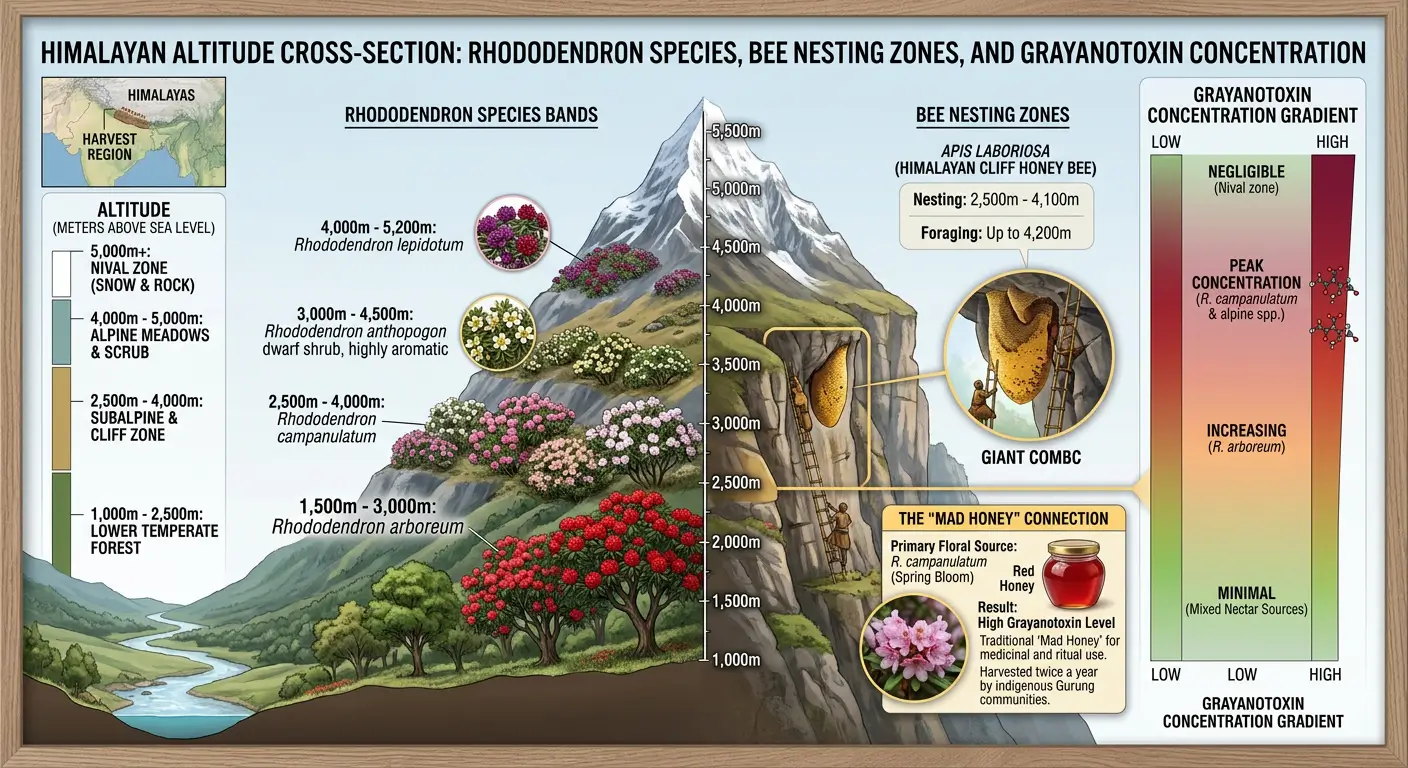
Not all rhododendron honey is mad honey. The concentration of grayanotoxin in rhododendron nectar — and therefore in the honey produced from it — varies dramatically based on altitude, microclimate, soil chemistry, and bloom timing. Geography is the single most important factor in determining whether rhododendron honey carries meaningful psychoactive properties.
Altitude–Concentration Relationship
| Altitude Band | Grayanotoxin Level | Rhododendron Species Present | Mad Honey Potential | Notes |
| 0–1,500 m (0–4,900 ft) | Very Low to Negligible | R. ponticum (lower range), ornamental species | Minimal | Warmer temperatures and lower UV exposure reduce secondary metabolite production |
| 1,500–2,500 m (4,900–8,200 ft) | Low to Moderate | R. arboreum (lower range), R. barbatum | Moderate | Transitional zone; honey may carry mild grayanotoxin |
| 2,500–3,600 m (8,200–11,800 ft) | HIGH | R. arboreum (upper range), R. campanulatum | High — Primary harvest zone | Optimal combination: cold stress, UV exposure, acidic soils |
| 3,600–4,500 m (11,800–14,800 ft) | High but limited | R. campanulatum, alpine species | High potency, low volume | Extreme conditions; fewer flowers, shorter bloom, reduced bee activity |
| Above 4,500 m (14,800 ft) | None | None | None | Above shrub line — no rhododendron growth |
Climate factors that drive grayanotoxin production:
- Cold stress: Harsh winters and cold spring nights stimulate greater production of defensive secondary metabolites, including grayanotoxin
- UV radiation: Increased ultraviolet exposure at altitude directly triggers secondary metabolite production as a biological stress response
- Soil acidity: Rhododendrons thrive in acidic soils (pH 4.5–5.5); nutrient-poor mountain soils at altitude may further amplify chemical defenses as the plant compensates for limited resources
- Moisture balance: Cloud forest conditions at mid-altitude support ideal rhododendron growth, but excessive moisture at lower elevations can dilute nectar concentration
- Floral isolation: Remote high-altitude rhododendron forests are largely free from competing nectar sources, meaning bees forage almost exclusively on rhododendron — producing concentrated, effectively monofloral honey
In our harvest work across Lamjung and Myagdi, we operate between 2,700 and 4,200 meters — the ecological sweet spot where R. arboreum grayanotoxin concentration peaks and Apis laboriosa nesting sites are most abundant. Over multiple seasons, we have consistently observed measurable differences between hives at 2,800 m and those above 3,500 m — in taste profile, consistency, and physiological effect — reflecting real shifts in compound concentration.
Nepal vs. Turkey — Key Differences
| Factor | Nepal (Himalayan Mad Honey) | Turkey (Deli Bal) |
| Primary Species | R. arboreum, R. campanulatum | R. ponticum, R. luteum |
| Harvest Altitude | 2,700–4,200 m (9,000–14,000 ft) | 500–2,100 m (1,600–6,900 ft) |
| Primary Bee | Apis laboriosa (wild, undomesticated) | Apis mellifera caucasica (managed hives) |
| Harvest Method | Wild cliff-face harvest, handwoven rope ladders | Traditional apiary-based extraction |
| Relative Potency | Generally higher | Moderate to high |
| Annual Volume | Very limited (single annual harvest) | Larger (multiple hive harvests possible) |
This variation is not about one region being superior — it is about ecology. Altitude, climate, and species interactions shape every batch of mad honey long before it reaches any jar.
The Bloom Calendar — When Rhododendrons Flower and How It Determines the Mad Honey Harvest Window
The mad honey harvest is not a human decision — it is dictated entirely by the rhododendron bloom. The flowers open on nature’s schedule, bees respond to that signal, and hunters have a narrow window to reach cliff-face hives before the comb is sealed and the season passes. Understanding this bloom cycle is fundamental to understanding why genuine mad honey is so rare.
Bloom Calendar — Nepal (Himalayan Mad Honey)
| Month | Altitude Band | Rhododendron Activity | Bee Activity | Harvest Status |
| January–February | All | Dormant; buds forming at lower elevations | Overwintering; minimal movement | ❌ No harvest |
| Early March | 1,500–2,000 m | R. arboreum begins blooming (red varieties) | Apis cerana begins early foraging | ❌ Too early |
| Late March–April | 2,000–2,800 m | Peak mid-altitude bloom; R. barbatum also flowering | Apis laboriosa becomes active; nectar collection intensifies | ⚠️ Approaching window |
| April–May | 2,800–3,600 m | R. arboreum at peak bloom in harvest altitude zone; R. campanulatum beginning | Apis laboriosa at peak foraging; combs filling rapidly | ✅ Primary harvest window |
| Late May–June | 3,500–4,200 m | Final high-altitude blooms; R. campanulatum peak | Honey ripening; comb capping begins | ✅ Late harvest (often highest potency) |
| July–August | All | Bloom ends; monsoon season begins | Foraging shifts to other plant sources | ❌ No harvest |
| September–December | All | Post-monsoon dormancy cycle resumes | Apis laboriosa migrating to lower altitudes | ❌ No harvest |
Bloom Calendar — Turkey (Deli Bal)
| Month | Activity | Harvest Status |
| April | R. luteum begins blooming; early nectar flow | ❌ Early season |
| May–June | R. ponticum peak bloom overlaps with late R. luteum; combined nectar flow | ✅ Primary harvest window |
| July | Bloom ends; honey extracted from hives | ✅ Extraction period |
Key insights from the bloom calendar:
- The Himalayan mad honey harvest window spans just 3–6 weeks — making it one of the shortest production cycles of any honey in the world
- Bloom timing can vary by up to four weeks between sheltered south-facing slopes and exposed north-facing aspects at identical altitudes
- Climate change is measurably shifting rhododendron bloom patterns upward and earlier — by an estimated 2–3 weeks over recent decades, according to research published in the Nepal Journal of Science (2019). This disruption of traditional bloom timing has real implications for harvest planning and long-term honey production
- Harvest timing directly affects both quality and practicality: too early and grayanotoxin concentration is underdeveloped; too late and capped wax combs make extraction significantly more difficult
- Gurung hunters read the bloom like a moving calendar — tracking the flowering line as it progresses up the mountainside, aligning their climbs precisely with peak nectar flow
Each spring, our partners in Lamjung begin monitoring R. arboreum blooms at around 2,000 meters in March, receiving weekly reports on bloom progression before committing to harvest dates. When flowering consistently reaches cliff zones above 2,800–3,000 meters, the window opens — and closes just as quickly. The 2026 Himalayan Giant harvest remains projected for May–June, consistent with this long-established ecological cycle.
Apis laboriosa and Rhododendron — The Inseparable Ecological Partnership
Mad honey exists because of a precise ecological relationship between rhododendron flowers and Apis laboriosa — the Himalayan giant cliff bee. This is the world’s largest honeybee species, reaching up to 3.0 cm (1.2 inches) in length, and it is uniquely adapted to life at extreme altitudes. Unlike any other bee, it constructs single, massive exposed combs on sheer Himalayan cliff faces at elevations up to 4,200 meters — the exact zone where grayanotoxin concentration in rhododendron nectar reaches its peak. At these heights, Apis laboriosa is essentially the only effective pollinator and honey producer.
Why Apis laboriosa is ecologically irreplaceable:
- Altitude tolerance: Forages at elevations above 4,000 m where Apis mellifera cannot maintain colonies year-round — accessing rhododendron stands that no managed bee can reach
- Foraging range: Documented to fly up to 14 km from cliff-face nests to reach rhododendron forests — covering vast high-altitude terrain
- Thermoregulation: Capable of generating sufficient body heat to remain active in temperatures as low as 5°C (41°F) — essential for early-morning foraging during cold spring blooms at altitude
- Rhododendron specialization: During peak bloom, Apis laboriosa feeds almost exclusively on rhododendron nectar, producing highly concentrated, effectively monofloral honey
- Undomesticable: This species cannot be kept in managed hives. It requires open cliff-face nesting environments and undertakes seasonal altitudinal migration. All documented attempts to domesticate Apis laboriosa have failed
- Single-comb architecture: Each colony constructs one massive exposed comb — often exceeding 1.5 meters (5 feet) in width — containing both brood cells and honey stores in a single structure suspended from rock overhangs
The pollination feedback loop:
Rhododendron and Apis laboriosa exist in a mutualistic ecological relationship refined over millions of years. The bee gains access to high-calorie nectar during early spring — a period when few other floral resources exist at altitude. The rhododendron receives pollination services from one of the only insects capable of reaching its remote, high-altitude stands. Some researchers further suggest that grayanotoxin in the nectar may actively discourage competing pollinator species and nectar-robbing insects — effectively giving Apis laboriosa near-exclusive access to this resource and strengthening the specificity of the relationship.
Why mad honey cannot be farmed:
- Apis laboriosa cannot be domesticated or relocated to managed apiaries
- High-altitude rhododendron forests cannot be replicated at lower elevations
- Grayanotoxin concentration depends on specific altitude, UV, and climate conditions that do not exist in agricultural settings
- The single annual harvest window is set by nature’s bloom cycle, not human scheduling
- Cliff-face nesting is essential to colony survival — enclosed hive structures are rejected
- Every jar of genuine mad honey must be wild-harvested from cliff-face nests, by hand
Comparison — Apis laboriosa vs. Other Honey Bee Species
| Attribute | Apis laboriosa | Apis mellifera (Western) | Apis cerana (Asian) |
| Size | Up to 3.0 cm | 1.2–1.5 cm | 1.0–1.3 cm |
| Nesting | Open cliff faces | Enclosed cavities / managed hives | Enclosed cavities / managed hives |
| Max Foraging Altitude | 4,200 m+ | ~2,500 m | ~3,000 m |
| Domesticable | No | Yes | Partially |
| Comb Type | Single exposed comb | Multi-frame | Multi-comb |
| Native Range | Nepal, Bhutan, NE India, Yunnan | Worldwide (introduced) | South/SE Asia |
| Mad Honey Role | Primary (Himalayan) | Supporting (Turkish deli bal) | Minor |
| Min. Foraging Temperature | ~5°C (41°F) | ~10°C (50°F) | ~12°C (54°F) |
In our fieldwork across Lamjung, we have observed Apis laboriosa colonies building combs exceeding 1.5 meters suspended from sheer rock overhangs. Experienced Gurung hunters can assess colony strength, honey volume, and harvest readiness through visual inspection alone — knowledge passed through generations without written record. This is irreplaceable expertise that no commercial operation could replicate.
The relationship between rhododendron flower and cliff bee is inseparable. Without Apis laboriosa, high-altitude rhododendron nectar would never become mad honey. Without rhododendron, Apis laboriosa would have no viable food source during early spring at extreme altitude. Each depends on the other — and both are necessary for every jar of genuine Himalayan mad honey.
Nepal’s Rhododendron Forests — Ecology, Culture, and Conservation
Nepal is one of the world’s most ecologically rich regions for rhododendron diversity. These forests form a vital living belt across the Himalayan mid-hills — blanketing slopes from around 1,200 meters up to 5,500 meters. They are the source of Himalayan mad honey, but they are also deeply woven into the country’s national identity, cultural practices, and long-term environmental future.
Nepal Rhododendron — Quick Facts
| Fact | Detail |
| National Flower Status | Rhododendron arboreum — designated 1962 |
| Nepali Name | Lali Gurans (लालीगुराँस) — “red flower” |
| Total Species in Nepal | 30+ confirmed species |
| Altitude Range | 1,200 m to 5,500 m |
| Key Forest Belt | 2,500–3,600 m (mid-hills and subalpine zone) |
| Key Conservation Areas | Annapurna Conservation Area, Langtang National Park, Sagarmatha National Park |
| Cultural Uses | Fresh petal juice, wine, traditional remedies, religious offerings, natural dye |
| Primary Threats | Climate change, deforestation, overgrazing, invasive species |
Cultural Significance — More Than a Flower
- Rhododendron arboreum (Lali Gurans) has been Nepal’s national flower since 1962, representing the country’s natural heritage, resilience, and mountain identity
- During spring, its blooms are integrated into festivals, temple offerings, and community celebrations across Nepal’s hill districts — the flower is not merely decorative but ceremonially significant
- Traditional rhododendron juice, pressed from fresh R. arboreum petals, is a popular seasonal drink across Nepal’s mid-hills, and is traditionally believed in folk medicine to support digestion and cardiovascular health. These are traditional beliefs — not clinically established medical claims
- For Gurung and Magar communities — the honey hunting cultures whose traditions form the foundation of Himalayan Giant’s work — the R. arboreum bloom marks the beginning of harvest preparation. It functions as both cultural calendar and ecological signal
- Rhododendron wood serves practical purposes in remote mountain communities, used for fuel and traditional construction
- The flower appears prominently in Nepali art, textiles, postage stamps, and national symbolism
In the villages where our hunting partners live, the first rhododendron blooms of spring carry meaning well beyond aesthetics. They signal movement, preparation, and the opening of a season. When red flowers begin appearing higher on the slopes, experienced hunters know the cliffs will soon become active. The bloom is simultaneously a clock, a signal, and a tradition — unchanged across generations.
Conservation Status and Threats
Despite their abundance and cultural significance, Nepal’s rhododendron forests face increasing and compounding pressure:
- Climate change: Research from the International Centre for Integrated Mountain Development (ICIMOD) documents that rhododendron bloom zones are shifting upward by approximately 5–10 meters per decade. This disrupts the critical synchrony between bloom timing and Apis laboriosa foraging cycles — posing a genuine long-term risk to Himalayan mad honey production
- Deforestation: Mid-hill rhododendron forests face ongoing clearing for agricultural expansion, grazing land, and timber extraction
- Overgrazing: Yak, cattle, and goat browsing damages rhododendron seedlings and significantly limits natural forest regeneration
- Pest and disease expansion: Rising temperatures allow insect pests and fungal diseases to colonize progressively higher elevations, damaging established rhododendron stands
- Unsustainable harvesting: Commercial collection of rhododendron flowers for juice, dye, and decorative trade places additional pressure on blooming populations in accessible areas
At Himalayan Giant, we work exclusively with hunting communities that follow traditional sustainable harvesting practices — taking only surplus honey and leaving sufficient comb intact for colony survival and regeneration. This balance has sustained both the bee populations and the rhododendron ecosystems for generations. Our direct-payment model ensures that hunting communities are economically incentivized to protect these forests rather than convert them — making conservation a financially viable choice, not just a moral one.
From Flower to Jar — How Rhododendron Nectar Becomes Mad Honey
Mad honey production is a precise biological and environmental process. It begins with rhododendron nectar and ends with a chemically stable, concentrated honey — shaped entirely by bee physiology, altitude conditions, and time. There is no shortcut, no substitute, and no industrial parallel.
The Journey — From Rhododendron Flower to Mad Honey Jar
- Bloom — High-altitude rhododendron species, primarily R. arboreum, flower between 2,500 and 3,600 meters. Nectar glands at the base of each flower produce liquid containing dissolved grayanotoxin, typically at trace concentrations of approximately 0.01–0.5%, varying by species, altitude, and environmental conditions
- Foraging — Apis laboriosa workers fly up to 14 km from cliff-face nests to reach rhododendron stands. Using their elongated proboscis to access deep floral tubes, they collect approximately 40–80 mg of nectar per foraging trip
- Transport & Enzymatic Processing — Nectar is stored in the bee’s honey stomach (crop) during flight. Enzymes — particularly invertase — begin converting complex sucrose sugars into simple glucose and fructose. Critically, bee digestive enzymes do not break down grayanotoxin — the compound passes through this enzymatic processing chemically intact
- Deposition — Returning bees deposit processed nectar into hexagonal wax cells on the single exposed cliff-face comb. At this stage, the nectar holds approximately 70% water content
- Evaporation & Ripening — Worker bees fan the open comb continuously, evaporating moisture over a period of 1–3 weeks. Water content drops from approximately 70% to below 20%. This process concentrates all dissolved compounds — including grayanotoxin — in direct proportion to water loss
- Capping — Once honey reaches approximately 18% moisture content, bees seal each cell with a thin wax cap. This signals fully ripened honey — and the optimal moment for harvest. Uncapped cells indicate honey still in the ripening process
- Harvest — Gurung hunters descend cliff faces on handwoven rope ladders, using smoke to temporarily calm the colony, and carefully cut sections of honeycomb from the exposed rock-face nest while preserving colony integrity
- Extraction — Raw comb is transported to processing areas where honey is separated from wax through gentle straining. No heat, no pressure, and no pasteurization is applied — preserving the complete compound profile of the honey exactly as the bees produced it
- Jar — Honey is tested, sealed, and assigned QR-coded harvest documentation linking each jar to its specific origin — the exact cliff, district, and harvest season it came from
Grayanotoxin Stability — Why It Survives the Journey
Grayanotoxin is unusually stable within the honey matrix. Research published in Food Chemistry (2012) demonstrated that grayanotoxin I levels in properly stored mad honey remained stable for over 12 months under normal conditions. The compound is not degraded by bee enzymes during processing, nor by the low-moisture, mildly acidic environment of finished honey. This chemical resilience is part of what defines mad honey — the rhododendron’s defense compound survives every step of the journey from flower to jar.
The Concentration Effect
| Stage | Grayanotoxin Concentration | Water Content |
| Fresh nectar | 1x (baseline) | ~70% |
| Deposited in comb | ~1x | ~70% |
| Partially ripened | ~2x | ~40% |
| Fully ripened (capped) | ~3–3.5x baseline | ~18% |
As water evaporates, grayanotoxin becomes progressively more concentrated — reaching approximately three to three-and-a-half times its original level in fresh nectar. This is why altitude matters twice over: higher-altitude rhododendrons produce nectar with a higher baseline grayanotoxin concentration, and the drier, thinner mountain air at elevation accelerates evaporation — compounding the concentration effect further.
We have documented this entire process across multiple harvest seasons. Through our QR-coded verification system, every jar can be traced directly to the specific cliff, comb, and harvest moment — a transparency that exists nowhere else in the mad honey market.
Rhododendron Mad Honey Through History — 2,400 Years of Human Encounter
The relationship between humans, rhododendrons, and mad honey stretches back at least 2,400 years in written records — and almost certainly far further through oral traditions that predate any text. Across cultures, centuries, and continents, one constant holds: the source has always been rhododendron. For a comprehensive account of the full mad honey historical record, including military, medicinal, and trade dimensions, our dedicated history guide covers the complete picture.
Historical Timeline
| Date | Event | Species Implicated | Region | Primary Source |
| 401 BC | Xenophon’s retreating Greek mercenaries consume wild honeycomb; thousands experience vomiting, disorientation, and collapse | R. ponticum, R. luteum | Black Sea, Pontus (Turkey) | Xenophon, Anabasis, Book IV |
| 67 BC | Mithridates VI’s forces position mad honey along Roman supply routes; three squadrons of Pompey’s legions incapacitated | R. ponticum | Pontus, Turkey | Strabo, Geographica, Book XII |
| 77 AD | Pliny the Elder documents toxic honey from the Pontic region | R. ponticum | Roman Empire | Pliny, Natural History, Book XXI |
| 18th Century | Ottoman Empire regulates and taxes “deli bal” trade from Black Sea provinces | R. ponticum, R. luteum | Ottoman Empire (Turkey) | Ottoman trade records |
| 19th Century | British colonial officers document intoxicating honey in Nepal and Sikkim | R. arboreum | Himalayan region | British colonial botanical surveys |
| 1891 | First scientific isolation of toxic compound from rhododendron by Plugge; later named grayanotoxin after botanist Asa Gray | Multiple species | Netherlands (laboratory) | Plugge (1891); refined by Hikino et al. |
| Mid-20th Century | Systematic ethnographic documentation of Gurung honey hunting traditions begins | R. arboreum | Nepal | Ethnographic research |
| 1983 | National Geographic publishes iconic photographic coverage of Gurung cliff honey hunters | R. arboreum | Lamjung, Nepal | National Geographic Magazine |
| 2000s–Present | Scientific research on grayanotoxin mechanisms accelerates; global awareness expands through documentary and digital media | Multiple species | Global | Multiple academic publications |
Key historical insights:
- Xenophon’s 401 BC account describes symptoms — widespread dizziness, vomiting, and disorientation — that correspond precisely to modern clinical descriptions of grayanotoxin exposure, demonstrating the compound’s consistency across millennia
- The 67 BC “Pontic trap” is frequently cited as the earliest documented deliberate use of a natural substance in a tactical military context — an application that required both knowledge of the honey’s effects and strategic planning to deploy it
- The naming of “grayanotoxin” honors American botanist Asa Gray (1810–1888), reflecting 19th-century Western scientific engagement with rhododendron chemistry — though the compound’s effects were thoroughly understood by local populations thousands of years earlier
- Gurung and Magar oral histories suggest honey hunting traditions extending potentially 10,000+ years — well beyond any written account
- The 1983 National Geographic feature brought Himalayan cliff honey hunting to global attention and remains one of the most referenced photographic records of the practice
Our hunting partners in Lamjung belong to the same communities documented in those photographs. The techniques, the seasonal rhythms, and the foundational reliance on rhododendron bloom have not changed. It is a rare and living continuity between ancient observation and modern understanding.
Frequently Asked Questions — Rhododendron and Mad Honey
Is all rhododendron honey considered “mad honey”?
No. Of the 1,000+ rhododendron species worldwide, only approximately 25 produce nectar with significant grayanotoxin concentrations. Even among these species, actual toxin levels vary dramatically based on altitude, climate, and specific growing conditions. Honey from ornamental rhododendron shrubs in temperate gardens typically contains negligible grayanotoxin. True mad honey comes almost exclusively from high-altitude wild ecosystems — primarily Rhododendron arboreum in Nepal (2,500–3,600 m) and Rhododendron ponticum in Turkey (500–2,100 m) — where very specific environmental conditions maximize toxin production. Assuming that any rhododendron honey carries psychoactive properties is both botanically inaccurate and potentially misleading.
Can I grow rhododendrons to make my own mad honey?
In practical terms, no. Genuine mad honey production requires a convergence of conditions that cannot be replicated in any home or commercial setting: specific high-altitude rhododendron species (not garden varieties), the environmental stress conditions that drive elevated grayanotoxin production, wild Apis laboriosa bees that cannot be domesticated, and cliff-face nesting habitats essential to those bees’ survival. Even if the correct species were planted, standard honeybees would produce honey with far lower grayanotoxin levels than those found in wild cliff-face honey. This is why genuine mad honey remains exclusively wild-harvested — not by choice, but by ecological necessity.
Which region produces stronger mad honey — Nepal or Turkey?
Himalayan mad honey from Nepal is generally considered more potent than Turkish deli bal, primarily due to three factors: significantly higher harvest altitude (9,000–14,000 ft versus 1,600–6,900 ft), the involvement of Apis laboriosa which forages almost exclusively on high-altitude rhododendron during bloom season, and the largely monofloral nature of cliff-face honey resulting in less dilution from non-rhododendron nectar sources. That said, potency varies between individual harvests in both regions, and Turkish deli bal has a longer, more established commercial history with wider availability. Himalayan mad honey is rarer and commands higher prices specifically because of the extreme difficulty of cliff-face harvesting at altitude — not as a marketing position, but as a direct reflection of ecological reality.
Are rhododendrons endangered?
The genus Rhododendron as a whole is not endangered — many species are abundant, and some introduced populations (such as R. ponticum in the UK) are aggressively invasive. However, individual high-altitude Himalayan species face real and documented localized pressure from climate change, deforestation, and overgrazing. The IUCN Red List identifies several Himalayan rhododendron species as Vulnerable or Near Threatened. Conservation programs, including Nepal’s Annapurna Conservation Area Project (ACAP) — one of the most successful community-based conservation models in Asia — actively work to protect these forests. R. arboreum itself is not globally threatened but faces genuine habitat pressure in specific regions.
Is mad honey safe to consume?
Mad honey can be consumed safely in small, controlled amounts. All effects are dose-dependent. A widely followed guideline for first-time consumption is to begin with ¼ teaspoon (approximately 2–3 g) and never exceed 1 tablespoon (15 g) within a 24-hour period. Mad honey should be avoided entirely by individuals with heart conditions, low blood pressure, or those taking cardiac medications, as grayanotoxin directly affects heart rate and blood pressure. Symptoms of overconsumption include dizziness, nausea, slowed heart rate, and low blood pressure. Documented cases of “mad honey poisoning” in medical literature typically involve consumption of 1–5 tablespoons.
Always consult a qualified healthcare provider before consuming mad honey, particularly if you have any pre-existing medical conditions. For complete dosage guidelines and safety protocols, see our dedicated resource: Complete Safety Guide
How can I tell if mad honey is genuine?
Authentic Himalayan mad honey typically displays a reddish to dark amber color, a slightly bitter aftertaste alongside floral sweetness, and may produce a mild tingling sensation on the tongue. However, sensory characteristics alone cannot reliably confirm authenticity. Reliable verification requires: traceable sourcing with documented harvest location, altitude, and date; laboratory testing confirming grayanotoxin content; and transparent supply chain documentation. Himalayan Giant provides QR-coded traceability for every jar — linking directly to video documentation of the specific harvest. Counterfeit and diluted products exist in this market; price is also a meaningful signal, as genuine Himalayan mad honey requires extreme effort to produce and is priced accordingly.
What time of year is mad honey available?
Himalayan mad honey from Nepal is harvested once per year, within a 3–6 week window typically falling in May–June, aligned precisely with the high-altitude R. arboreum bloom at harvest elevation. Turkish deli bal is generally harvested between May and July. Because of the single annual harvest cycle and the inherently limited quantity produced, genuine mad honey frequently sells out well before the following season. Himalayan Giant’s 2026 spring harvest is projected for May–June 2026, with a limited quantity available. Pre-ordering is strongly recommended to secure allocation from each year’s harvest.
Understanding the Flower Means Understanding the Honey
Mad honey is not manufactured — it is the product of a three-way ecological convergence that has existed for thousands of years. Specific rhododendron species produce grayanotoxin-rich nectar in high-altitude forests shaped by cold, UV radiation, and acidic soils. Wild Apis laboriosa bees — which cannot be domesticated, relocated, or substituted — collect that nectar from remote cliff-face nesting zones. And Gurung hunters, carrying generations of accumulated knowledge, descend sheer rock faces on handwoven rope ladders during a window that nature opens and closes in a matter of weeks.
Key takeaways:
- Only approximately 25 of 1,000+ rhododendron species produce significant grayanotoxin
- R. arboreum (Nepal) and R. ponticum (Turkey) are the world’s primary mad honey plants
- Altitude is the single most important factor influencing grayanotoxin concentration and honey potency
- Apis laboriosa is ecologically irreplaceable — it cannot be farmed, domesticated, or substituted
- The harvest window lasts just 3–6 weeks each year — set entirely by nature’s bloom calendar
- Every jar of genuine Himalayan mad honey traces directly to specific flowers, specific bees, and specific cliffs
Experience what these ecosystems produce at their peak. Himalayan Giant’s Spring 2026 harvest — sourced from Rhododendron arboreum forests above 9,000 feet in Lamjung and Myagdi — is now available for pre-order. Each jar includes QR-coded video documentation linking it to the exact harvest, cliff, and season.
→ Pre-order Spring 2026 Harvest
→ Read the Complete Safety Guide
→ Explore the Sacred Harvest Expedition
⚠️ Medical Disclaimer: The information in this article is provided for educational purposes only and does not constitute medical advice. Mad honey contains grayanotoxin, a naturally occurring compound that affects heart rate and blood pressure. Consult a qualified healthcare provider before consuming mad honey, particularly if you have cardiovascular conditions, low blood pressure, or take any medications. Never exceed recommended quantities.