Why Is Mad Honey So Expensive? 12 Reasons behind Its High Price
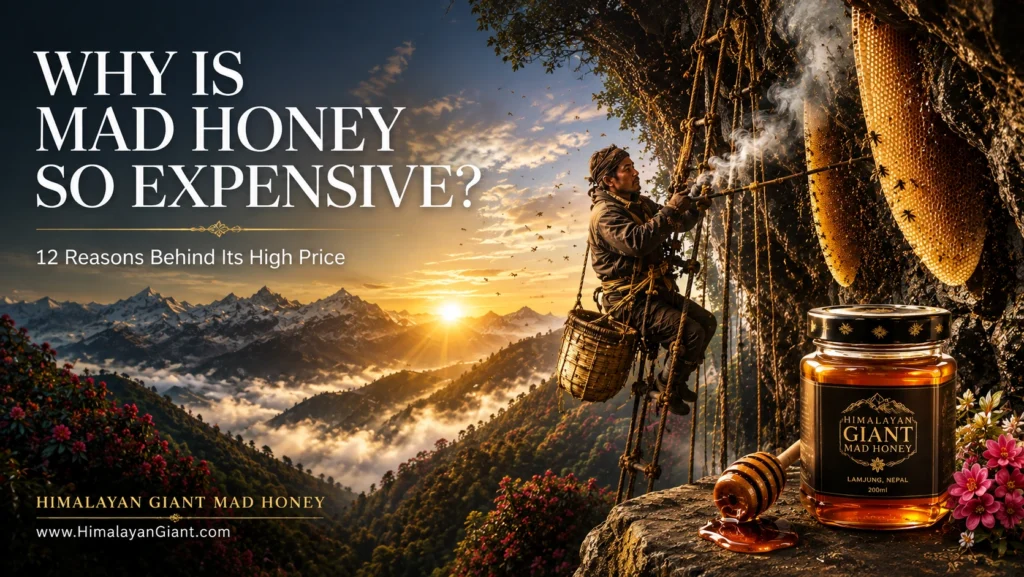
If you have ever searched for authentic Himalayan mad honey, you may have been surprised by its price. Compared to regular honey found in supermarkets, mad honey often costs much more. Many people wonder why such a small jar can be so expensive and whether it is really worth the price. This is one of the most common questions asked by first-time buyers, and the answer goes far beyond simple supply and demand.
The truth is that mad honey is not an ordinary food product. Every jar represents a remarkable journey that begins high in the Himalayan mountains, where nature, tradition, and human courage come together. Long before the honey reaches your table, experienced honey hunters travel to remote villages, hike through rugged mountain trails, and climb towering cliffs using traditional rope ladders. They risk their safety to collect honey from the world’s largest wild honey bees, a practice that has been passed down through generations. Their knowledge, patience, and respect for nature are an important part of what makes this honey so valuable.
Many people believe the high price exists only because mad honey is rare. While rarity certainly plays a role, it is only one piece of a much bigger story. The flowers that produce this unique honey bloom for only a short time each year. Weather conditions, bee populations, mountain geography, transportation, harvesting methods, food safety, and international shipping all influence the final cost. Every season is different, and no two harvests are exactly the same.
When asking Why Is Mad Honey So Expensive, it is important to understand that you are not only paying for the honey itself. You are also supporting traditional mountain communities, preserving an ancient honey hunting culture, and purchasing a product that cannot be mass-produced in factories or commercial bee farms.
In this guide, we will explore the 12 main reasons behind the high price of authentic Himalayan mad honey. From dangerous cliff harvesting and limited seasonal production to the challenges of transporting honey from remote mountain regions, each factor helps explain Why Is Mad Honey So Expensive and why genuine mad honey remains one of the world’s most unique and valuable natural products.
What Makes Mad Honey Different from Regular Honey?
At first glance, mad honey may look similar to ordinary honey. It has a rich color, a natural sweetness, and comes from bees just like other types of honey. However, once you learn where it comes from and how it is produced, it becomes clear that mad honey is very different from the commercial honey found on supermarket shelves.
One of the biggest differences is the source of the nectar. Authentic mad honey is produced when bees collect nectar from specific species of rhododendron flowers that grow in high mountain regions. These flowers naturally contain compounds called grayanotoxins. As bees gather nectar and transform it into honey, small amounts of these naturally occurring compounds become part of the final product. This unique connection between bees, flowers, and mountain ecosystems is what makes mad honey unlike ordinary honey.
Another important difference is the way it is harvested. Most commercial honey comes from managed beehives that can be easily accessed by beekeepers. Mad honey, however, is often collected from wild cliff bee colonies built by the Himalayan giant honey bee, also known as Apis laboriosa. These massive hives are attached to steep rock faces high above the ground. Honey hunters must climb dangerous cliffs using traditional rope ladders and simple tools to reach them. The process requires courage, experience, and teamwork that has been passed down through generations.
Mad honey is also a seasonal product. The most important harvest usually takes place during the spring when rhododendron forests bloom across the mountains. Some areas may have a smaller autumn harvest, but production remains limited. Unlike commercial honey operations that can produce large amounts throughout the year, mad honey depends heavily on nature’s timing. If weather conditions affect flowering or bee activity, the harvest may be smaller than expected.
Rarity is another major factor that sets mad honey apart. Commercial honey is produced on a large scale in many countries around the world. Mad honey is found only in certain mountain regions where the right flowers, climate, and bee species exist together. Because of this limited production, authentic mad honey is much harder to find.
Understanding these differences helps answer the question, Why Is Mad Honey So Expensive. It is not simply honey in a jar. It is a rare natural product shaped by wild mountain landscapes, seasonal flowering cycles, and the dedication of honey hunters who continue an ancient tradition. These unique qualities play a major role in explaining Why Is Mad Honey So Expensive compared to regular honey.
The 12 Reasons Why Mad Honey Is So Expensive
The price of authentic Himalayan mad honey is not determined by just one factor. Many people assume it is expensive only because it is rare, but the story is much deeper than that. Every jar reflects the work of skilled honey hunters, the challenges of harvesting in remote mountains, the short flowering season, and the limited amount nature provides each year. Transportation, quality control, and growing global demand also play important roles. When people ask Why Is Mad Honey So Expensive, the answer lies in a combination of natural, cultural, and economic factors. Let’s explore each of these 12 reasons and discover why this remarkable honey is valued around the world.
1. It Comes from Dangerous Himalayan Cliffs
One of the biggest reasons authentic mad honey costs so much is the place where it is harvested. Unlike regular honey that is collected from managed beehives, Himalayan mad honey comes from wild bee colonies built on towering cliffs deep in the mountains. These cliffs can rise hundreds of feet above the ground, making every harvest a challenging and risky journey.
Before the honey hunters even reach the cliffs, they often spend hours or even days walking through remote mountain trails. Many of these locations have no roads, and the only way to reach them is on foot. They carry ropes, baskets, protective clothing, and other simple tools across forests, rivers, and steep hills. The journey itself requires strength, patience, and careful planning.
When the hunters arrive at the cliff, the real challenge begins. Using traditional rope ladders made from natural materials or strong ropes, they slowly climb down the rock face toward the massive bee hives. There are no modern safety platforms or machines to make the job easier. Every movement must be made with care because one mistake could have serious consequences. At the same time, thousands of wild bees fly around the hunters as they carefully collect the honey.
Harvesting honey from these cliffs is physically demanding. The hunters must balance on narrow rope ladders while cutting sections of the hive and lowering the honey safely to the people waiting below. Wind, changing weather, and the rough mountain environment make the work even more difficult. Each harvest requires teamwork, trust, and years of experience passed down from one generation to the next.
The remote location also means that every jar of mad honey represents many hours of travel and hard work before it even leaves the mountains. Unlike commercial honey farms that are easy to access, these natural cliff colonies cannot be reached quickly or harvested frequently.
When people ask Why Is Mad Honey So Expensive, the answer begins with these remarkable Himalayan cliffs. The effort, danger, and dedication involved in reaching the wild bee colonies make every harvest a powerful example of the connection between people and nature. Understanding this incredible process helps explain Why Is Mad Honey So Expensive and why each jar carries the story of courage, tradition, and respect for the mountains.
2. Harvesting Requires Skilled Honey Hunters
Authentic Himalayan mad honey is valuable not only because of where it is found but also because of the people who harvest it. Collecting honey from wild cliff bee colonies is not something anyone can do after a few days of training. It requires years of experience, deep respect for nature, and traditional knowledge that has been passed from one generation to the next. This human story is one of the biggest reasons Why Is Mad Honey So Expensive.
In many mountain villages of Nepal, honey hunting is an ancient tradition. Older honey hunters teach younger members of the community how to read the mountains, understand the behavior of wild bees, and choose the right time to harvest. These lessons are learned through experience rather than books. Every season brings new challenges, and the knowledge gained over many years helps hunters make safe and careful decisions.
Experience is especially important because every cliff and every bee colony is different. Honey hunters must know how to approach the hive without damaging it more than necessary. They also need to understand changing weather conditions, wind direction, and the safest way to climb and work on steep rock faces. Their skills help protect both the people involved and the wild bee colonies that continue producing honey for future generations.
Honey hunting is never a one-person job. It depends on teamwork from beginning to end. While one hunter climbs the rope ladder to reach the hive, others remain above and below to hold the ropes, guide the baskets, prepare equipment, and help transport the honey. Good communication and trust are essential because every person has an important role during the harvest.
Another reason for the high value of mad honey is that the number of experienced honey hunters is becoming smaller. Many younger people leave mountain villages for education or work in cities, making it harder to pass this tradition to the next generation. As fewer skilled hunters continue this demanding work, authentic mad honey becomes even more limited.
When people ask Why Is Mad Honey So Expensive, they are also asking about the value of human knowledge and tradition. Every jar reflects the courage, patience, and skills of experienced honey hunters who continue an ancient practice despite its challenges. Their dedication keeps this remarkable Himalayan tradition alive and plays an important role in explaining Why Is Mad Honey So Expensive.
3. Wild Giant Honey Bees Cannot Be Farmed
One of the biggest reasons behind the high price of authentic mad honey is the remarkable bee that produces it. Himalayan mad honey is made by Apis laboriosa, also known as the Himalayan giant honey bee. This is the world’s largest honey bee species, and unlike the bees commonly used in commercial beekeeping, it is completely wild. Because these bees cannot be farmed or raised in managed hives, the supply of authentic mad honey always remains limited. This is another important answer to the question, Why Is Mad Honey So Expensive.
Most commercial honey comes from bee species that can be kept in wooden boxes or modern beehives. Beekeepers can move these hives, care for the bees, and harvest honey in a controlled environment. This makes large-scale honey production possible in many parts of the world.
Apis laboriosa is very different. These giant honey bees naturally build their massive colonies on steep rock cliffs high in the Himalayan mountains. They choose remote locations where they can live in their natural environment, often far away from villages and roads. Scientists and local communities have observed that these bees cannot simply be moved into ordinary beehives like other honey bee species. They depend on the unique mountain ecosystem, natural cliff faces, and seasonal flowering of rhododendron forests.
Because these bees cannot be domesticated, honey hunters must wait for nature instead of controlling production. They cannot increase the number of colonies or speed up the harvest. Every year, they depend on healthy bee populations, favorable weather, and successful flowering seasons. If nature produces a smaller harvest, there is no practical way to replace the lost supply.
The wild lifestyle of Apis laboriosa also means that every harvest must respect the natural balance of the mountains. Responsible honey hunters avoid taking the entire hive so the bee colony can recover and continue producing honey in future seasons. This traditional approach supports the survival of the bees but also limits the amount of honey collected each year.
When people ask Why Is Mad Honey So Expensive, the answer begins with the extraordinary life of Apis laboriosa. These wild giant honey bees cannot be managed like ordinary honey bees, making every jar dependent on nature rather than farming. Their unique habitat, limited production, and deep connection to the Himalayan mountains make authentic mad honey one of the rarest natural honey products in the world.
4. The Harvest Season Is Very Short
One of the most important reasons authentic Himalayan mad honey is expensive is that it can only be harvested during a very short period each year. Unlike commercial honey, which can often be collected multiple times depending on beekeeping practices, mad honey depends entirely on nature’s schedule. If the right flowers are not blooming, there is simply no harvest. This limited harvesting window is a major reason Why Is Mad Honey So Expensive.
The main harvest takes place during the spring, usually between March and May. During these weeks, rhododendron forests across the Himalayan mountains burst into colorful blooms. The Himalayan giant honey bee, Apis laboriosa, collects nectar from these flowers, creating the unique honey that has become famous around the world. This short flowering season is one of the most important moments of the year for mountain honey hunters, who prepare for months before the harvest begins.
Some mountain regions may also experience a smaller autumn harvest. However, this harvest is usually less predictable and often produces a much smaller quantity of honey than the spring season. Weather conditions, flowering patterns, and the natural behavior of the bees all influence whether an autumn harvest is possible. Because of these uncertainties, spring remains the primary harvesting season for authentic mad honey.
The actual harvesting period lasts only a few weeks each year. During this short time, honey hunters must organize their teams, travel to remote mountain cliffs, and collect the honey before the flowering season ends. If heavy rain, strong winds, or other natural conditions interrupt the harvest, there may not be another opportunity until the following season.
Missing the harvest has serious consequences. Honey hunters cannot simply return a few weeks later and expect the same results. Once the flowering period is over, they often have to wait several months before nature provides another opportunity. This makes every successful harvest incredibly valuable and naturally limits the amount of honey available on the market.
When people ask Why Is Mad Honey So Expensive, the short harvest season is one of the biggest reasons. Every jar represents a rare opportunity that comes only once or, in some areas, twice a year. The narrow harvesting window, combined with nature’s unpredictability, makes authentic Himalayan mad honey a truly seasonal treasure that cannot be produced whenever demand increases.
5. Annual Production Is Limited
Unlike products that can be manufactured in factories throughout the year, authentic Himalayan mad honey depends entirely on nature. No company or honey hunter can decide how much honey will be produced in a season. The mountains, the flowers, the weather, and the bees all work together to determine the final harvest. This natural limitation is one of the biggest reasons Why Is Mad Honey So Expensive.
Every year begins with uncertainty. A healthy harvest depends on favorable weather during the flowering season. If heavy rain arrives too early, if temperatures become unusually high or low, or if strong winds affect the mountain forests, the rhododendron flowers may not bloom as expected. Since these flowers provide the nectar needed to produce authentic mad honey, any change in nature can directly reduce the amount of honey available.
The flowering season itself is another important factor. Rhododendron forests bloom for only a short period, and the quality of the bloom changes from year to year. Some seasons produce hillsides covered with colorful flowers, while others may have fewer blossoms because of changing environmental conditions. Since the bees depend on these flowers, a weaker flowering season often means a smaller honey harvest.
Bee populations also play a major role. The Himalayan giant honey bee, Apis laboriosa, lives in a delicate mountain ecosystem. Healthy bee colonies are essential for producing authentic mad honey, but their numbers can naturally change over time. Weather, food availability, and environmental conditions all influence the strength of the colonies each season. Honey hunters cannot control these factors because the bees live freely in the wild.
This is why no two years are exactly the same. One season may produce a generous harvest, while the next may result in much smaller quantities. Honey hunters and local communities accept these changes because they understand that nature always follows its own rhythm. They cannot simply increase production to meet growing demand.
When people ask Why Is Mad Honey So Expensive, limited annual production is one of the clearest answers. The supply is controlled by nature rather than human planning, making authentic mad honey a truly seasonal product. Every jar reflects the unique conditions of that particular year, reminding us that some of the world’s most valuable natural treasures cannot be produced on demand.
6. Rhododendron Flowers Grow in Specific Mountain Areas
Another important reason authentic Himalayan mad honey is so valuable is that it depends on a very special flower. Mad honey is produced when bees collect nectar from certain species of rhododendron that naturally contain grayanotoxins. These flowers do not grow everywhere. They thrive only in specific mountain regions where the climate, altitude, soil, and weather create the right conditions. This natural dependence is a major reason Why Is Mad Honey So Expensive.
Many of the rhododendron forests that produce authentic mad honey are found at high altitudes in the Himalayan mountains of Nepal and in a few other mountain regions around the world. These forests experience cool temperatures, clean air, and unique environmental conditions that cannot easily be recreated elsewhere. Because the flowers grow only in selected locations, the bees must also live in these remote mountain habitats to produce genuine mad honey.
The blooming season is another important factor. Rhododendron flowers bloom for only a short period each year, mainly during the spring. For just a few weeks, the mountains become covered with colorful blossoms that provide nectar for the Himalayan giant honey bees. Once the flowering season ends, the bees must rely on other natural food sources, and the production of authentic mad honey comes to a stop until the next suitable season.
Nature controls every step of this process. If the weather changes, the flowering season may begin earlier, end sooner, or produce fewer flowers than expected. Heavy rain, unusual temperatures, or dry conditions can all affect the number of blossoms available. Since the bees depend on these flowers, any change in the blooming season directly influences how much mad honey can be produced.
Unlike crops that can be planted in different places or flowers that can be grown on commercial farms, these mountain rhododendrons are part of a delicate natural ecosystem. Honey hunters and local communities must wait for nature to provide the right conditions each year. They cannot speed up the flowering season or increase the number of flowers to produce more honey.
When people ask Why Is Mad Honey So Expensive, the answer includes this rare relationship between wild bees and mountain rhododendron forests. Authentic mad honey exists only because these flowers bloom in limited high-altitude regions for a short time each year. This close connection to nature makes every harvest unique and every jar a reflection of the Himalayan landscape itself.
7. Harvesting Takes Days of Preparation
When people see a small jar of authentic Himalayan mad honey, they often think only about the moment it is collected from the cliff. In reality, the harvest begins many days before the honey hunters ever reach a bee colony. Every successful expedition requires careful planning, physical endurance, and the support of local communities. This long preparation is another important reason Why Is Mad Honey So Expensive.
The journey usually starts with trekking through remote Himalayan landscapes. Honey hunters and their teams travel across mountain trails, forests, rivers, and steep hills to reach areas where the giant honey bees build their colonies. Many of these places have no roads, so every piece of equipment must be carried by hand. Food, ropes, baskets, protective clothing, and other essential tools all need to be transported to the harvesting site.
Finding the bee colonies is another challenge. The hives are often attached to high rock cliffs hidden deep within the mountains. Experienced local guides and honey hunters know where these colonies are likely to be found because they have learned the landscape over many years. Even then, every season is different. Some colonies may move, while others may not survive from one year to the next. Locating active hives requires patience, observation, and knowledge that has been passed down through generations.
Once a suitable hive is found, the team prepares for the harvest by building or securing traditional rope ladders. These ladders must be carefully positioned on the cliff to allow the lead honey hunter to safely reach the hive. Every rope is checked, every knot is tightened, and each team member understands their role before the harvest begins. This preparation is essential because there is very little room for mistakes on a steep mountain cliff.
Weather is another factor that cannot be ignored. Strong winds, heavy rain, or unstable conditions can delay or even cancel a planned harvest. Honey hunters closely watch the weather and often wait for the safest possible conditions before beginning their climb. Nature decides when the harvest can take place, not the people.
When people ask Why Is Mad Honey So Expensive, they often do not see the many days of work that happen before a single drop of honey is collected. The trekking, careful planning, local knowledge, rope preparation, and dependence on favorable weather all add time, effort, and cost to every harvest. Each jar represents not only the final collection of honey but also the dedication of the people who prepare tirelessly to continue this remarkable Himalayan tradition.
8. Remote Mountain Transportation Adds Cost
The journey of authentic Himalayan mad honey does not end once it is harvested from the cliffs. In many ways, one of the biggest challenges begins after the honey has been collected. Moving fresh honey from remote mountain villages to customers around the world takes time, effort, and careful planning. This long journey is another important reason Why Is Mad Honey So Expensive.
Most honey harvesting areas are located deep in the Himalayan mountains, where modern roads are limited or do not exist. After the honey is collected, it is often carried by foot along narrow mountain trails. Honey hunters and local villagers carefully transport heavy containers across steep hills, forests, and rocky paths until they reach villages or places where vehicles can finally access the area. This part of the journey can take many hours or even several days, depending on the location.
Many mountain communities that practice traditional honey hunting are far from large towns and cities. These villages may not have direct road connections, making transportation much more difficult than in commercial farming areas. Every step of the journey requires physical effort, patience, and coordination. Unlike products made in factories near highways or ports, authentic mad honey begins its journey in some of the most remote landscapes in the world.
Once the honey reaches a road, it still needs to be transported to processing facilities or major cities. Here, it is cleaned, packed, labeled, and prepared for local sales or international shipping. Each stage adds additional costs, including safe packaging to protect the honey during long-distance transportation.
For customers outside Nepal, the process becomes even more complex. Exporting food products requires documentation, customs procedures, quality checks, and international logistics. Reliable companies also invest in secure packaging to ensure that glass jars arrive safely after traveling thousands of kilometers by air or sea. These transportation and export expenses become part of the final price paid by the customer.
When people ask Why Is Mad Honey So Expensive, transportation is often an overlooked part of the answer. Every jar travels an extraordinary route from a wild cliff in the Himalayas to homes around the world. The combination of mountain trails, remote villages, careful handling, and international shipping adds significant value to the product. Understanding this remarkable journey helps explain Why Is Mad Honey So Expensive and why every jar carries not only rare honey but also the story of the mountains it came from.
9. Small-Batch Production
One of the main reasons authentic Himalayan mad honey is so valuable is that it is produced in small batches. Unlike commercial honey, which is often collected from thousands of managed beehives and processed on a large scale, mad honey is gathered from a limited number of wild bee colonies in remote mountain regions. There is no factory producing thousands of identical jars every day. This limited production is another important answer to the question, Why Is Mad Honey So Expensive.
Every harvest produces only a small amount of honey. Honey hunters cannot collect unlimited quantities because the number of wild bee colonies is naturally limited. They also follow traditional harvesting practices that help protect the colonies for future seasons. Instead of taking everything, responsible honey hunters leave part of the hive so the bees can continue living and producing honey. This sustainable approach supports nature but also reduces the total amount of honey available each year.
Each batch of authentic mad honey is unique. Since the bees collect nectar from flowers growing in different mountain areas and under changing weather conditions, no two harvests are exactly alike. One batch may have a deeper amber color, while another may appear lighter. The aroma, texture, and natural characteristics can also vary from season to season. These differences are part of what makes raw, wild honey special and reflect the natural environment where it was produced.
Seasonal availability adds another layer of rarity. Once a harvest has been sold, there may not be another opportunity to collect fresh mad honey until the next flowering season. Customers often have to wait several months for a new batch to become available. Unlike commercial honey that can usually be found throughout the year, authentic Himalayan mad honey follows nature’s calendar rather than market demand.
Because production is so limited, every jar receives more attention during harvesting, handling, and packaging. Small-batch production allows producers to focus on maintaining the natural quality of the honey instead of trying to produce large quantities as quickly as possible. This careful approach helps preserve the unique characteristics that make authentic mad honey so highly valued.
When people ask Why Is Mad Honey So Expensive, small-batch production is one of the clearest reasons. Every jar represents a limited harvest that cannot be mass-produced or easily replaced. The combination of seasonal availability, natural variation, and sustainable harvesting practices makes each batch a rare product created by nature rather than industry.
10. Quality Control and Testing
After authentic Himalayan mad honey is harvested from the cliffs, the work is far from over. Before it reaches customers, responsible producers spend time making sure the honey is clean, safely handled, and carefully packaged. These important steps require additional effort, skilled workers, and financial investment. They are another reason Why Is Mad Honey So Expensive and why trusted brands often stand out from low-quality products.
The first step is cleaning the honey. During traditional harvesting, small pieces of natural beeswax or other tiny particles may be present because the honey is collected directly from wild hives. Reputable producers carefully remove unwanted materials while preserving the honey’s natural character. The goal is to provide a clean product without unnecessary processing that could reduce its original qualities.
Many producers also use gentle filtering methods. This is different from heavy industrial processing used for some commercial honeys. Light filtering helps remove larger natural particles while allowing the honey to remain as close to its raw form as possible. Careful handling throughout this process helps maintain the honey’s natural appearance, aroma, and texture.
Food safety is another important part of quality control. Responsible companies follow proper hygiene standards during collection, storage, bottling, and packaging. Clean equipment, sanitized containers, and careful handling reduce the risk of contamination and help ensure the honey reaches customers in good condition. These standards require time, training, and investment.
Some reputable companies also choose to perform laboratory testing. Lab reports may provide useful information about the honey’s quality, purity, moisture level, and other natural characteristics. Testing can improve transparency and give customers additional confidence in the product they are buying. However, it is important to understand that not every authentic producer has access to laboratory facilities. Many small honey-harvesting communities in remote mountain regions produce genuine mad honey but may not have the resources for regular laboratory analysis.
Finally, careful packaging helps protect the honey during storage and transportation. Strong glass jars, secure lids, clear labels, and protective shipping materials all add to the overall cost but help preserve the honey’s quality from the mountains to the customer’s home.
When people ask Why Is Mad Honey So Expensive, quality control is an important part of the answer. Trusted producers invest in careful cleaning, food safety, thoughtful packaging, and, when possible, laboratory testing to deliver a product they are proud to share. These extra steps require both time and resources, helping explain Why Is Mad Honey So Expensive while giving customers greater confidence in the authenticity and quality of every jar.
11. International Shipping and Import Costs
Authentic Himalayan mad honey may be harvested in remote mountain regions, but many of its customers live thousands of kilometers away. Getting a jar of genuine mad honey from the Himalayas to homes in the United States, Europe, Australia, and other countries is a long and carefully managed process. International shipping involves much more than simply placing a jar in a box. These additional steps are another important reason Why Is Mad Honey So Expensive.
Before the honey can leave its country of origin, producers must prepare the necessary export documents. These documents help show that the product is being shipped legally and meets the requirements for international trade. Preparing export paperwork takes time and involves different government procedures that add to the overall cost.
Once the shipment reaches another country, it must pass through customs. Customs authorities inspect imported products and verify that they follow local rules and regulations. Since honey is a food product, many countries have specific import requirements designed to protect consumers and maintain food safety standards. Meeting these requirements often involves additional fees, inspections, and processing time.
Food regulations also differ from one country to another. Reputable companies must ensure that their labels, packaging, and product information meet the standards of the countries where they sell their honey. Following these regulations requires careful planning and ongoing attention to changing import rules.
Packaging is another important part of the journey. Mad honey is usually packed in glass jars, which need extra protection during international transport. Strong boxes, protective wrapping, secure seals, and careful packing materials help prevent damage while the honey travels through airports, warehouses, delivery vehicles, and distribution centers. Good packaging increases shipping costs, but it helps ensure the honey arrives safely and in excellent condition.
International delivery itself is another major expense. Transporting products across continents by air or sea requires reliable logistics services. Fuel costs, handling charges, storage, insurance, and final delivery all become part of the overall price of the product. Every stage of the journey adds value by making authentic Himalayan mad honey available to customers around the world.
When people ask Why Is Mad Honey So Expensive, international shipping and import costs are often overlooked. Behind every jar is a carefully managed process involving export documents, customs procedures, food regulations, secure packaging, and global transportation. These essential steps help protect product quality and ensure that authentic Himalayan mad honey can safely travel from remote mountain cliffs to customers across the world.
12. Growing Global Demand
Over the past few years, authentic Himalayan mad honey has become known far beyond the mountain villages where it has been harvested for generations. What was once a traditional local product is now attracting interest from people across the world. As more people discover its unique story, demand continues to grow while nature still produces only a limited amount each year. This growing popularity is one of the final reasons Why Is Mad Honey So Expensive.
Social media has played a major role in introducing mad honey to a global audience. Videos showing brave honey hunters climbing towering Himalayan cliffs have inspired millions of viewers. The breathtaking landscapes, traditional harvesting methods, and remarkable bee colonies have captured the attention of travelers, nature lovers, and people interested in rare natural products. Many people first learn about mad honey through these videos before searching for more information online.
Worldwide awareness has also increased because of educational articles, documentaries, travel blogs, and scientific research. As people become more interested in authentic foods and traditional cultures, they often look for products that have a genuine story behind them. Mad honey offers much more than its natural characteristics. It represents centuries of tradition, respect for nature, and the lives of mountain communities that continue practicing one of the world’s oldest honey-hunting traditions.
While interest keeps growing, the supply remains limited. Honey hunters cannot simply produce more honey because demand increases. The amount available each year still depends on flowering seasons, healthy bee colonies, suitable weather, and successful harvests. Nature continues to decide how much authentic mad honey can be collected, regardless of how many people want to buy it.
This creates a situation where demand is often greater than production. More buyers are searching for genuine Himalayan mad honey than the mountains can naturally provide. As a result, authentic products become more valuable, while dishonest sellers sometimes try to take advantage of the growing market by offering fake or misleading products. This is why choosing a trusted and transparent producer is more important than ever.
When people ask Why Is Mad Honey So Expensive, growing global demand is an important part of the answer. Millions of people now appreciate the remarkable story behind this rare honey, but the supply remains limited by nature and tradition. Every jar reflects a harvest that cannot be rushed, expanded, or mass-produced, making authentic Himalayan mad honey one of the world’s most sought-after natural treasures.
Is Expensive Mad Honey Always Better?
It is easy to think that the most expensive jar of mad honey must also be the best. Many buyers believe a higher price automatically means higher quality or greater authenticity. However, this is not always true. While authentic Himalayan mad honey is naturally more expensive than regular honey because of the challenges involved in harvesting it, price alone is not enough to prove that a product is genuine. This is an important point to remember when asking Why Is Mad Honey So Expensive.
Some companies charge higher prices because they invest in responsible harvesting, quality control, secure packaging, and customer support. Others may simply increase their prices to make their products appear more exclusive, even if they provide very little information about where the honey comes from. A premium price without transparency should always encourage buyers to ask more questions before making a purchase.
The first thing to check is the origin of the honey. A trustworthy seller should clearly explain where the honey was harvested, whether it comes from Nepal, the Black Sea region of Turkey, or another known source. Knowing the harvest location helps buyers understand the product’s background and gives greater confidence in its authenticity.
You should also learn about the harvest itself. Reliable companies often explain when the honey was collected, whether it was a spring or autumn harvest, and how the honey hunters gathered it. These details show that the company understands its product and values transparency.
Reading genuine customer reviews is another helpful step. Look for detailed reviews on independent platforms rather than relying only on testimonials displayed on the seller’s own website. Honest feedback from real customers often provides valuable insights into product quality and customer service.
The ingredient list is equally important. Authentic mad honey should simply contain honey, without added sugar, glucose syrup, corn syrup, or artificial flavors. Clear labeling is a good sign that the producer values honesty.
Finally, consider the company’s overall reputation. Reputable producers usually provide educational content, explain their harvesting practices, share information about local honey hunters, and offer reliable customer support. Companies that openly answer questions and provide complete product information are generally more trustworthy than those that share very little.
When thinking about Why Is Mad Honey So Expensive, remember that a fair price often reflects the effort, rarity, and care involved in producing authentic honey. At the same time, the smartest buyers look beyond the price tag and evaluate the origin, harvest details, ingredients, transparency, reviews, and company reputation before deciding which product to trust.
What Is a Fair Price for Authentic Mad Honey?
One of the most common questions buyers ask is how much authentic Himalayan mad honey should actually cost. There is no single price that applies to every jar because many factors influence the final cost. Understanding these factors helps buyers make informed decisions and better understand Why Is Mad Honey So Expensive without assuming that every expensive product is automatically the best.
The country where the honey is sold is one of the biggest factors affecting price. A jar purchased in Nepal may cost less than the same product sold in the United States, Europe, or Australia. This difference is often caused by export expenses, import duties, customs procedures, taxes, and international shipping rather than changes in the honey itself.
The harvest season also affects the price. Spring harvests are often the most sought after because they are closely linked to the blooming of rhododendron flowers. If weather conditions reduce the harvest in a particular year, the available supply may become even more limited, increasing the market value of authentic mad honey.
Jar size is another important consideration. Larger jars naturally cost more than smaller ones, although the price per gram may sometimes be lower. Comparing products by their weight rather than only by the total price helps buyers understand the actual value they are receiving.
Brand reputation also plays a role. Companies that invest in responsible harvesting, careful packaging, quality control, educational content, and reliable customer service may charge more because of the additional work involved. These extra efforts often provide greater confidence for customers looking for genuine products.
Shipping costs can also make a noticeable difference. International delivery, protective packaging, and safe transportation all add to the final price, especially for customers ordering from overseas.
While authentic Himalayan mad honey is naturally more expensive than ordinary honey, buyers should be cautious of products that are priced far below the market average. Extremely cheap products may raise questions about their origin, ingredients, or authenticity. At the same time, an unusually high price does not guarantee that a product is genuine. Some sellers simply increase prices without offering better quality or greater transparency.
When considering Why Is Mad Honey So Expensive, it is important to look beyond the price tag alone. A fair price reflects the rarity of the honey, the effort required to harvest it, and the care taken to deliver it safely. The best buying decision comes from balancing price with trusted information about the product’s origin, harvest, and the reputation of the company selling it.
Why Cheap Mad Honey Can Be Risky
Finding a very cheap jar of mad honey may seem like a great deal, especially if you are buying it for the first time. However, authentic Himalayan mad honey is naturally limited, difficult to harvest, and expensive to transport. When a product is priced far below the normal market range, it is worth taking a closer look before making a purchase. Understanding these risks is another important part of learning Why Is Mad Honey So Expensive.
One of the biggest concerns is fake products. As the popularity of mad honey has grown around the world, some sellers have taken advantage of the increasing demand by marketing ordinary honey as authentic mad honey. Attractive packaging and impressive product descriptions may look convincing, but they do not always reflect what is actually inside the jar.
Some low-cost products may also contain mixed honey. Instead of offering pure mad honey, dishonest sellers may blend it with regular honey or inexpensive sweeteners to increase the quantity and reduce production costs. Buyers often have no easy way to identify these mixtures unless the company is transparent about its ingredients and sourcing.
Poor labeling is another warning sign. Authentic products usually include useful information such as the harvest location, production date, ingredient list, storage instructions, and company contact details. Cheap products with missing or unclear labels make it difficult to understand where the honey came from or how it was produced. A lack of basic information should encourage buyers to ask more questions before purchasing.
An unknown source is another reason to be cautious. Trusted producers are usually proud to explain where their honey was harvested, who collected it, and how it reached the customer. If a seller cannot provide clear information about the honey’s origin, it becomes much harder to judge its authenticity.
Misleading marketing is also common in the online marketplace. Some sellers use dramatic claims, edited photos, or exaggerated promises to attract attention. Others may describe ordinary wild honey as rare Himalayan mad honey without providing evidence or explaining the harvesting process. These marketing tactics can easily confuse first-time buyers.
When people ask Why Is Mad Honey So Expensive, it is important to remember that genuine products reflect the effort, tradition, and limited supply behind every harvest. Extremely cheap prices often raise questions about authenticity rather than offering exceptional value. Taking time to research the seller, check product details, and choose a transparent company can help you avoid disappointment and make a more confident purchase.
Tips for Buying Authentic Mad Honey
Buying authentic Himalayan mad honey is about much more than finding the lowest price or the most attractive packaging. Since this is a rare natural product, choosing the right seller is one of the most important decisions you can make. A little research before buying can help you avoid fake products and give you greater confidence in the honey you receive. If you have ever wondered Why Is Mad Honey So Expensive, these buying tips will also help you understand the value behind a genuine product.
Start by choosing trusted companies with a good reputation. Reliable sellers are usually open about their harvesting practices, the regions where their honey comes from, and the people who collect it. They are proud to share the story behind their products because authenticity is an important part of their business.
Reading customer reviews is another helpful step. Look for detailed reviews that describe the buying experience, packaging, customer service, and product quality. Reviews on independent platforms often provide a more balanced picture than testimonials displayed only on a company’s website. Honest feedback from previous customers can help you make a more informed decision.
Do not hesitate to ask questions about the harvest. A trustworthy seller should be able to explain where the honey was collected, whether it came from a spring or autumn harvest, and how it reached the market. Companies that answer these questions clearly often show greater transparency and knowledge about their products.
Always check the ingredient list before buying. Authentic mad honey should simply contain honey, with no added sugar, glucose syrup, corn syrup, artificial flavors, or unnecessary ingredients. Simple and honest labeling is usually a good sign of product quality.
It is also important to verify the harvest location. Genuine mad honey comes from specific mountain regions where the right flowers and wild bee species exist naturally. If a seller cannot explain where the honey was harvested, you should be cautious before making a purchase.
Finally, look for companies that value transparency. Trusted producers often provide educational articles, harvest stories, clear contact information, storage guidance, and helpful customer support. They are willing to explain their process instead of relying on exaggerated marketing claims.
When considering Why Is Mad Honey So Expensive, remember that the best value comes from authenticity rather than price alone. A trusted company that openly shares information about its honey gives buyers greater confidence and helps preserve the traditions, communities, and natural environments that make authentic Himalayan mad honey so special.
Frequently Asked Questions
Many people have questions before buying authentic Himalayan mad honey, especially when they notice its higher price. Below are some of the most common questions and simple answers to help you better understand Why Is Mad Honey So Expensive and what makes this rare honey different from ordinary honey.
Why is Himalayan mad honey more expensive than regular honey?
Himalayan mad honey is collected from wild bee colonies that live on steep mountain cliffs. It requires skilled honey hunters, dangerous climbing, seasonal harvesting, and long transportation from remote villages. Unlike commercial honey, it cannot be mass-produced, making it naturally more valuable.
Is expensive mad honey worth the price?
For many buyers, the value comes from its rarity, traditional harvesting methods, and unique origin rather than just the honey itself. A fair price often reflects the effort, risk, and limited supply involved in every harvest. However, buyers should always research the product carefully before making a purchase.
Does price guarantee authenticity?
No. A high price alone does not prove that a product is genuine. Some sellers may charge premium prices without offering authentic honey. It is always better to check the harvest location, ingredients, customer reviews, company transparency, and reputation instead of judging the product only by its cost.
Why is production so limited?
Production depends entirely on nature. The bees collect nectar from specific rhododendron flowers that bloom for only a short time each year. Weather conditions, healthy bee populations, and successful flowering seasons all affect how much honey can be harvested. These natural limits are one of the main reasons Why Is Mad Honey So Expensive.
Can mad honey be farmed?
No. Authentic Himalayan mad honey is produced by Apis laboriosa, the Himalayan giant honey bee. These wild bees cannot be raised in ordinary beehives like commercial honey bees. They build their colonies naturally on high mountain cliffs, making the harvest dependent on wild ecosystems.
Why does the harvest happen only once or twice a year?
The harvest follows the natural flowering cycle of rhododendron forests. The main harvest usually takes place during the spring, while some regions may also have a smaller autumn harvest. Outside these seasons, the bees do not produce the same type of honey because the necessary flowers are no longer blooming.
Does imported mad honey cost more?
Yes, in many cases it does. Export documents, customs procedures, food regulations, international shipping, and secure packaging all increase the final cost. These additional expenses help explain Why Is Mad Honey So Expensive for customers buying it outside its country of origin.
Why do different brands charge different prices?
Prices vary because every company has different harvesting methods, packaging standards, shipping costs, quality control practices, and customer services. Some brands also invest more in supporting local honey hunters and maintaining product transparency. Instead of choosing a product based only on price, compare the origin, harvest details, ingredients, and company reputation to make a more informed decision.
Buy from a Trusted Source That Values Authenticity
If you have read this far, you now know that authentic Himalayan mad honey is much more than a rare natural product. It represents the courage of traditional honey hunters, the beauty of the Himalayan mountains, and a harvest that happens only when nature allows. That is why choosing a trusted seller is just as important as choosing the honey itself.
If you are looking for genuine Himalayan mad honey, consider buying from Himalayan Giant Mad Honey. The company works directly with traditional honey hunters in Nepal through a direct-trade model and emphasizes transparent sourcing, fair compensation, and responsible harvesting practices. Each batch is traceable to its harvest, and the company provides harvest information, batch details, and authenticity documentation to help customers understand exactly where their honey comes from.
Himalayan Giant Mad Honey also focuses on fair pricing rather than simply offering the cheapest product or charging premium prices without explanation. Their pricing reflects the real cost of ethical sourcing, careful packaging, quality assurance, and international delivery while supporting the communities that continue this centuries-old Himalayan tradition.
When buying authentic mad honey, always choose transparency over marketing claims. Look for companies that openly explain their harvest process, share the origin of every batch, provide clear customer support, and value honesty. A trusted producer gives you confidence that the honey in your jar truly comes from the Himalayan cliffs where this remarkable tradition began.
Conclusion
When people first see the price of authentic Himalayan mad honey, it is easy to wonder why it costs so much more than regular honey. After learning about the complete journey behind every jar, the answer becomes much clearer. There is no single reason that explains Why Is Mad Honey So Expensive. Instead, the price reflects many factors working together, including dangerous cliff harvesting, the skill of experienced honey hunters, wild giant honey bees, short harvest seasons, limited annual production, remote mountain transportation, quality control, international shipping, and growing demand around the world.
Every jar of authentic mad honey represents much more than a natural food product. It carries the story of mountain communities, generations of traditional knowledge, and the dedication of honey hunters who continue one of the world’s oldest harvesting traditions. Nature also plays the biggest role. The bees, the rhododendron flowers, the weather, and the changing seasons all decide how much honey can be collected each year. Unlike commercial honey, this process cannot be rushed or expanded through mass production.
Understanding Why Is Mad Honey So Expensive also helps buyers make smarter purchasing decisions. Instead of choosing the cheapest product or assuming the highest price always means the best quality, it is better to look for clear information about the harvest location, ingredients, production methods, customer reviews, and company reputation. Honest producers are usually transparent about where their honey comes from and how it reaches customers.
Authenticity should always be more important than price alone. A trusted producer who shares harvest stories, supports local honey hunters, provides clear labeling, and values quality offers much greater confidence than a seller making unrealistic claims or offering unusually cheap products. Taking a little extra time to research before buying helps ensure that you receive genuine Himalayan mad honey while also supporting the people and traditions that make this remarkable natural product possible.