Mad Honey Book vs. Real Mad Honey: Summary, Review & Facts

Ever heard of the “Mad Honey” book by Jodi Picoult? Read a spoiler-light summary and review, then learn the real story behind mad honey from Nepal.

Jodi Picoult and Jennifer Finney Boylan chose a title that sticks with you. Mad Honey, the New York Times bestselling novel, sounds like pure metaphor at first—something beautiful with danger folded into it—until you realize it’s pointing to something real. That’s part of what makes the story work. The book functions as a courtroom drama, a family story, and a meditation on truth. It also leaves a lot of readers wondering about the actual substance behind the name.

Whether you landed here after finishing the last page of Picoult’s novel, or you’ve been chasing the legend of Himalayan mad honey down an internet rabbit hole at 2am—you’re in the right place. This guide covers both kinds of curiosity: the literary kind and the obsessive kind.

You’ll find a clear, spoiler-light look at the mad honey book, including its themes, collaboration, and reception. Then we’ll shift from Mad Honey the novel to mad honey as a real, rare honey traditionally harvested in Nepal and other rhododendron-rich regions. Along the way, we’ll separate fact from fiction, explain the science without jargon, and share why this unusual honey has fascinated readers, historians, and honey hunters for centuries.

About “Mad Honey” the Novel by Jodi Picoult and Jennifer Finney Boylan

The Story Behind the Collaboration

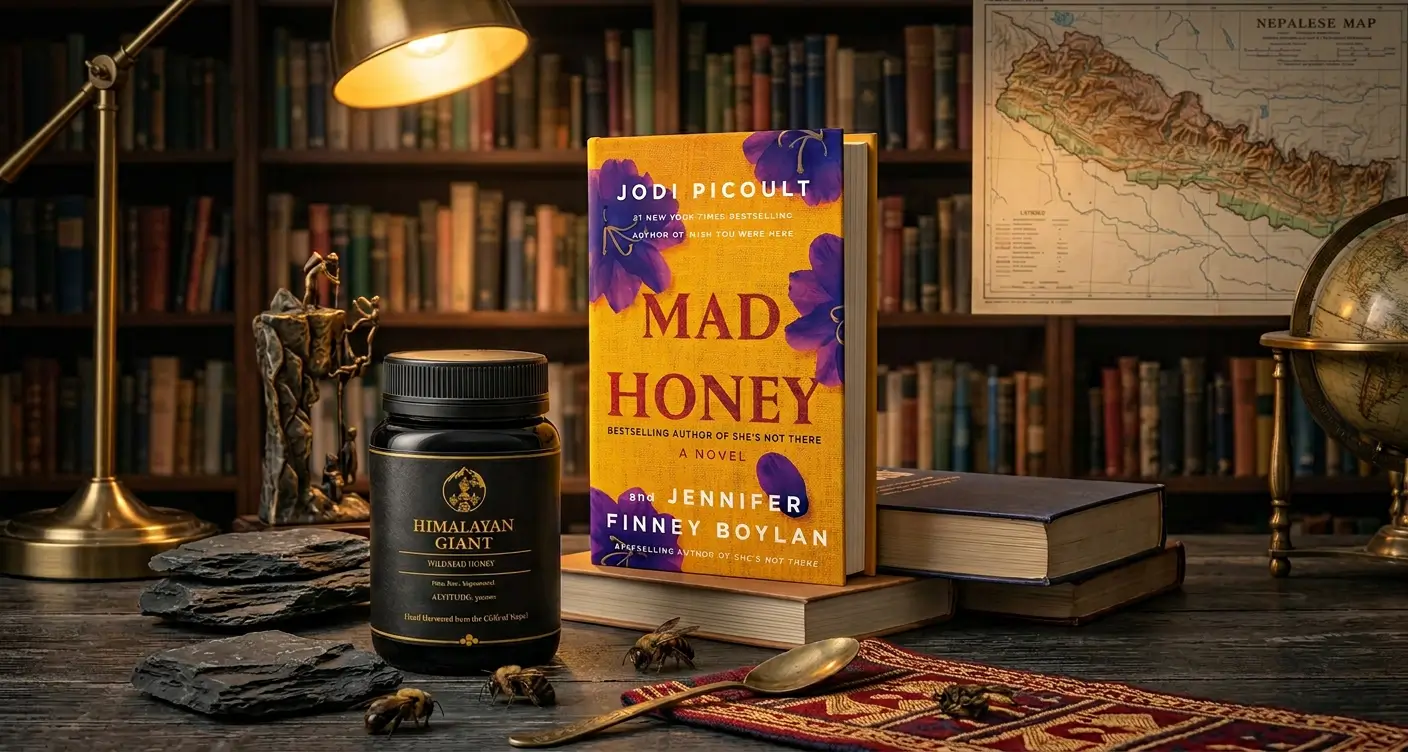
Published on October 4, 2022, by Ballantine Books, Mad Honey brought together two writers whose voices fit the story in unusually thoughtful ways. Jodi Picoult, known for novels like My Sister’s Keeper and Small Great Things, teamed up with Jennifer Finney Boylan, author of She’s Not There and a longtime voice in conversations around transgender identity. The two had been friends for years, and that history shows up on the page.

In this Jodi Picoult Mad Honey collaboration, Picoult wrote Olivia’s chapters while Boylan wrote Lily’s, creating a structure built on alternating perspectives and partial truths. That design suits the Mad Honey novel perfectly: one story, two lenses, and a steady reminder that what you think you know is rarely the whole thing.

Mad Honey Book Summary (No Major Spoilers)

Set in the small New Hampshire town of Adams, the novel follows two families whose lives become painfully entangled. Olivia McAllister has returned to her hometown with her teenage son, Asher, after leaving an abusive marriage. She keeps bees, rebuilds a life that feels more stable than happy, and tries to protect the boy she loves without losing sight of the truth about him.

Then Lily Campanello arrives—bright, thoughtful, and new to town—and she and Asher fall hard for each other.

That setup might sound straightforward, but the novel quickly turns. When Lily is found dead, Asher becomes the prime suspect, and the story opens outward into grief, memory, secrecy, and fear. Olivia’s sections move through the present, while Lily’s voice reaches back through flashback, slowly reshaping what you think happened.

This mad honey book summary only scratches the surface, because the novel’s real force lies in how it reveals information. The book takes on domestic abuse, identity, perception, and the transgender experience with unusual care. Beekeeping isn’t decorative here—it’s central to Olivia’s work, her healing, and the novel’s title metaphor: sweetness with danger close behind.

Mad Honey Book Reviews: What Readers and Critics Are Saying

A fair mad honey book review has to admit two things at once: the novel is emotionally effective, and it follows some familiar Picoult courtroom-drama patterns. Critical reception has been largely positive, with reviewers praising its treatment of domestic abuse and transgender identity with care, empathy, and narrative clarity.

Many readers single out Jennifer Finney Boylan’s chapters as especially affecting and authentic. On Goodreads, the book holds a strong rating of around 4.1 out of 5 from thousands of readers. For a broader range of reactions—from deeply enthusiastic to thoughtfully mixed—Goodreads is still the best place to browse deeper reviews.

Disclosure: HimalayanGiant sells authentic mad honey from Nepal. This article is designed to help readers understand both the novel and the real substance behind its title.

The Real Inspiration: What Exactly Is Mad Honey?

From the Pages of Fiction to the Cliffs of Nepal

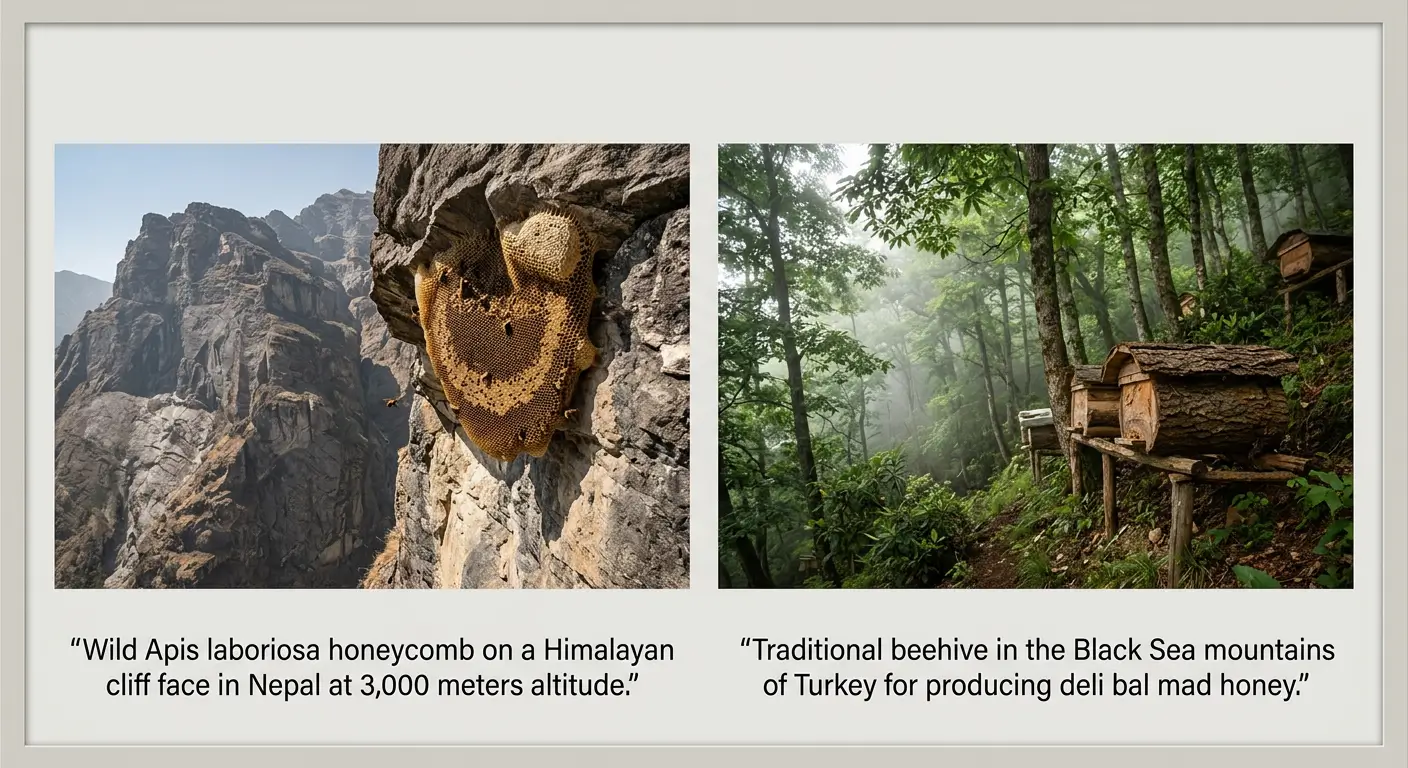
The title of Picoult’s novel may be literary, but the honey itself is real. Mad honey Nepal usually refers to rare honey gathered in highland regions like Annapurna and Langtang, where giant cliff-dwelling bees—Apis dorsata laboriosa—build hives on sheer rock faces. The honey gets its unusual character from nectar collected from grayanotoxin-containing rhododendron species growing in the Himalayas.

In Turkey’s Black Sea region, a related tradition produces what’s often called deli bal, associated with species like Rhododendron ponticum and Rhododendron luteum. In Nepal, the harvest is closely tied to Gurung communities, whose ancestral honey-hunting methods remain rooted in hand-built ladders, smoke, and deep local knowledge.

That’s the real landscape behind Himalayan mad honey—not a symbol, but a substance shaped by altitude, flowers, bees, and tradition.

The Science Behind the “Mad”—Grayanotoxins Explained Simply

So, what is mad honey in scientific terms? It’s honey that contains naturally occurring compounds called grayanotoxins, found in certain rhododendron plants. These toxins affect sodium channels in your body’s cells, making it harder for those channels to return to their resting state.

That sounds technical, but the basic idea is simple: the honey can change how your nervous system and cardiovascular system respond for a period of time.

In small amounts, some people report warmth, tingling, light-headedness, and a deeply relaxed feeling. In larger amounts, mad honey effects can become unpleasant or even risky, including nausea, vomiting, dizziness, low blood pressure, and bradycardia (slowed heart rate). This is why dosage matters.

Mad honey is not considered addictive, and it’s not a classic psychedelic. Its effects come from plant toxins, not the same pathways associated with serotonin-based hallucinogens.

Historical references to this phenomenon go back at least to Xenophon in 401 BC, when Greek soldiers near the Black Sea reportedly became incapacitated after eating toxic honey. Today, the same chemistry still explains both the intrigue and the caution around real mad honey.

Safety note: Mad honey can affect blood pressure and heart rate, especially in higher amounts. This article is for educational purposes only and should not be taken as medical advice.

What “Mad Honey” the Novel Gets Right (and Where It Takes Creative License)

The first thing the mad honey book gets right is the simplest: mad honey is real. It wasn’t invented as a dramatic metaphor, even though the novel uses it beautifully as one. Real mad honey does come from rhododendron-rich regions, and the book is also right to place beekeeping at the heart of its emotional world. Olivia’s relationship with bees feels grounded, not decorative.

More importantly, the Mad Honey novel understands the honey’s strange middle ground. In both literal and symbolic terms, it sits between comfort and danger, remedy and risk.

Where the story shifts into mad honey fiction is mostly a matter of setting and scale. The novel takes place in New Hampshire, while authentic mad honey is associated with specific regions like parts of Nepal and Turkey, where grayanotoxin-containing rhododendron nectar shapes the honey’s chemistry. New England honey traditions are real, of course, but not quite in that form.

The other creative leap is dramatic intensity. Fiction heightens cause and consequence because that’s part of the job. Real mad honey is generally approached with much more caution, and its grayanotoxin effects are usually subtler than novels make them seem. That gap between fiction and reality is exactly what makes real mad honey worth understanding.

The Real Mad Honey Experience: Stories from the Himalayas

The Gurung Honey Hunters—The Real Story Behind the Legend

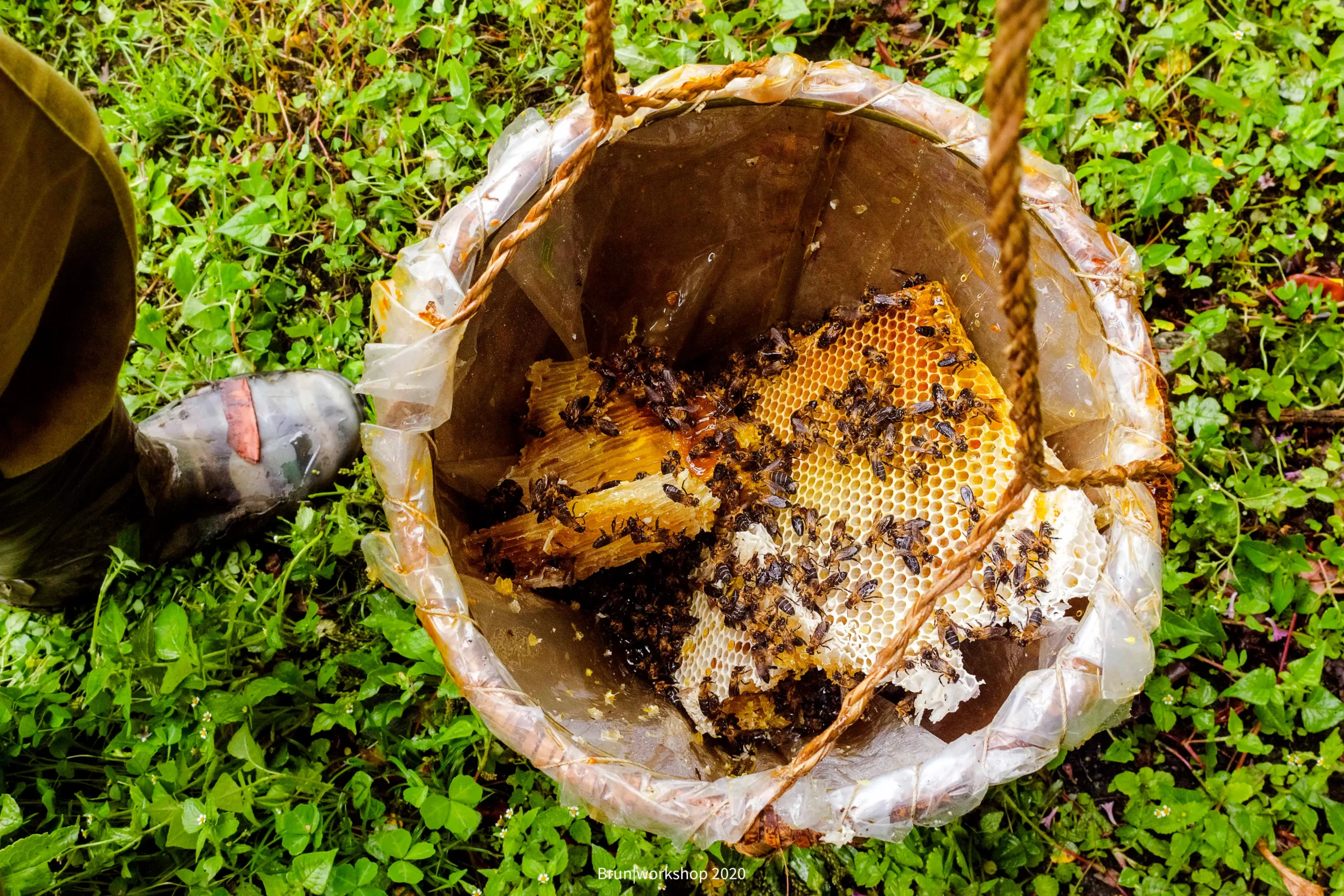
In the highlands of Nepal, honey hunting isn’t a stunt or a tourist fantasy. It’s an ancestral practice tied to land, season, skill, and community. Among Gurung communities in the Annapurna region, cliff harvesting has been preserved across generations using hand-woven ladders, smoke, and long tools often referred to as tangos to cut honeycomb from hives fixed to sheer rock faces.

The spring harvest is the one most closely associated with mad honey, when rhododendrons are in bloom and grayanotoxin levels are highest. An autumn harvest follows, usually yielding a different kind of honey.

The work is dangerous, precise, and deeply cultural. It asks for nerve, but also for local knowledge that can’t be improvised. Eric Valli’s 1987 National Geographic documentation helped introduce the Gurung honey hunters to the wider world, and his Honey Hunters of Nepal documentary is still one of the best places to begin if you want to see the tradition with the respect it deserves.

What Does Real Mad Honey Actually Feel Like?

A responsible mad honey experience is often described in quiet terms rather than dramatic ones. For some people, the first signs are warmth that begins in the chest, then a faint tingling in the lips or fingertips. A light head rush can follow—not usually intense, more like a gentle shift in balance and awareness. Some also notice a sense of physical ease or a slightly heightened sensitivity to sound, taste, or touch.

That said, mad honey effects vary from person to person. Body size, sensitivity, recent meals, and the potency of the honey itself all matter. Effects typically begin around 30 to 45 minutes after consumption and may last anywhere from 2 to 6 hours.

A small starting amount—often about 1 teaspoon—is the safest place to begin. This is not a honey you eat by the spoonful. Anyone with heart conditions, low blood pressure, or relevant medications should speak with a medical professional before trying it.

Cultural and Medicinal Heritage of Mad Honey

In Nepal, mad honey has long held a place in folk practice as well as food culture. Gurung and other hill communities have traditionally used it in small amounts in relation to digestion, blood pressure, wound care, and general wellness. Honey also appears in broader Ayurvedic traditions across the region. In some communities, it’s shared at weddings and celebrations as a symbol of health and prosperity.

These are mad honey traditional use histories, not modern medical claims. The cultural importance is real; the medical interpretation should remain careful, current, and evidence-based.

For Your Book Club: Real Mad Honey Facts That Make the Novel Even Better

One of the best mad honey book club talking points is that the honey in the title has real historical weight. In 401 BC, Xenophon wrote about Greek soldiers near the Black Sea who became disoriented and incapacitated after eating toxic honey. That means the substance behind the novel isn’t modern literary invention—it’s been part of military and medical history for centuries.

Then there’s Nepal. The mad honey discussion questions almost write themselves once you see Eric Valli’s images of cliff honey hunting for National Geographic. The Gurung harvest from near-vertical rock faces using ladders, smoke, and nerve. Showing those photographs at book club changes the scale of the story immediately.

Another rich thread is legality. Real mad honey is natural, but because potency and regulation vary, it sits in an awkward space in some markets—lawful in many places, watched more carefully in others. That mirrors one of the novel’s recurring ideas: not everything dangerous announces itself clearly.

And Olivia’s beekeeping life isn’t there by accident. Jodi Picoult researched beekeeping for the novel, which helps explain why those scenes feel lived-in rather than decorative. You can also bring in deli bal, the Turkish name for mad honey, and its long association with battlefield confusion and political intrigue.

For extra texture, end your mad honey book club questions with Eric Valli’s Honey Hunters of Nepal documentary.

Frequently Asked Questions About “Mad Honey” the Book and Real Mad Honey

Is mad honey real, or was it invented for the Jodi Picoult novel?

Yes. Is mad honey real? Absolutely—and it long predates the novel. Jodi Picoult and Jennifer Finney Boylan used a real substance as the title and metaphor for their story. Historically, real mad honey is most closely associated with parts of Nepal and Turkey, where grayanotoxin-containing rhododendron nectar gives it unusual properties.

Where does real mad honey come from?

Real mad honey comes primarily from the Himalayan region of Nepal and the Black Sea region of Turkey, with smaller amounts found in other rhododendron-rich areas. In Nepal, the tradition is closely tied to Gurung honey hunters. The giant Himalayan honey bee, Apis dorsata laboriosa, is central to that harvest.

Is “Mad Honey” the novel appropriate for young adults?

Mad Honey is generally marketed as adult fiction and is best approached that way. It deals with domestic abuse, violence, identity, grief, and other mature themes. Many older teen readers may find it meaningful, but for younger teens, parental discretion is wise. It’s not a light or casual YA read.

Is real mad honey legal to buy?

In many places, yes—real mad honey is sold as a natural food product. That said, import rules, labeling standards, and marketplace restrictions can vary by country and platform, especially across the US and Europe. Buy only from trusted sources that are transparent about origin, potency, and responsible use, including sellers like HimalayanGiant.

What should I read or watch if I loved “Mad Honey” the novel?

Start with Eric Valli’s Honey Hunters of Nepal for the real-world backdrop behind the title. Then try other Jodi Picoult novels if you liked the courtroom-and-family structure, or Jennifer Finney Boylan’s memoir She’s Not There for her voice outside fiction. For the honey side of the story, explore the HimalayanGiant blog.

Ready to Experience the Real Thing?

Part of what makes Mad Honey such a good title is that it holds two truths at once. The phrase sounds symbolic, and it is, but it also points to something tangible, ancient, and a little hard to categorize. Real mad honey carries that same tension. It’s sweet, but not simple. Natural, but not ordinary. The novel uses that duality to talk about truth, perception, and harm; the honey itself has inspired centuries of fascination for much the same reason.

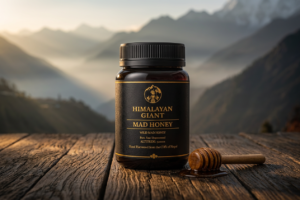
If Picoult’s novel sent you looking for the substance behind the name, you’re among the right people here. At HimalayanGiant, we’re transparent about the fact that we sell real mad honey, and our interest in it goes beyond novelty. We focus on Himalayan mad honey sourced through direct relationships in Nepal, with respect for the Gurung honey-hunting tradition behind it. It’s rare, seasonal, and unlike standard table honey in both story and character.

If you want more background before you buy mad honey, our guides on what mad honey is and its history are good places to keep reading.

If you’re ready to try the real thing, our Himalayan mad honey is here whenever you are.

Explore Our Authentic Mad Honey →

Mad Honey Effects: What Does It Actually Do to Your Body?

Mad honey effects—from a single mild mad honey effect to a full psychoactive experience—come from grayanotoxin, a natural compound in Rhododendron nectar that messes with your nervous system’s sodium channels. What does mad honey do to you specifically? When you take it responsibly, you’ll feel tingling, warmth, mild euphoria, and deep relaxation. The effects of mad honey start in 30–60 minutes, last 2–4 hours, and get stronger with higher doses—which also means more risk.

The first time I tried mad honey up in Lamjung, Nepal, the sweetness wasn’t what caught me off guard—it was this weird tingling on my tongue, followed by warmth spreading through my chest within maybe 20 minutes. It felt strange, not overwhelming, just… different from anything I’d felt before. That moment, sitting in the hills where this honey gets harvested, made it obvious: mad honey isn’t just another jar of honey—it genuinely does something to your body.

If you’re here, you’re probably asking the same thing I did before trying it: what does mad honey actually do? You want real information, not just marketing talk. This guide breaks down the complete picture of mad honey effects—how grayanotoxin works, what you’ll physically feel, the mental experience, timing, how dose changes everything, and warning signs you can’t ignore. Everything here comes from both scientific research and my direct experience sourcing from the mountains of Lamjung.

Important: This is educational information. It’s not medical advice. Talk to your doctor before trying mad honey—seriously, especially if you have heart issues (check our Safety Guide).

How Grayanotoxin Works in Your Body

The Sodium Channel Mechanism

All mad honey effects trace back to grayanotoxin, a natural toxin in certain high-altitude Rhododendron flowers. To understand what it does, you need to know how your nerve cells actually work.

Your nerves use voltage-gated sodium channels—basically tiny gates in cell membranes that open and close to send electrical signals. Normally, these gates open for a split second, then snap shut, keeping everything controlled and organized.

Grayanotoxin screws with this whole system. It latches onto these sodium channels (at what scientists call Site II) and stops them from closing properly. Your nerve and muscle cells stay “switched on” way longer than they should.

Think of a light switch that gets jammed in the “on” position—that’s basically what grayanotoxin does to your nerve cells.

This constant activation hits your autonomic nervous system hard, especially the vagus nerve that controls heart rate and blood pressure. When that nerve gets overstimulated, your heart slows down (doctors call this bradycardia), blood pressure drops (hypotension), and your whole body shifts into this deeply relaxed state. That tingling sensation everyone talks about? That’s also from these messed-up nerve signals.

This sodium channel mad honey interaction is what makes grayanotoxin so unique among naturally occurring compounds—it’s not just sedating you or stimulating you, it’s fundamentally changing how your nerves fire.

Research backs all this up. A study by Gunduz and his team back in 2006, published in the American Journal of Emergency Medicine, found consistent patterns of slowed heart rate and low blood pressure in people who’d eaten mad honey. A bigger review by Silici and others in 2015, looking at over 1,100 cases, confirmed these cardiovascular effects are dose-dependent and predictable. More recently, the European Food Safety Authority in 2023 set a reference point of 15.3 micrograms per kilogram of body weight for combined grayanotoxin I and III—basically drawing a line for safe consumption.

Why the Bees Don’t Get Affected

Despite collecting nectar loaded with grayanotoxin, Apis laboriosa—the Himalayan giant honeybee—doesn’t get affected at all. These bees evolved sodium channels that resist the toxin completely. What alters human nerve signaling doesn’t touch their biology, which is how they safely make mad honey in these extreme mountain environments. The resulting Apis laboriosa honey effects are entirely dependent on which Rhododendron species the bees visit and at what altitude they’re foraging.

The Physical Effects of Mad Honey

What You Feel First — Early Onset (30–60 Minutes)

From our experience sourcing and testing mad honey in Lamjung, the beginning is subtle but you definitely notice it. Within about 30 minutes of taking our first teaspoon, the first thing I felt was this light tingling on my tongue and lips—almost like when your foot falls asleep, but gentler and it doesn’t go away. Shortly after, warmth starts building in your chest and spreading outward.

You might feel slightly light-headed—not drunk or confused, but noticeable enough to make you stop and think “okay, something’s happening here.” Some people notice more saliva in their mouth. Under all this, your body’s already changing: heart rate’s slowing down a bit, blood pressure’s dropping. At responsible doses, these early mad honey body effects are usually mild, but they’re your body’s signal that grayanotoxin is working.

Peak Physical Effects (60–120 Minutes)

As you move into the hour to two-hour window, things get more obvious. The warmth deepens into a full-body sensation that most people describe as grounding or heavy. Your muscles, especially in your legs, feel so relaxed they almost feel weighted down—like walking takes more effort than usual.

Your heart rate is measurably slower now. Some people notice their vision gets a bit soft or slightly blurred, especially when standing up quickly or moving around. Your skin might feel warm or a little flushed. If you took a higher dose, you might start feeling nauseous, especially if your body’s struggling with the intensity.

This phase really depends on how much you took. At around ¼ teaspoon, these feelings stay gentle and totally manageable. But if you took closer to a tablespoon, they can get significantly stronger and shift from pleasant to uncomfortable pretty damn quick.

Cardiovascular Effects — What’s Actually Happening to Your Heart

The most important thing to understand about mad honey is what it does to your heart. Grayanotoxin directly affects your heart by overstimulating the vagus nerve, which slows your heart rate and drops your blood pressure. At responsible doses, this is what creates that characteristic calm, slowed-down feeling people describe.

But here’s the thing: this same mechanism is what makes higher doses dangerous. Clinical data from Turkish emergency rooms—where mad honey poisoning is well-documented because people there have been eating it for centuries—shows a clear relationship between how much you take and what happens. As dose increases, heart rate can drop to dangerously low levels, and blood pressure can fall enough to make you pass out. In more severe cases, doctors have seen conduction problems like atrioventricular block or irregular heartbeats.

This isn’t theoretical. It’s a well-documented physiological effect of grayanotoxin. Understanding the difference between controlled relaxation and cardiovascular stress is crucial if you’re thinking about trying mad honey.

The Psychoactive and Mental Effects of Mad Honey

Is Mad Honey Hallucinogenic? The Honest Answer

No—mad honey is not hallucinogenic like LSD or magic mushrooms. At normal, responsible doses, you won’t see things that aren’t there or hear voices. There are no geometric patterns, no reality distortions, nothing psychedelic in that classic sense.

What mad honey does produce is more subtle. People often describe mild euphoria, a loosening of mental tension, and thoughts that feel calm and slightly dreamlike. At moderate doses, perception might feel gently “smoothed out”—colors might seem a touch warmer, physical sensations more noticeable—but this isn’t hallucination.

As a Himalayan honey psychoactive substance, mad honey produces effects distinct from both traditional psychedelics and simple intoxicants. The rhododendron honey effects stem from grayanotoxin’s specific action on nerve cells, not from fermentation or anything else.

At higher doses, especially beyond what’s recommended, the experience changes. You might feel confused, disoriented, or mentally foggy. Here’s what matters: this isn’t a “stronger high”—it’s a sign you took too much. This distinction is important. Mad honey isn’t a psychedelic; it’s a biologically active substance with dose-dependent effects on your nervous system.

What the Mental Experience Actually Feels Like

From my experience, the mental side of mad honey is best described as quiet rather than intense. There’s a mild euphoria—a steady sense of ease that settles in without rushing you. Your thoughts slow down. That constant background noise in your head gets quieter.

A lot of people compare it to the early stages of drinking—that gentle relaxation, loosening of tension. But unlike alcohol, there’s usually no loss of control or doing stupid shit at low doses. You stay aware, present, functional.

There’s also this increased awareness of your body. Breathing feels deeper. Physical sensations become more noticeable. Time can seem to stretch slightly—not dramatically, but enough to create this more reflective, almost meditative state.

This lines up with how people culturally describe it. Joe Rogan, after trying mad honey, said: “About 20 minutes in, I’m like ‘oh, okay, this is a new one.'” That captures it well—it’s not overwhelming, but it’s definitely different.

The Full Mad Honey Experience: A Realistic Account

The complete mad honey experience unfolds in phases. In the first 30 minutes, you’ll notice subtle changes—the tingling, the first warmth. By 60 minutes, it deepens: your body feels grounded, your mind quiets down, and time seems to slow slightly. This is when the psychoactive qualities become clear, though not overwhelming.

What makes the mad honey experience unique is its dual nature: simultaneously physical and mental, relaxing yet consciousness-altering. Unlike alcohol, which dulls awareness, or caffeine, which amps it up, mad honey creates this middle ground—a calm alertness paired with bodily heaviness.

Most people describe their first mad honey experience as surprising in its subtlety. You remain functional and aware, but unmistakably altered. It’s this balance that makes it both fascinating and, when you overdo it, potentially problematic.

The Complete Timeline — Mad Honey Onset Time to Full Resolution

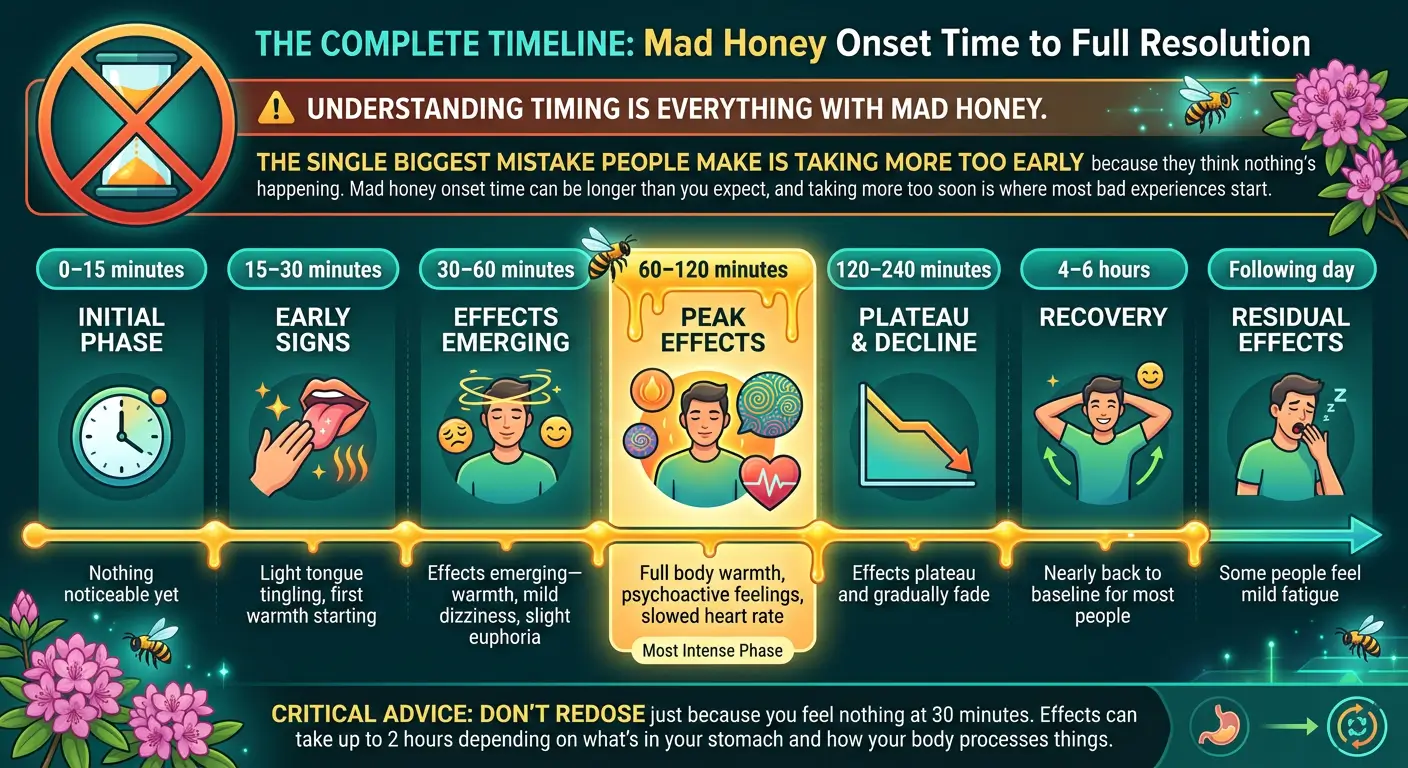
Understanding timing is everything with mad honey. The single biggest mistake people make is taking more too early because they think nothing’s happening. Mad honey onset time can be longer than you expect, and taking more too soon is where most bad experiences start.

Time After Taking It What You Experience Important Notes
0–15 minutes Nothing noticeable yet Don’t take more—this is totally normal
15–30 minutes Light tongue tingling, first warmth starting Early signals it’s beginning to work
30–60 minutes Effects emerging—warmth, mild dizziness, slight euphoria Onset phase; still building in intensity
60–120 minutes Peak effects—full body warmth, psychoactive feelings, slowed heart rate Strongest phase; how intense depends on dose
120–240 minutes Effects plateau and gradually fade Body starting to return to normal
4–6 hours Nearly back to baseline for most people Residual effects usually minimal
Following day Some people feel mild fatigue Not a hangover, but you might need rest

Don’t redose just because you feel nothing at 30 minutes. This is the most common mistake—effects can take up to 2 hours depending on what’s in your stomach and how your body processes things.

Empty stomach = faster onset and stronger effects. Full stomach = slower absorption and delayed timeline.

Dose-Dependent Effects — How Much Changes Everything

Mad honey’s effects are completely dose-dependent. The difference between a calm, controlled experience and being physically overwhelmed is measured in teaspoons—not tablespoons. This is especially true with Himalayan Giant’s Spring Harvest, which is naturally more potent because of the high-altitude Rhododendron arboreum nectar found between 2,500 and 4,000 meters.

Dose Level Amount What to Expect Who It’s For
Micro ¼ tsp (2–3g) Subtle warmth, light tongue tingling, mild relaxation without obvious heart effects First-timers and cautious explorers
Low ½ tsp (4–5g) Noticeable warmth, gentle euphoria, slight light-headedness, physical effects becoming clear After your first experience
Moderate 1 tsp (8–10g) Clear psychoactive effects, pronounced body relaxation, slowed heart rate, deeper mental quietness Experienced users only
Strong 1–2 tsp Strong physical and mental effects, heavy limbs, significant heart impact, possible nausea Experienced users with someone present
Maximum 1 tablespoon High-risk zone—severe dizziness, very low heart rate, potential toxicity Never exceed—overdose territory

Everyone responds differently to mad honey dose levels. Your body weight, whether you take it on an empty or full stomach, personal sensitivity, and whether it’s spring or autumn harvest all affect how strong the effects are.

This article is educational only—it’s not medical advice. Talk to a healthcare provider before trying mad honey, especially if you have heart issues, blood pressure concerns, or take medications.

Mad Honey Side Effects: What to Expect vs. What to Worry About

Normal Side Effects at Responsible Doses

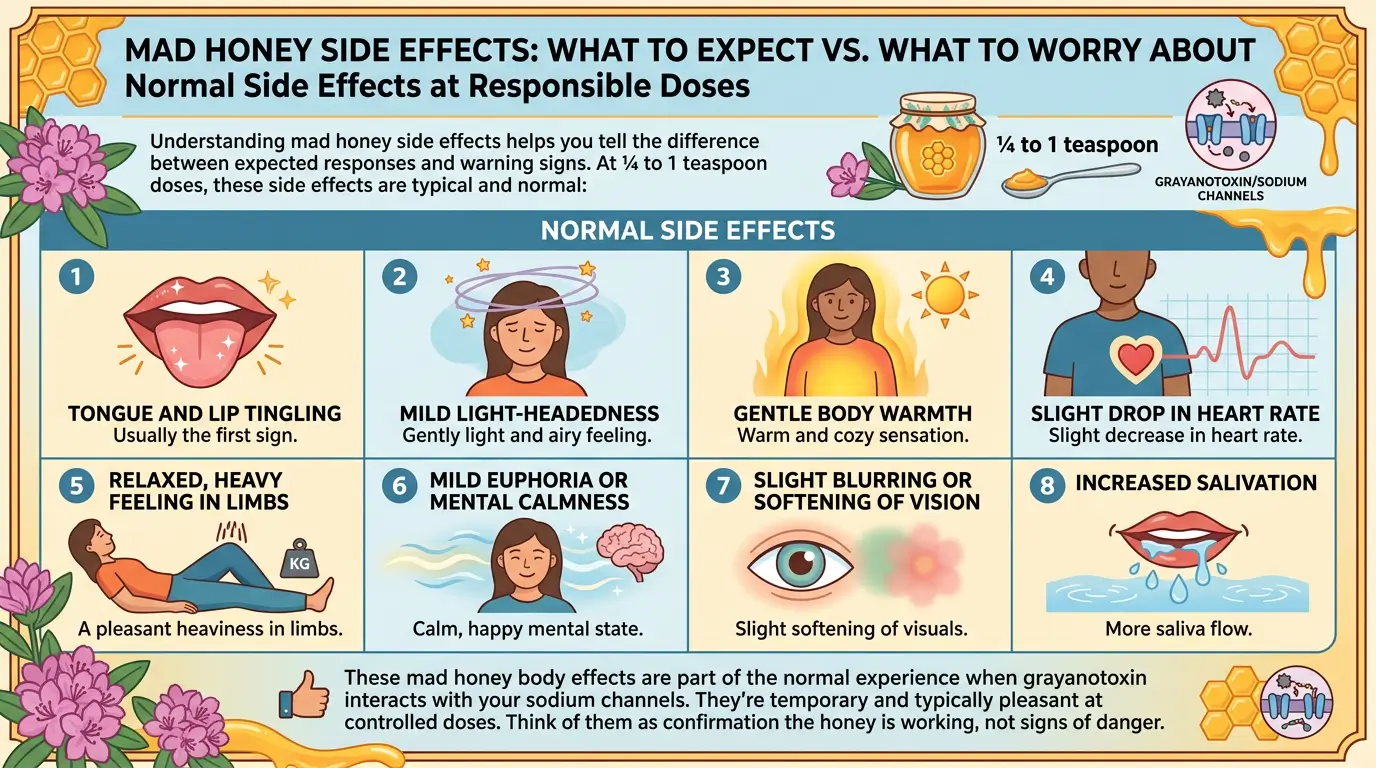
Understanding mad honey side effects helps you tell the difference between expected responses and warning signs. At ¼ to 1 teaspoon doses, these side effects are typical and normal:

Common and expected:

  • Tongue and lip tingling (usually the first sign)
  • Mild light-headedness
  • Gentle body warmth
  • Slight drop in heart rate
  • Relaxed, heavy feeling in limbs
  • Mild euphoria or mental calmness
  • Slight blurring or softening of vision
  • Increased salivation

These mad honey body effects are part of the normal experience when grayanotoxin interacts with your sodium channels. They’re temporary and typically pleasant at controlled doses. Think of them as confirmation the honey is working, not signs of danger.

mad honey side effects

Side Effects That Signal You’ve Taken Too Much

More concerning side effects indicate you’ve crossed from therapeutic to toxic territory:

  • Severe nausea or vomiting
  • Extreme dizziness or inability to stand without support
  • Very slow heart rate (below 50 beats per minute)
  • Blurred vision beyond slight softening
  • Profuse sweating
  • Chest discomfort or pressure
  • Extreme weakness
  • Difficulty coordinating movements
  • Mental confusion or disorientation

If you experience these mad honey overdose symptoms, follow the emergency protocol in the next section immediately.

The difference between normal side effects and dangerous ones is usually obvious. Normal effects are mild and even pleasant. Dangerous effects make you think “something is wrong” rather than “this feels interesting.”

Warning Signs — When Effects Become Dangerous

Signs of Overconsumption

Mad honey isn’t something to mess around with. When you take too much, effects shift from manageable to medically serious. The warning signs are clear and you should never ignore them.

Severe dizziness or being unable to stand upright is often the first red flag. This can quickly turn into pronounced nausea and repeated vomiting. As blood pressure drops further, you might feel faint or like you’re about to black out. Heart rate can get extremely slow—well below normal resting levels—which might feel like weakness or pressure in your chest.

Vision can become significantly blurred, not just softened. Coordination might break down, making even simple movements difficult. In more serious cases, symptoms escalate to chest pain, difficulty breathing, or complete loss of consciousness.

These aren’t “strong effects.” These are signs of overconsumption and need immediate attention.

What to Do If You Take Too Much

If you or someone with you experiences these symptoms, act quickly and calmly:

  1. Stop taking mad honey immediately.
  2. Lie down somewhere safe—preferably flat on your back to prevent fainting.
  3. Drink water to stay hydrated.
  4. Don’t take anything else—no alcohol, no stimulants, nothing.
  5. If symptoms are severe—especially chest pain, trouble breathing, or loss of consciousness—get emergency medical help immediately.

In hospitals, atropine is the standard treatment and works very well to reverse mad honey’s cardiovascular effects. In many moderate cases, symptoms resolve within 24 hours even without medical intervention, but you should never count on this in advance.

For immediate guidance in the United States, contact Poison Control at 1-800-222-1222.

This section exists because informed users are safe users. Himalayan Giant includes full dosage guidelines with every order for exactly this reason.

This article is educational and doesn’t constitute medical advice—consult a healthcare provider for any concerns.

Traditional and Potential Wellness Uses — What History Tells Us

Long before mad honey became known outside the Himalayas, it had a place in local traditions. In Nepal, particularly among Gurung communities in places like Lamjung, people have consumed small amounts for specific purposes. Local knowledge passed down through generations suggests it was used in measured doses for managing blood pressure, easing joint discomfort, and supporting digestion. These practices were never about taking a lot—they were rooted in restraint and familiarity with the substance.

Similar traditions exist far beyond Nepal. In Turkey, people have used mad honey for centuries as a daily wellness tonic. Historical accounts describe taking it in small spoonfuls, sometimes mixed into warm milk, as part of routine life. It’s also been traditionally associated with use as an aphrodisiac and digestive aid. These practices carried into the Ottoman era, where mad honey was valued not for its intensity, but for its subtle effects when used carefully.

Mad honey even appears in ancient texts. The Greek geographer Strabo documented its effects as early as the first century BCE, describing how soldiers encountered its properties in regions near the Black Sea. Roman accounts later echoed similar observations, showing that humans have known about its unique effects for thousands of years.

Important: These are documented traditional uses from ethnobotanical and historical sources. They’re not medical claims. Mad honey is not a medicine. Consult a healthcare provider for any health condition.

Frequently Asked Questions About Mad Honey Effects

What are the effects of mad honey?

Mad honey effects usually include tongue tingling, warmth spreading through your body, mild euphoria, light-headedness, and deep physical relaxation. These come from grayanotoxin, which affects sodium channels and slows your heart rate and blood pressure. At higher doses, you might experience nausea, blurred vision, dizziness, and more serious cardiovascular symptoms.

What does mad honey do to you?

Mad honey affects your nervous system by binding to sodium channels, causing physical relaxation, slowed heart rate, lowered blood pressure, and mild psychoactive effects including euphoria and mental calmness. Effects are dose-dependent and begin within 30-60 minutes. At responsible doses, it creates a unique combination of bodily heaviness and mental quietness.

How long does it take for mad honey to work?

Mad honey typically starts working within 30 to 60 minutes, though some people notice early tongue tingling or warmth sooner. How fast it hits depends on dose, what’s in your stomach, your metabolism, and personal sensitivity. A full stomach often delays effects, while an empty stomach can make them appear faster and feel noticeably stronger.

How long do the effects of mad honey last?

Mad honey effects usually last 2 to 4 hours, with the strongest phase happening around 60 to 120 minutes after you take it. Most people return close to normal within 4 to 6 hours. Some users report mild fatigue the next day, especially after stronger doses, but it’s not typically like an alcohol hangover.

Is mad honey a hallucinogen?

No, mad honey isn’t a hallucinogen in the psychedelic sense. It doesn’t normally cause visual or auditory hallucinations like LSD or psilocybin. Instead, it produces mild euphoria, mental quietness, body warmth, and slight perceptual softening. If confusion happens at high doses, that’s toxicity, not a psychedelic experience.

What does a mad honey high feel like?

A mad honey high usually feels calm, warm, and slightly dreamlike rather than intense or chaotic. Most people describe mild euphoria, relaxed muscles, quieter thoughts, and stronger awareness of their body. It’s sometimes compared to the early stages of drinking alcohol, but without the same loss of inhibition or obvious loss of control at low doses.

What are the side effects of mad honey?

Normal mad honey side effects at responsible doses include tongue tingling, mild light-headedness, body warmth, and gentle euphoria. More serious side effects from overconsumption include severe nausea, very slow heart rate, extreme dizziness, blurred vision, and potential loss of consciousness requiring medical attention. Understanding the difference between normal effects and dangerous side effects is critical for safe use.

Can mad honey make you sick?

Yes, mad honey can make you sick if you take too much or if you’re especially sensitive to grayanotoxin. Warning signs include severe dizziness, nausea, vomiting, blurred vision, weakness, faintness, and an unusually slow heart rate. In more serious cases, chest pain, breathing difficulty, or loss of consciousness require immediate medical attention.

Does spring harvest mad honey have stronger effects than autumn?

Yes, spring harvest mad honey is generally stronger than autumn harvest because it comes from peak Rhododendron bloom, when grayanotoxin levels are typically higher. That’s why spring honey is usually more psychoactive and more dose-sensitive. Himalayan Giant’s Spring Harvest is sourced specifically for this higher-potency profile.

Note: You can explore Himalayan Giant’s Spring Harvest here: Mad Honey Rare Spring Harvest

What factors affect how strong mad honey effects are?

Mad honey effects vary based on dose, body weight, empty versus full stomach, personal sensitivity, and the potency of the specific batch. Spring harvests are often stronger than autumn harvests, and even small increases in amount can change the experience significantly. That’s why responsible use starts with measuring carefully, not guessing.

This FAQ is educational only and doesn’t constitute medical advice. Consult a healthcare provider before consuming mad honey, especially if you have any heart, blood pressure, or medication-related concerns.

Final Thoughts

Mad honey effects are real, biologically active, and unlike anything you’ll get from regular honey. Caused by grayanotoxin acting on sodium channels, they’re entirely dose-dependent—when used responsibly in the ¼ to 1 teaspoon range, mad honey can produce one of nature’s most distinctive combinations of warmth, relaxation, and mental quietness.

If you’re ready to experience authentic Himalayan mad honey for yourself, our Spring Harvest from the cliffs of Lamjung is harvested once a year, rigorously sourced, and available now.

By the Himalayan Giant Team


Buy Mad Honey Online: The Only Guide You Need

Buying Mad Honey: Quick Reference

  • Legal in USA: Generally sold as a food product
  • Legal in Europe: Typically treated as food; country rules may vary
  • Main authentic source: Nepal, high-altitude Himalayan regions
  • What to verify: Source district, harvest season, supply chain transparency
  • What to avoid: Vague marketplace listings, no sourcing detail
  • Ships to: USA, Europe and Worlwide
  • Product: Explore spring harvest mad honey →

✓ Direct Nepal Source | ✓ Spring Harvest | ✓ Ships USA, Europe & worldwide | ✓ Satisfaction Guarantee

Why Buying Mad Honey Online Is Harder Than It Looks

The surge in interest around mad honey has made one thing clear: it is now much easier to find listings than it is to verify what is actually in the jar. If you are ready to buy mad honey, you have probably already noticed how inconsistent the market feels. One seller emphasizes rarity, another focuses on origin, and a third offers mad honey for sale with almost no sourcing detail at all. For buyers, the real challenge is not finding options. It is knowing which ones deserve trust.

That confusion is exactly why this guide exists. Himalayan Giant does sell mad honey, and it is important to say that plainly from the start. But we are also writing this as a genuine buying resource because real mad honey should be evaluated by clear standards, not by bold claims or attractive packaging. If buyers do not know what to look for, authentic products and questionable ones can appear almost identical online.

So this page is designed to help you make an informed decision before you order from anyone, including us. We will explain what authentic sourcing actually looks like, what details a legitimate seller should be able to provide, how to think about harvest season, and what practical questions matter most before you buy. By the end, you should have a much clearer sense of where to buy mad honey with confidence — and how to recognize a seller that is transparent enough to earn it.

What You Are Actually Buying: Mad Honey in Plain Terms

The Geographic Reality: Why Mad Honey Only Comes from Specific Places

If you are still asking what is mad honey before placing an order, the shortest answer is this: it is a rare type of honey produced only in a few specific mountain ecosystems where the right bees, flowers, and altitude come together. Mad honey Nepal is the best-known modern source for many buyers, especially from Himalayan regions where traditional cliff harvesting still survives. That geographic detail matters more than most product labels suggest.

So where does mad honey come from in practical terms? Authentic Himalayan mad honey is associated with high-altitude zones, often above roughly 2,500 meters, where certain rhododendron species grow in abundance and giant cliff-dwelling bees forage seasonally. In Nepal, this is closely tied to communities such as the Gurung people, who have harvested honey in mountain regions for generations. If a seller uses terms like “Himalayan” or “wild mountain honey” but cannot tell you where is mad honey from beyond the country name, that should raise questions. Real sourcing starts with a real place.

The Botanical Source: Rhododendrons and Grayanotoxin Explained Simply

The reason rhododendron mad honey differs from ordinary honey comes down to nectar. In certain high-altitude environments, bees collect nectar from specific rhododendron species that naturally contain grayanotoxins. As that nectar is gathered and concentrated into honey, trace amounts of those compounds can remain in the final product. That is the basic botanical explanation behind grayanotoxin mad honey.

Mad honey is produced when Apis laboriosa bees collect nectar from certain rhododendron species in high-altitude Himalayan regions, primarily in Nepal. In the Himalayan context, this process is often linked to Apis laboriosa, the giant Himalayan honey bee, which nests on exposed cliff faces and forages in rugged mountain terrain. What is in mad honey, then, is still honey first — but honey shaped by a very unusual ecological setting. Traditionally, this is what has given it its distinctive reputation and cultural interest. For buyers, one practical rule matters: if a seller cannot explain which flowers, region, or harvesting conditions define their product, that is your first serious red flag.

For a complete guide to mad honey, visit our full mad honey guide

The Uncomfortable Truth About the Mad Honey Market

Why Mad Honey Counterfeiting Is a Real Problem

The market for mad honey has grown much faster than the supply of genuinely harvestable product. Increased visibility through social media, travel content, and documentaries has created strong demand, but authentic supply remains limited by geography, season, and harvesting difficulty. That gap is exactly where confusion enters the market. When demand rises faster than traceable production, substitution, dilution, and vague origin claims become much more likely.

That does not mean every questionable listing is intentionally deceptive. In many cases, the problem is simpler: buyers cannot easily verify real mad honey on their own. Color, thickness, and taste can vary from batch to batch, and none of those factors alone prove authenticity. Even price is unreliable. Expensive jars are not automatically authentic mad honey, and low prices are not the only warning sign. The real issue is that most consumers are being asked to trust claims they have no practical way to confirm without clear sourcing information.

The Specific Problem with Buying Mad Honey on Amazon

The issue with mad honey Amazon listings is not that every seller on the platform is dishonest. The issue is that the marketplace structure makes meaningful verification very difficult. On large third-party marketplaces, sellers can create product listings with broad claims, minimal origin detail, and limited accountability. In food categories, that often leaves buyers relying on photos, short descriptions, and review patterns rather than a transparent sourcing chain.

That matters even more when the product is rare and poorly understood by the average customer. If you want to buy mad honey online with confidence, you need more than a generic title and a handful of star ratings. Marketplace systems are not built to explain district-level sourcing, harvest season, or direct relationships with harvesting communities. They also make it harder to know who is actually responsible for the product if something is unclear. So the question is not simply whether mad honey Amazon options exist. It is whether the platform gives you enough information to evaluate them properly.

What “Authentic” Actually Means — And What It Does Not

For buyers, authentic mad honey should mean something practical and verifiable. It should point to a specific source region, not just a country name. It should connect the honey to the right ecological conditions and, ideally, to the traditional harvesting communities or supply chain involved. It should also include basic harvest information, because season matters in this category far more than it does for ordinary commercial honey.

Just as importantly, real mad honey does not need luxury packaging, dramatic branding, or inflated pricing to be legitimate. A polished label may help presentation, but it is not proof of origin. Celebrity mentions are not proof either. If you are trying to decide on the best mad honey to buy, the strongest indicators are always the least glamorous ones: source specificity, seasonal transparency, and a seller who can explain exactly how the honey got from the mountain to the jar. These are the standards we hold ourselves to at Himalayan Giant — and the same standards you should apply to anyone you buy from, including us.

6 Things to Verify Before You Purchase Mad Honey from Anyone

Before deciding where to buy mad honey, it helps to use the same checklist for every seller, not just the one with the best-looking website. If you are trying to purchase mad honey with confidence, these are the questions that matter most. They are simple, practical, and useful whether you are comparing direct importers, niche wellness stores, or marketplace listings. If you have ever wondered, can you buy mad honey online without guessing, this is the framework that makes that possible. Finding the best mad honey to buy starts with knowing what questions separate transparent sellers from vague ones.

Source Specificity: Ask for the District, Not Just the Country

“Nepal” is a start, but it is not enough. Mad honey Nepal products should be tied to a specific district, altitude range, or harvesting community, because that is how origin becomes meaningful. Ask: What district is this honey from, and where is mad honey from within that region?

Red flag: vague phrases like “from the Himalayas” with no details.
Green flag: a named district, approximate altitude, and community-level sourcing information.

Harvest Season Disclosure: Spring vs. Autumn and Why It Matters

Harvest timing affects how Himalayan mad honey is described, priced, and understood. In mad honey Nepal sourcing, spring and autumn are not interchangeable labels; they reflect different flowering conditions and different harvest windows. Ask: Was this harvested in spring or autumn, and what months does that mean?

Red flag: no season mentioned anywhere.
Green flag: a seller clearly states the harvest window, such as May to June.

Supply Chain Transparency: How Many Steps Between Hive and Jar?

The more intermediaries involved, the harder it becomes to verify real mad honey. Authentic mad honey does not require a perfect supply chain, but it should come with a clear explanation of how it moved from harvesters to exporter to customer. Ask: Do you source directly, through a named importer, or from wholesale brokers?

Red flag: the seller cannot explain how they obtain it.
Green flag: a documented relationship with a harvesting community or direct regional supplier.

Company Accountability: Can You Actually Reach a Human?

A serious specialty seller should be reachable, responsive, and able to answer basic sourcing questions. If you want to buy mad honey from a trustworthy company, customer support matters more than polished branding. Ask: If I have a question before or after ordering, how do I contact you and when should I expect a response?

Red flag: only a generic form and no clear contact details.
Green flag: direct email, contact page, and a visible response commitment.

Return and Satisfaction Policy: What Happens If You Are Unhappy?

Before you purchase mad honey, read the policy page. Rare products can still be sold responsibly, and any company offering mad honey for sale should explain what happens if an order arrives damaged, delayed, or not as described. Ask: What is your satisfaction or replacement policy if there is a problem with my order?

Red flag: “all sales final” with no context.
Green flag: a clear, specific policy written in plain language.

Community and Ethical Sourcing: The Question Most Buyers Forget

Mad honey Nepal sourcing is not only about geography. It is also about people. The Gurung honey hunters and other traditional harvesting communities carry knowledge that makes this product possible, so buyers should ask how sellers talk about that relationship. Ask: How do you work with or support the harvesting community behind this honey?

Red flag: no mention of harvester relationships at all.
Green flag: specific, respectful sourcing details and evidence of long-term community-minded purchasing.

If a seller can answer all six clearly, you are already much closer to identifying the best mad honey to buy — and far less likely to rely on guesswork alone.

Want a seller that can answer all six? Explore our spring harvest mad honey →

Spring Harvest vs. Autumn Harvest: Does the Season Actually Matter?

Why Rhododendron Bloom Season Changes Everything

In the Himalayas, season is not a minor detail. It is one of the main reasons one batch of honey differs from another. Spring, typically from March to May, is the peak bloom period for the high-altitude rhododendron species most closely associated with rhododendron mad honey. During this window, nectar flow is at its fullest, and the mountain ecosystem is at its most active. This is why many harvesting communities in mad honey Nepal regions traditionally regard spring as the most important season.

Autumn harvests, usually from August to October, come from a different ecological moment. Flowers may still be available, but bloom volume is lower and nectar conditions are not the same as they are during the main mad honey flower season. In himalaya mad honey sourcing, this matters because the surrounding forage environment shapes the character of the honey itself. That is why experienced harvesters and buyers pay close attention to season, not just origin.

What This Means Practically for What You Buy

For buyers, the most important point is simple: both spring and autumn honey can be authentic, but they are not identical categories. Spring harvest usually commands higher pricing because it is more limited, more traditionally prized, and tied to the most active rhododendron bloom period. That does not mean every buyer will experience the same mad honey effects from every spring batch, and it should never be treated as a guaranteed shortcut to a stronger mad honey high. Season is a sourcing distinction, not a promise.

If you are trying to identify the best mad honey to buy, check whether the seller clearly discloses the harvest window. If you want to purchase mad honey and the listing says nothing about season, ask directly. A serious seller should be able to explain whether the jar comes from spring or autumn and why that matters. When mad honey for sale is presented without that basic context, buyers are missing one of the most useful quality signals available. Himalayan Giant specializes in spring harvest honey from Nepal, and you can explore those details in the product section below.

Is It Legal to Buy Mad Honey in the USA and Europe?

Legal Status in the United States: The Clear Answer

Yes, mad honey is legal to buy in the USA. It is generally treated as a food product and is not classified as a controlled substance under federal law. Honey itself is not a controlled substance, and grayanotoxin is not listed as a controlled substance under U.S. federal drug schedules. In practical terms, that means the answer to both is mad honey legal in us and is mad honey legal in the us is generally yes.

Mad honey is treated as honey, not as a drug, which is why the key compliance issue is food import documentation rather than narcotics law. Buyers in the U.S. can purchase it online, and importers can ship it with the proper customs and food paperwork. So if your question is can you buy mad honey legally in the United States, the answer is generally yes. That said, regulations, customs practices, and food import guidance can change, which is why buyers should still verify current rules if they have any specific legal or compliance concerns.

Legal Status in Europe: Country-by-Country Overview

Across most of Europe, mad honey is generally treated as a food product rather than a controlled substance, which means the legal position is broadly similar to the United States. In the UK, it is also generally understood as a honey product for sale and import purposes. So if you are asking is mad honey legal in Europe, the broad answer is usually yes — but with an important caveat.

European food regulation can be more nuanced at the country level, especially when unusual imported foods are involved. One issue worth mentioning honestly is the EU Novel Foods Regulation (EU) 2015/2283. In some contexts, unusual honey products may raise novel food questions depending on how they are marketed, described, or introduced into the market. That does not automatically make mad honey illegal, but it does mean compliance should be handled carefully. For European customers, proper documentation matters, especially where mad honey for sale Europe searches reflect cross-border ordering concerns.

Importing Mad Honey: What Customs Actually Involves

From a customs perspective, mad honey is generally handled as a food import, not as a controlled substance import. That means the process usually centers on shipment declarations, product identification, and standard supporting documents for imported honey. If you purchase mad honey from an international seller, the main issue is whether the exporter handles food shipping documentation properly.

When you buy mad honey online, you should expect routine customs processing similar to other specialty food imports. Himalayan Giant provides shipment documentation to support that process. For readers who want more detail, we recommend reviewing our [full legal guide] as well.

This information reflects our understanding of current regulations as of 2025. Food import regulations can change. We recommend verifying current rules with your country’s food safety authority before purchasing if you have specific concerns.

What to Know About Safe Consumption Before You Buy

⚠️ IMPORTANT SAFETY NOTICE
Mad honey contains grayanotoxin, a naturally occurring compound that affects the body at sufficient doses. The information below is general educational guidance based on traditional use and available research. It is not medical advice. Consult a qualified healthcare provider before using mad honey, particularly if you have any medical conditions or take any medications.

How Mad Honey Works: The Basics Every Buyer Should Understand

If you are wondering what does mad honey do, the answer starts with what is in mad honey. Mad honey contains grayanotoxin, a natural compound found in nectar from certain rhododendron species. In grayanotoxin mad honey, that compound can affect sodium channels in cell membranes, which in turn can influence neuromuscular and cardiac function at sufficient doses.

The key point is dose dependence: small amounts may produce mild effects, while larger amounts can cause much more serious reactions. Those effects are temporary and generally resolve as the body metabolizes the compound, but that does not make careless use safe. Traditional Gurung use involved very small amounts and informed familiarity built over generations. Understanding the mechanism helps people approach mad honey more responsibly, whether they are curious about the traditional mad honey high some users describe or simply want to understand the product before purchase.

Starting Dose Guidance: The Most Important Thing to Know

The single most important principle with mad honey dose guidance is to start with the smallest possible amount. Traditional use and common buyer guidance often suggest beginning with about 1/2 teaspoon, and at most 1 teaspoon, for a healthy adult trying it for the first time. Even then, that is not a prescription. It is only a cautious general reference point. Wait at least two hours before considering any additional amount, because mad honey dosage responses can take time and vary widely between individuals.

Do not use it on an empty stomach the first time. Do not combine it with alcohol. Do not combine it with blood pressure medication, heart medication, or anything that may affect heart rate or circulation. This is general guidance only. Individual responses vary significantly.

Who Should Not Use Mad Honey

A balanced answer to is mad honey dangerous is this: it can be, especially for the wrong person or at the wrong dose. Avoid mad honey if you:

  • have any cardiovascular condition
  • have low or high blood pressure
  • take medication for blood pressure or heart rhythm
  • have a heart rhythm disorder
  • are pregnant or breastfeeding
  • are under 18
  • have known bee product allergies
  • have diabetes or blood sugar disorders
  • take any medication that affects heart rate or circulation
  • have not spoken with a doctor about your specific situation

Some people search can mad honey kill you. At excessive doses, grayanotoxin can cause serious cardiovascular effects and should be treated with respect. If you are unsure whether mad honey is appropriate for you, please speak with your doctor before purchasing. Many reported mad honey side effects occur when people underestimate dose or ignore contraindications.

What to Do If You Experience Adverse Effects

Mild mad honey side effects such as dizziness, nausea, or lightheadedness can occur and may pass as the compound is metabolized. If symptoms are severe, worsening, or feel unusual, seek medical attention immediately. Tell medical personnel exactly what was consumed: grayanotoxin-containing mad honey from Nepal. In the USA call 911; in much of Europe call 112. When in doubt, seek medical attention. Do not wait and hope symptoms resolve on their own.

For more detail, read our full effects and safety guide →

Our Source: The Gurung Honey Hunters of Nepal’s Annapurna Region

The Gurung Community: Who Actually Makes This Honey

Behind genuine mad honey Nepal sourcing are the harvesting communities whose knowledge makes this product possible. The Gurung people are an Indigenous ethnic community of Nepal’s mountain regions, especially in and around Gandaki Province, and their honey-hunting tradition is widely recognized as one of the most distinctive in the Himalayas. Harvesting is not simply a matter of collecting honey. It requires cliff navigation, rope work, smoke control, an understanding of seasonal bee behavior, and the use of traditional tools in difficult terrain.

That knowledge has been passed down across generations, and for many families it carries cultural meaning beyond income alone. Honey hunting is tied to identity, local knowledge, and continuity with older mountain lifeways. At the same time, this tradition exists under pressure from migration, economic change, and the physical risks of the harvest itself. That is why direct, respectful purchasing relationships matter. When people talk about himalayan mad honey, the real story begins with the communities who still know how to harvest it.

Lamjung District: Why This Specific Location Matters

When buyers ask where does mad honey come from, “Nepal” is only part of the answer. Our honey comes from Lamjung District, a mountainous region often described as a gateway to the Annapurna area. Lamjung matters because its varied elevation, steep terrain, and rhododendron-rich forest zones create the right ecological conditions for the kind of honey most people mean when they talk about mad honey from Nepal.

In higher-altitude bands, especially in rugged cliff environments, Apis laboriosa — the giant Himalayan honey bee — builds exposed colonies on rock faces and forages across mountain flowering zones. Those landscapes are influenced by the broader ecology of the Annapurna region and nearby conservation areas, where elevation and seasonal bloom patterns shape what nectar is available. This is what we know about our source region, and it is why place matters so much. Authentic origin is not just a country label. It is a specific ecological setting with a specific harvesting tradition behind it.

How Our Direct Sourcing Works

Himalayan Giant sources mad honey from Lamjung District, Nepal, through direct relationships with Gurung honey hunting communities in the Annapurna region. For us, direct sourcing means working through a traceable relationship tied to the harvesting region rather than buying anonymous wholesale stock with minimal background. That does not mean a perfectly simple chain. Honey still has to move from harvesters in Nepal through packaging, export logistics, and international shipping before it reaches the customer. But that process is still meaningfully more accountable than buying from a reseller who cannot explain where the jar came from.

Our goal is to offer authentic mad honey with as much source clarity as we can genuinely provide. Each shipment is supported with the practical documentation required for export and international delivery, and we try to be transparent about what we know, what we can verify, and what we cannot overstate. Direct sourcing has real logistical challenges, but it remains one of the strongest answers to the question of where to buy mad honey if traceability matters to you. In a market full of vague claims, that is one of the clearest ways to identify real mad honey.

Himalayan-giant-where-your-honey-was-born-map

What We Sell: Rare Spring Harvest Mad Honey from Nepal

Product Description: What Is in the Jar

Our product is raw, unprocessed spring harvest mad honey Nepal sourced from Lamjung District through Gurung harvesting communities in the Annapurna region. “Raw and unprocessed” means it is not heat-treated to standardize texture and not heavily filtered into a uniform commercial finish. We keep it as close as possible to its natural harvested state while preparing it for safe packaging and shipment.

In the jar, the honey is typically darker than conventional supermarket honey, with color and consistency that can vary slightly by batch and season. That variation is normal in traditionally harvested honey and should be expected in real mad honey. The flavor is also different from ordinary table honey: floral, earthy, and complex, with the distinctive bitter undertone buyers often associate with this category.

Each order includes the product information needed to understand origin and harvest context. Available sizes include 200g, 400g and 600g jars. If you are ready to buy mad honey, you can review the full listing here:
View product details and purchase →

Pricing Context: Why Authentic Mad Honey Costs What It Costs

If you compare listings online, you will quickly notice that mad honey for sale is often priced well above ordinary honey. That is not just branding. Genuine spring harvest mad honey carries real sourcing costs: difficult cliff harvesting in remote mountain terrain, limited seasonal availability, small yields from wild colonies, export logistics from Nepal, and the documentation needed for international delivery. When sellers work more directly with source communities, fair payment is also part of the cost structure.

Spring harvest availability is limited to one main collection window per year, which is why inventory can be seasonal rather than year-round. In that sense, the category is closer to other premium specialty imports — such as high-grade saffron, rare single-origin coffee, or artisan truffle products — than to mass-market honey. If you plan to purchase mad honey, very low prices should be treated cautiously, because they often signal weak traceability or questionable authenticity. At the same time, a very high mad honey price does not automatically prove quality. In general, fair market pricing for authentic imported mad honey tends to sit in the premium specialty-food range rather than the standard honey aisle.

Buy Himalayan mad Honey

Shipping Mad Honey to the USA and Europe: What to Expect

Ordering from abroad should feel straightforward, especially when you are ready to buy mad honey online and want clear expectations before checkout. We offer free worldwide shipping, and we package every order with international delivery in mind. For the most current shipping details, policies, and updates, please see our full Shipping & Delivery page.

Region Estimated Delivery Time Tracking Shipping Cost
USA 7-14 business days Yes Free
Europe 10-18 business days Yes Free

USA Shipping: Timelines, Packaging, and What to Expect

For U.S. orders, we currently ship to all 50 states. If you are ready to buy mad honey, your order is packed for long-distance transit using protective materials appropriate for packaging, with a discreet outer box and product documentation included. Jars are shipped in secure packaging designed to help preserve quality during transport. Tracking is provided with every order, and delivery usually takes 7-14 business days depending on destination and carrier processing.

From a customs perspective, mad honey for sale USA orders are generally handled as food imports rather than restricted goods. That means standard customs processing may still apply, but there are no special narcotics-style import procedures involved. Occasional delays can happen during customs review, and that is normal for international food shipments.

European Shipping: Countries We Serve and Import Process

For Europe, we ship to all EU member states and the UK, and provide the documentation needed for international food delivery. If you plan to purchase mad honey Europe orders, estimated transit time is typically 10-18 business days, although local customs review can occasionally extend delivery slightly. Tracking is provided, and packaging is the same secure format used for U.S. orders.

Because mad honey for sale in Europe is generally treated as a food product, the key issue is proper declaration and shipment documentation rather than controlled-substance compliance. We handle that process as part of fulfillment. If you are comparing sellers and deciding where to buy mad honey, shipping clarity matters — and we believe that should include honest expectations about timing, customs, and packaging from the start.

What Customers Say About Buying from Himalayan Giant

The experiences customers share with us reflect what we care about most: whether the honey was authentic, whether it arrived as described, and whether people felt they purchased from a company they can trust. Real mad honey reviews help future buyers understand what to expect, and honest feedback — positive or critical — helps us continue to improve.

Frequently Asked Questions About Buying Mad Honey

Is mad honey legal to buy in the USA?

Yes, mad honey is generally legal to buy in the USA as a food product. Based on current understanding, it is not scheduled as a controlled substance, and honey is not regulated as a drug in the usual sense. Regulations can change, so if you have specific compliance concerns, check current guidance.

Where can I actually buy mad honey online?

You can buy mad honey online from legitimate specialty sellers who provide clear origin, harvest season, and supply chain details. The important question is not whether it exists, but whether the seller provides transparency about sourcing. If you are comparing where to buy mad honey, look for district-level origin information, harvest season disclosure, and direct community relationships. You can also explore our spring harvest product page for a direct-source option.

How do I know if mad honey is authentic without lab testing?

Without lab testing, verifying real mad honey with complete certainty is difficult. The best indicators are source transparency, district-level origin, harvest season disclosure, and a clear explanation of how the honey moved from harvesters to seller. Authentic sellers should answer those questions directly. Testing offers stronger confirmation, but in its absence, traceable sourcing is your best practical filter.

Is mad honey on Amazon worth buying?

Mad honey Amazon listings are not automatically bad, but they are harder to verify. Large marketplaces often provide limited sourcing detail, and that makes it difficult to judge authenticity, harvest season, or accountability. If you do buy there, ask the seller for source region, harvest timing, and supply chain information before ordering. Platform convenience is not the same as product transparency.

Does mad honey show up on a drug test?

No, standard drug tests do not typically test for grayanotoxin, so mad honey does not usually show up on a drug test. Grayanotoxin is not a controlled substance, and standard employment panels are designed to screen for other substances. That said, no one can guarantee the scope of every specialized test in every context, so this should not be treated as a legal assurance.

How much should I expect to pay for genuine mad honey?

A genuine mad honey price usually falls into the premium specialty-food range, not the ordinary honey range. Authentic sourcing involves seasonal scarcity, difficult harvesting, international shipping, and documentation costs. Very low prices are a red flag, but very high prices do not automatically mean better quality. Look for fair pricing backed by traceable source information.

Is mad honey safe?

Mad honey can be used carefully by healthy adults in small amounts, but it is genuinely risky in excess or for people with certain medical conditions. Dose matters, and responses vary significantly. People with heart conditions, blood pressure issues, medication interactions, pregnancy, diabetes, or bee product allergies should avoid it unless cleared by a healthcare provider. [Read our full safety guide] before use.

What is the difference between mad honey and regular honey?

The main difference is that mad honey can contain grayanotoxin from certain rhododendron nectar sources. It is also associated with specific high-altitude regions and with bees such as Apis laboriosa, rather than standard commercial honey production. Traditional knowledge links it with distinctive effects, but those are not guaranteed outcomes. In every other sense, it is still honey shaped by unusual ecology.

Ready to Purchase Authentic Mad Honey from Nepal?

If you have made it this far, you already know more than most people who search for mad honey online. You know what authentic sourcing looks like, which questions a serious seller should be able to answer, how harvest season affects quality, and what legal and safety considerations matter before ordering. That matters, because the decision to buy mad honey should be based on traceability and transparency, not guesswork or hype.

We have tried to hold ourselves to the same standards described throughout this guide. Himalayan Giant sources from Lamjung District in Nepal, works to be clear about harvest context and shipping, and aims to present real mad honey honestly rather than dramatically. We are transparent about what we know, careful not to promise what we cannot guarantee, and committed to standing behind every order. If that is what you want from a supplier when you purchase mad honey, we would be honored to be your source.

Have Questions First? Contact Us

Why buyers choose Himalayan Giant:

  • ✓ Direct Nepal source
  • ✓ Spring harvest
  • ✓ Satisfaction guarantee
  • ✓ Ships USA and Europe

If you are ready to move from research to decision, our mad honey for sale is presented with the same clarity and care this guide was written to provide.For questions about sourcing, shipping, or product details, visit our Contact Page or email info@himalayangiant.com

By the Himalayan Giant Team

What Is Mad Honey? Complete Guide to Intoxicating Himalayan Honey

Mad honey (also called “deli bal”) is a rare, naturally occurring honey produced by bees that forage on specific species of rhododendron flowers containing grayanotoxin, a naturally occurring neurotoxin. Found primarily in Nepal’s Himalayas and Turkey’s Black Sea region, mad honey is known for producing mild psychoactive and relaxing effects when consumed in small, controlled amounts.

A Honey That Can Make the World Spin

The first time we tasted mad honey straight from the comb, we were standing on a narrow ledge at 2,800 meters in the Annapurna foothills — rope ladders swinging behind us, the Modi Khola valley falling away into mist hundreds of meters below. A Gurung honey hunter named Dhan Bahadur sliced a chunk of fresh comb from the cliff face and held it out on the flat of his blade. The honey was darker than any we’d seen before — a deep amber with reddish undertones, almost syrupy in its thickness, catching the thin Himalayan light like liquid bronze.

The sweetness hit first, rich and floral. Then came something else entirely: a faint tingling across the tongue, a subtle warmth radiating down through the chest, and a strange, pleasant heaviness settling behind the eyes. This was no ordinary honey. This was intoxicating honey — the same substance that has captivated humanity for over 2,500 years.

Most people have never heard of mad honey. Yet Greek armies were brought to their knees by it. Roman legions were ambushed with it. Kings and healers across Asia coveted it for centuries. Today, harvested from remote cliff faces across Nepal’s Himalayas, it remains one of the rarest and most misunderstood natural substances on Earth — and scientists are still working to fully understand it.

This guide answers every question: what mad honey is, how it works, whether it’s safe, where it’s legal, and why it endures. Written by the people who harvest it.

What Is Mad Honey?

Mad honey is a rare type of wild honey produced when bees collect nectar from specific species of Rhododendron flowers that contain naturally occurring compounds called grayanotoxins. In the Nepal Himalayas, the bee responsible is Apis laboriosa — the Himalayan giant honey bee and the largest honey bee species on Earth, measuring up to 3cm in length. In Turkey’s Black Sea region, the common European honey bee (Apis mellifera) produces a similar product from different rhododendron species.

The name “mad” refers to the intoxicating, mildly disorienting effects the honey can produce when eaten. In Turkey, it’s called deli bal — deli meaning crazy or mad, bal meaning honey. Gurung honey hunting communities in Nepal have their own traditional name for it in the Gurung language. Over centuries, Western writers have labeled it “bitter honey,” “poisonous honey,” and even “hallucinogenic honey,” though each of these terms overstates or misrepresents what the substance actually does.

So what is in mad honey that makes it different from every other honey on the planet? The answer is grayanotoxin — specifically grayanotoxin I and grayanotoxin III. These are neurotoxic diterpenoid compounds that, in small doses, interact with sodium ion channels in the body to produce mild psychoactive effects: a spreading warmth through the chest, a gentle tingling on the lips and tongue, lightheadedness, physical relaxation, and mild euphoria. In excessive amounts, however, these same compounds can cause dizziness, nausea, and a temporary drop in blood pressure.

“Mad honey is not manufactured or artificially altered — it is created entirely by nature, through a remarkable chain of events involving specific flowers, specific bees, specific altitudes, and specific seasons.”

The rhododendron species responsible vary by region. In Turkey, Rhododendron ponticum and Rhododendron luteum are the primary sources. In Nepal, the key species is Rhododendron arboreum — the country’s national flower — which blooms in vivid red clusters across slopes between 2,500 and 4,000 meters. Across dozens of harvests, we’ve consistently noticed that Himalayan mad honey carries a distinctly deeper, reddish-amber color compared to the lighter Turkish variety. That richness comes directly from the high-altitude rhododendron nectar and the intense UV exposure at those elevations — something no amount of reading can teach you, but that becomes obvious the moment you hold both side by side.

Mad honey accounts for far less than 0.1% of global honey production. It cannot be factory-farmed or industrially scaled. It requires a precise alignment of blooming season, altitude, geography, and the survival of wild cliff-dwelling colonies. That convergence of conditions makes authentic rhododendron honey one of the rarest natural foods on Earth.
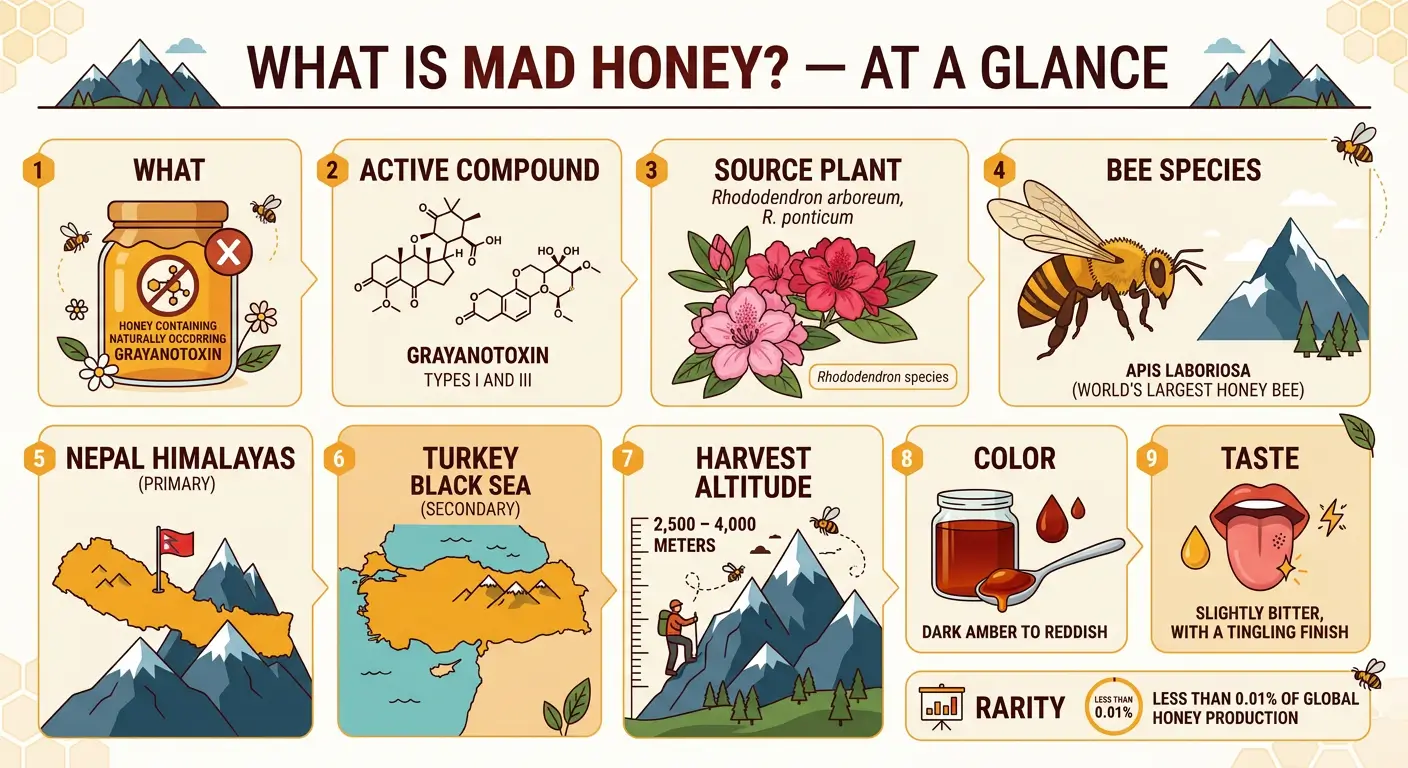
What Is Mad Honey Infographic

The Science Behind Mad Honey: How Grayanotoxin Works

Understanding what makes mad honey psychoactive means understanding a single molecule — and the remarkable biological chain that delivers it from a mountain flower to your nervous system.

What Is Grayanotoxin?

Grayanotoxins are a group of closely related cyclic diterpenoid compounds — polyhydroxylated molecules found in the leaves, flowers, pollen, and nectar of plants in the Ericaceae family. The Rhododendron genus is the most significant source, though related plants like Pieris and Kalmia also produce them.

Scientists have identified over 25 distinct grayanotoxin variants to date. Two matter most for mad honey: Grayanotoxin I — historically called andromedotoxin or acetylandromedol in older literature — and Grayanotoxin III. These are the compounds primarily responsible for the physiological effects people experience when consuming mad honey. Jansen et al. (2012), in their comprehensive review published in Cardiovascular Toxicology, identified the specific receptor-binding mechanisms of these two variants and confirmed their role as the principal bioactive agents in grayanotoxin poisoning cases.¹

From Flower to Honey: The Chain of Events

The journey of grayanotoxin into honey follows a specific biological pathway — and every step matters.

It begins during the rhododendron bloom. In Nepal, the critical window falls between March and May, when species like Rhododendron arboreum erupt across high-altitude slopes in massive waves of red and pink. Nectar glands within these flowers secrete a sugar-rich liquid that contains dissolved grayanotoxin molecules. Apis laboriosa foragers collect this nectar and carry it back to their cliff-face hives.

Here is where the chemistry becomes remarkable: unlike many plant-derived toxins, grayanotoxin is not broken down or neutralized during the bees’ enzymatic honey-making process. The compound passes through regurgitation, enzymatic addition, and evaporation completely intact — remaining fully bioactive in the finished comb.

The final concentration of grayanotoxin in any given batch depends on several converging variables: which rhododendron species the bees foraged on, the altitude of those flowers, whether the harvest is spring or autumn, how much non-rhododendron nectar diluted the batch, and even the specific weather conditions during bloom. This is why mad honey potency is never perfectly uniform — it is a wild product shaped by wild conditions.

The Mechanism: What Grayanotoxin Does to Your Nerve Cells

Once consumed, grayanotoxin binds to voltage-gated sodium channels — specifically at what pharmacologists call site 2 — on the membranes of nerve and muscle cells.²

Think of sodium channels as tiny gates in your nerve cells. Under normal conditions, these gates open briefly to transmit an electrical signal, then snap shut within milliseconds. Grayanotoxin essentially props these gates open, locking them in an activated state and preventing normal inactivation. This creates persistent, low-level depolarization across affected cells.

In small doses, your body registers this sustained signaling as a spreading warmth through the chest, a gentle tingling on the lips and extremities, mild euphoria, muscular relaxation, and a slight decrease in blood pressure and heart rate. In excessive amounts, however, the same mechanism can produce significant hypotension, bradycardia, dizziness, nausea, and in rare extreme cases, temporary loss of consciousness.² ³ A thorough understanding of these potential side effects is essential before trying mad honey.

Why Potency Varies: What We’ve Observed Firsthand

As harvesters and suppliers, we’ve consistently observed that spring harvest mad honey collected above 3,000 meters in Nepal is noticeably more potent than autumn harvest or lower-altitude batches. The science explains exactly why: the specific Rhododendron species blooming at those elevations during spring produce nectar with higher grayanotoxin concentrations, and the bees have fewer alternative nectar sources at those altitudes, resulting in far less dilution. This is precisely why we source exclusively from high-altitude spring harvests.
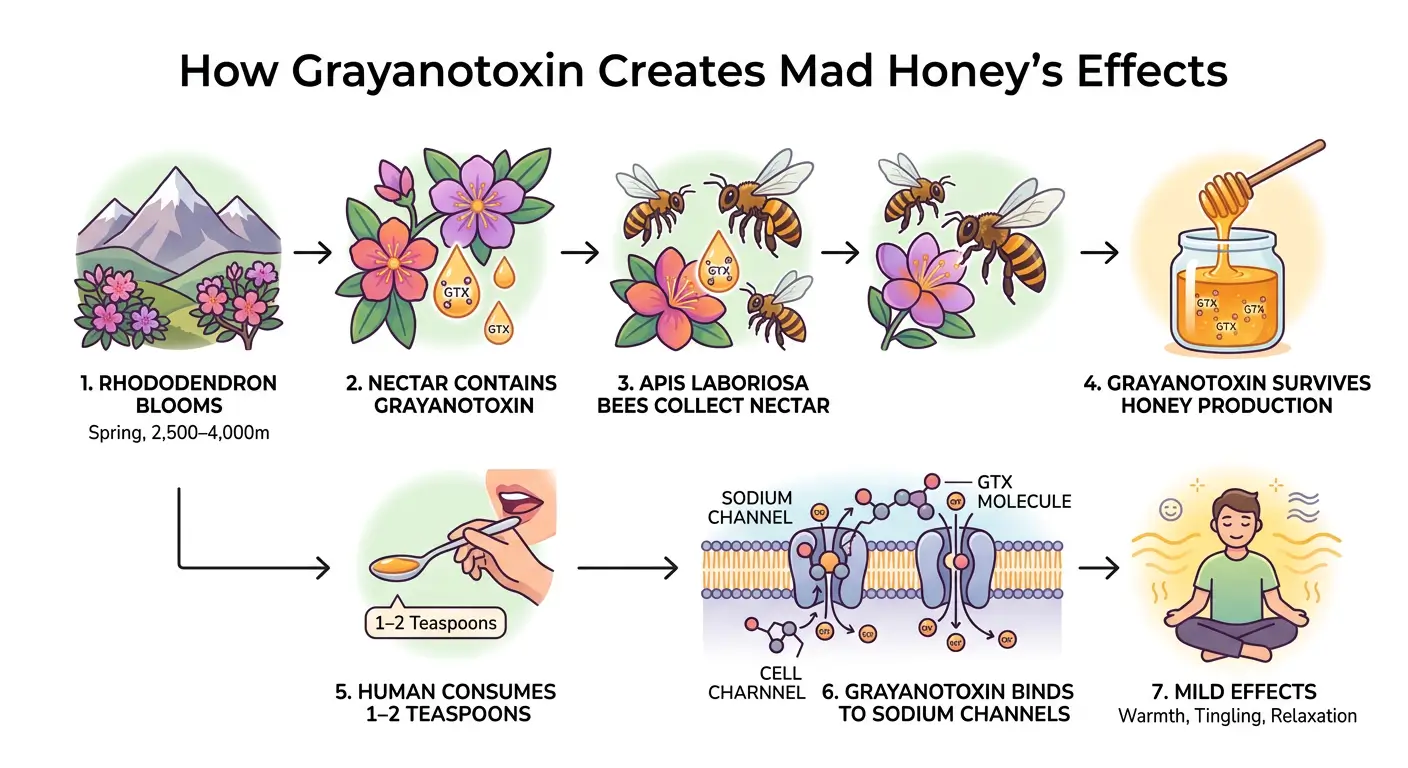
How Grayanotoxin Creates Mad Honey's Effects

References for this section:

¹ Jansen, S.A., et al. (2012). “Grayanotoxin poisoning: ‘Mad honey disease’ and beyond.” Cardiovascular Toxicology, 12(3), 208-215.

² Gunduz, A., Turedi, S., Russell, R.M., & Ayaz, F.A. (2008). “Clinical review of grayanotoxin/mad honey poisoning past and present.” Clinical Toxicology, 46(5), 437-442.

³ Gunduz, A., et al. (2006). “Does mad honey poisoning require hospital admission?” American Journal of Emergency Medicine, 24(5), 595-598.

Where Does Mad Honey Come From?

Mad honey is not produced in factories, apiaries, or labs. It comes from two remote mountain regions on opposite ends of Asia — and the differences between them matter significantly.

Nepal — The Himalayas (The World’s Premium Source)

When people ask where does mad honey come from, the answer that matters most is Nepal’s central Himalayas — the single most prized source of potent, high-altitude mad honey on Earth.

The bee responsible is Apis laboriosa, the Himalayan giant honey bee. Workers measure up to 3cm in length — roughly twice the size of a European honey bee — and they build massive, crescent-shaped combs on sheer cliff faces at elevations between 2,500 and 4,000 meters. A single colony can produce a comb stretching over 1.5 meters across, hanging exposed against vertical rock, hundreds of meters above the valley floor.

This extreme altitude is precisely what makes Himalayan mad honey so potent. At 3,000 meters and above, the rhododendron forests that blanket Nepal’s middle hills are often the only significant nectar source available during the spring bloom — which runs from roughly March through May. With fewer alternative flowers to dilute their forage, the bees produce honey with substantially higher grayanotoxin concentrations than their lower-altitude counterparts.

The harvest itself is conducted by the Gurung people — an indigenous ethnic group of central Nepal who have practiced cliff honey harvesting for generations using handmade rope ladders, long bamboo poles called tangos, and smoke from smoldering green vegetation to calm the massive colonies. The work is genuinely dangerous, strictly seasonal, and yields are modest — a single cliff expedition typically produces only 20 to 40 kilograms of usable honey.

We work directly with Gurung honey hunting families in the Annapurna and Lamjung regions of central Nepal. Every jar we sell can be traced back to a specific cliff, a specific harvest date, and a specific community. This isn’t a marketing claim — it’s our supply chain.

Turkey — The Black Sea Region (The Historic Source)

The eastern Black Sea coast of Turkey — particularly the Kaçkar Mountains — is the historically best-known source of mad honey, where deli bal has been produced, sold, and consumed for centuries. Most of the ancient accounts you’ll encounter in history books, from Xenophon to Pliny the Elder, describe mad honey from this region.

Turkish mad honey is produced by European honey bees (Apis mellifera caucasica) foraging on Rhododendron ponticum and Rhododendron luteum, which grow densely across the humid, forested slopes between roughly 800 and 2,000 meters. Unlike the wild cliff colonies of Nepal, Turkish production is semi-managed — beekeepers position hives near rhododendron-dense areas and harvest using conventional methods.

The result is a honey that is generally considered less potent than Himalayan varieties — a function of lower altitude, different rhododendron chemistry, and greater dilution from diverse floral sources. It’s worth noting that in Gunduz et al.’s 2008 clinical review published in Clinical Toxicology, the majority of documented mad honey poisoning cases occurred in Turkey’s Black Sea region — largely because locals there consume honey in much larger daily quantities as a breakfast staple, not because Turkish honey is stronger.

Other Regions

Trace amounts of grayanotoxin-containing honey have been identified in parts of the Caucasus (particularly Georgia), certain regions of Japan, rare pockets of southern Brazil, and even the Pacific Northwest of the United States and Canada — wherever wild rhododendron species grow in sufficient density. However, none of these regions produce mad honey in commercially meaningful quantities. For all practical purposes, Nepal and Turkey remain the world’s only two reliable sources.

While Turkish deli bal carries deep historical roots and genuine cultural significance, mad honey from Nepal is widely regarded by both researchers and connoisseurs as the most potent and sought-after variety in the world — and it’s what we at Himalayan Giant specialize in.

Factor Nepal (Himalayan) Turkey (Black Sea)
Bee Species Apis laboriosa (Himalayan giant honey bee) Apis mellifera caucasica (European honey bee)
Altitude 2,500–4,000m 800–2,000m
Primary Rhododendron R. arboreum + high-altitude species R. ponticum, R. luteum
Typical Potency Higher (especially spring harvest) Moderate
Harvest Method Wild cliff harvesting (traditional) Semi-managed beekeeping
Rarity Very rare Less rare
Price Range Premium Moderate

Wild Apis laboriosa honeycomb on a Himalayan cliff face in Nepal at 3,000 meters altitude and Traditional beehive in the Black Sea mountains of Turkey for producing deli bal mad honey.

[IMAGE: Side-by-side photographs — Himalayan cliff hive and Turkish forest apiary. Alt text image 1: “Wild Apis laboriosa honeycomb on a Himalayan cliff face in Nepal at 3,000 meters altitude.” Alt text image 2: “Traditional beehive in the Black Sea mountains of Turkey for producing deli bal mad honey.”]

The Rhododendron Connection: The Flower That Makes Honey “Mad”

Mad honey begins not with bees, but with a flower.

Rhododendrons belong to the Ericaceae family — the heath family, which also includes blueberries, cranberries, and common garden azaleas. The genus name itself comes from the Greek rhodon (rose) and dendron (tree). Over 1,000 rhododendron species have been identified worldwide, and they thrive everywhere from suburban British gardens to temperate Pacific Northwest forests. But only a small subset — fewer than a few dozen — produce nectar containing meaningful concentrations of grayanotoxin. Fewer still grow in the right conditions to make potent mad honey.

In Nepal, the most critical species is Rhododendron arboreum — the country’s national flower. It produces brilliant crimson to deep pink blooms and grows across middle-hill slopes between 1,500 and 3,500 meters. Several additional high-altitude species contribute above 3,000 meters, some found nowhere else on Earth. In Turkey, the primary sources are Rhododendron ponticum, with its purple-mauve flowers carpeting the Black Sea hillsides, and Rhododendron luteum, a yellow-flowered azalea whose nectar is especially rich in grayanotoxins.

During spring harvests in the Annapurna foothills, we’ve stood on ridgelines above 2,500 meters and looked out at entire mountainsides blazing crimson and pink with R. arboreum in full bloom. The air smells sweet and faintly resinous. The hum of Apis laboriosa is constant — thousands of the world’s largest honey bees working the flowers in every direction. This narrow, intense blooming window — typically late March through mid-May — is when the most potent mad honey of the year is produced.

Altitude is the hidden variable that explains potency. Higher elevation means harsher conditions — more UV exposure, colder nights, thinner soil. Under this stress, rhododendron plants produce more grayanotoxin as a chemical defense against herbivorous insects and grazing animals. It’s the same principle that makes high-altitude tea and coffee more complex — biological stress produces richer chemistry. At 3,000 meters, rhododendron nectar is simply more concentrated with defensive compounds than at 1,000 meters.

This also explains why mad honey doesn’t appear in places where rhododendrons grow abundantly at lower elevations — the UK, the American Pacific Northwest, much of Japan. The bees there have access to dozens of alternative nectar sources, and the lower-altitude rhododendrons produce less grayanotoxin to begin with. The result is extreme dilution. In Nepal’s high Himalayas, during peak spring bloom, rhododendrons are often the only game in town — and the honey reflects it.

Rhododendron arboreum in full spring bloom on a Himalayan hillside in Nepal — the primary flower source for mad honey

Mad Honey vs. Regular Honey: What’s the Difference?

On the surface, mad honey looks like honey. It even tastes like honey — at first. But beyond that initial impression, almost everything is different.

Regular honey — the kind you squeeze from a bear-shaped bottle onto your morning toast — is one of the most common food products on Earth. Global production exceeds 1.9 million tonnes annually. It’s produced by domesticated Apis mellifera colonies fed on whatever diverse flora surrounds the hive, and it contains exactly what you’d expect: fructose, glucose, trace minerals, antioxidants, and natural enzymes. There is nothing psychoactive about it. It is sweet, safe, and unremarkable.

Mad honey shares that basic nutritional foundation — then departs from it entirely.

The defining difference is a single molecule: grayanotoxin. No other commercially available honey on the planet contains this compound in meaningful concentrations. It enters the honey because the source nectar comes from a specific group of plants — high-altitude Rhododendron species — rather than the diverse buffet of wildflowers that regular honey bees visit. And in Nepal, the bee doing the foraging isn’t a managed European honey bee. It’s Apis laboriosa, a wild, undomesticated cliff-dwelling giant that cannot be kept in conventional hives.

These differences cascade into everything you experience when you actually consume it.

The taste is the first clue. Where regular honey is straightforwardly sweet, mad honey is layered — an initial sweetness that gives way to a subtle bitterness, followed by a distinctive tingling sensation that spreads across the tongue and the back of the throat. We describe it as honey with a secret: there’s something happening beneath the sweetness that you can feel.

The color is different, too. While regular honey ranges from pale gold to light amber, mad honey runs darker — a deep, reddish-amber, sometimes catching the light with an almost coppery sheen. The texture tends to be denser and more viscous, with a thick, slow-flowing quality that clings to the spoon.

Then there are the effects. Regular honey produces none whatsoever beyond caloric energy. Mad honey, consumed on its own, produces noticeable physical sensations within 15 to 45 minutes — a spreading warmth through the chest, gentle relaxation in the muscles, a pleasant tingling in the extremities, and a mild sense of euphoria. These effects are dose-dependent, which is why proper dosage matters: beginners should start with half a teaspoon to one teaspoon, never exceeding two teaspoons in a single session.

Finally, there is the matter of rarity and price. Regular honey is produced on an industrial scale across six continents. Mad honey — authentic, potent, high-altitude Himalayan mad honey — is produced in quantities measured in mere tonnes globally, harvested by hand from cliff faces once or twice a year. Authentic mad honey costs roughly 20 to 50 times more per gram than quality regular honey. That price isn’t artificial markup. It reflects genuine scarcity, extreme difficulty of harvest, and a product that simply cannot be replicated or scaled.

People often ask us: “Is it really that different?” We tell them: try a teaspoon and wait 30 minutes. You’ll never confuse the two again.

Characteristic Regular Honey Mad Honey
Active Compound None (psychoactive) Grayanotoxin (I and III)
Source Flower Various wildflowers Rhododendron species
Bee Species Apis mellifera (domesticated) Apis laboriosa (wild, Nepal)
Taste Uniformly sweet Sweet → bitter → tingling
Color Pale gold to amber Deep amber to reddish-brown
Texture Smooth, flows easily Denser, more viscous
Effects None Warmth, tingling, relaxation, mild euphoria
Dosage Unlimited ½–2 teaspoons (beginners)
Price (per 100g) $1–5 $100–150+
Rarity ~1.9 million tonnes/year globally Extremely rare — mere tonnes globally

A Brief History of Mad Honey: From Ancient Warfare to Modern Curiosity

Mad honey has been dropping humans to their knees for at least 2,500 documented years. Its history reads less like a food story and more like a thriller.

401 BC — The Soldiers Who Were Defeated by Honey

In 401 BC, a Greek mercenary army known as the Ten Thousand was retreating through the mountainous coastal region of Pontus — modern-day northeastern Turkey — after a failed campaign deep in Persia. Exhausted, starving, and far from home, the soldiers discovered wild honeycombs in abundance along their route. They ate freely.

What happened next was recorded by their commander, Xenophon, in his military chronicle Anabasis (Book IV, Chapter 8). Within hours, the soldiers began vomiting. They lost control of their limbs. They collapsed in rows on the ground, unable to stand or speak coherently. Xenophon wrote that they lay scattered across the hillside “as if after a defeat in battle” — except no enemy had touched them. The enemy was the honey.

None of the soldiers died. But they were completely incapacitated for one to two days. Hardened warriors — men who had marched fighting across an empire — brought low by a few handfuls of golden comb. This remains the first written record of mad honey’s effects in human history.

67 BC — Honey as a Weapon of War

Over three centuries later, a far more deliberate — and deadly — use of mad honey was documented. Roman general Pompey the Great was pursuing King Mithridates VI of Pontus through the Black Sea mountains. Mithridates, a ruler legendary for his knowledge of poisons, devised a cunning trap.

His forces placed honeycombs of toxic deli bal along the route they knew the Romans would march. Three full squadrons of Roman soldiers found the combs and consumed them. Within hours, they were writhing on the ground — disoriented, nauseated, unable to lift their weapons. Mithridates’ troops attacked. The Romans were slaughtered.

It was one of history’s earliest documented uses of a biological weapon. And the weapon was honey. The account survives through Strabo’s Geographica and later references by Pliny the Elder in his Natural History.

The Ottoman Era — Commerce and Custom

By the Ottoman period, mad honey had moved from battlefield to marketplace. Deli bal became a recognized trade commodity in Black Sea coastal markets, sold in small quantities as a traditional folk remedy and, in some communities where alcohol was restricted, consumed as a mild, socially accepted intoxicant. It was never mass-produced — but it was known, valued, and traded.

Nepal — An Ancient Tradition, Still Alive

Half a world away from Turkey, a parallel mad honey tradition has existed for centuries among the Gurung people of central Nepal — and unlike the Ottoman markets, it never stopped. Gurung honey hunting is an unbroken cultural practice with spiritual, medicinal, and economic dimensions that continues today in largely the same form it has been practiced for generations. The Western world knew almost nothing about it until documentaries and media coverage began emerging in the late 20th century.

The Gurung families we work with speak of honey hunting as something their grandfathers’ grandfathers did. It is not a novelty to them. It is heritage.

Modern Rediscovery

Mad honey entered global consciousness through a wave of modern media — National Geographic features, PBS documentaries, viral YouTube and TikTok videos, mainstream podcasts including Joe Rogan’s show, and even Jodi Picoult’s 2022 novel Mad Honey. Overnight, a substance that had been quietly harvested from Himalayan cliffs for centuries became one of the most talked-about rare natural products in the world, with surging demand from the United States and Europe.

For the complete, detailed history of mad honey — from Xenophon’s warriors to modern-day Himalayan cliff expeditions — read our full article: The Fascinating History of Mad Honey Through the Ages.
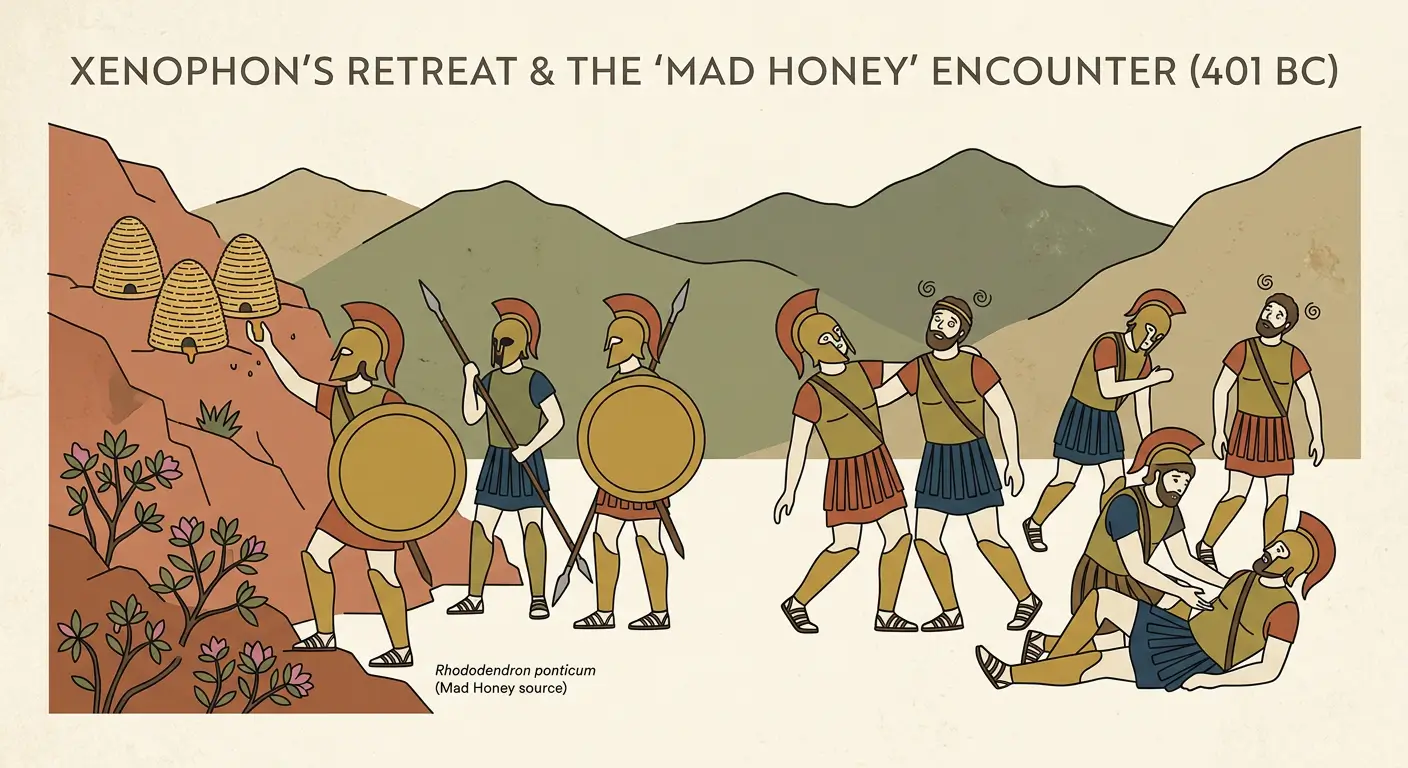
Historical illustration of Xenophon's Greek soldiers encountering mad honey in 401 BC during their retreat through modern-day Turkey

What Does Mad Honey Do? Effects, Onset, and Duration

The single most common question we hear — from first-time customers, from journalists, from curious friends — is simple: what does mad honey actually feel like?

Having consumed it ourselves across years of harvests, and having heard from thousands of customers across the US and Europe, we can describe the experience with confidence. But we also want to be clear: everyone’s body is different, and the effects of mad honey are not identical for every person.

What You’ll Likely Feel (At Recommended Doses: ½ to 2 Teaspoons)

The onset typically begins 15 to 45 minutes after consumption. The timing depends on your metabolism, body weight, and whether you’ve eaten recently — an empty stomach produces faster, more noticeable effects.

The first thing most people notice is a gentle tingling in the throat and chest, followed by a mild warmth that gradually radiates outward through the body. It’s not heat, exactly — more like a spreading glow, similar to the feeling after stepping into a warm bath on a cold day.

Over the next hour, this warmth deepens into a noticeable sense of physical relaxation. Tension in the shoulders, jaw, and back tends to soften. Many users report mild lightheadedness — not dizziness or disorientation, but a gentle sense of buoyancy. At the peak, roughly one to two hours after consumption, some people experience mild euphoria, heightened sensory awareness, a calm and centered feeling, and occasionally increased sociability or quiet introspection.

The total duration of mad honey’s effects runs approximately two to six hours, tapering gradually. There is no “crash,” no hangover, no groggy aftermath the following morning.

Many of our customers describe the experience as somewhere between a glass of good red wine and a strong cup of chamomile tea — relaxing, pleasant, and gently warming, but you remain fully aware and in control. That comparison resonates with what we’ve felt ourselves.

Everyone’s experience is slightly different. Body weight, individual sensitivity, food in the stomach, and the specific potency of the batch all play a role.

What Happens If You Take Too Much

Transparency matters here. Mad honey contains a neurotoxin, and exceeding recommended amounts has real consequences.

Higher doses — more than two tablespoons — can produce noticeable dizziness, nausea, excessive sweating, and a significant drop in blood pressure and heart rate. Very high doses, which we strongly advise against, can cause severe bradycardia, significant hypotension, blurred vision, vomiting, and in extreme cases, temporary loss of consciousness.

These side effects are temporary. In Gunduz et al.’s 2006 study published in the American Journal of Emergency Medicine, the vast majority of hospital-presenting patients recovered fully within hours with basic supportive care.⁵ Documented cases almost always involve people consuming large, unmeasured quantities — not careful, controlled doses.

This is exactly why dosage matters — and why we include clear guidelines with every order and created our comprehensive Mad Honey Dosage Guide. Start with half a teaspoon. Wait a full hour before considering more. Adjust gradually over multiple sessions. Responsible enjoyment is our philosophy at Himalayan Giant.

The effects of mad honey vary based on body weight, individual sensitivity, honey potency, and other factors. This information is educational and should not be taken as medical advice. Consult a healthcare professional if you have any health concerns or take medications that affect blood pressure or heart rate. For a full overview, read our guide: Is Mad Honey Safe?

[IMAGE: Timeline infographic showing onset, peak, and duration of mad honey effects. Alt text: “Mad honey effects timeline showing onset at 15-45 minutes, peak effects at 1-2 hours, and total duration of 2-6 hours”]

⁵ Gunduz, A., et al. (2006). “Does mad honey poisoning require hospital admission?” American Journal of Emergency Medicine, 24(5), 595-598.

Is Mad Honey Safe?

Yes — mad honey is safe when consumed responsibly, in appropriate doses, by healthy adults who are aware of what they’re consuming.

Mad honey has been consumed intentionally for over 2,500 years across two continents. The documented cases of serious adverse effects in peer-reviewed medical literature almost universally involve one of two scenarios: accidental consumption of large quantities by people who had no idea the honey contained grayanotoxin, or deliberate overconsumption far exceeding any reasonable amount. In Gunduz et al.’s 2008 clinical review in Clinical Toxicology, the researchers noted that the vast majority of cases resolved fully without any lasting effects.⁶

The principle is one that applies to many substances humans consume regularly. Caffeine is safe in a morning cup of coffee — dangerous in large amounts. Alcohol is enjoyed in moderation by billions of people worldwide; it is toxic in excess. Even nutmeg, a spice sitting in most kitchen cabinets, is genuinely neurotoxic at high doses. Context and dosage define the line between enjoyment and harm. This is equally true for mad honey.

That said, certain people should not consume mad honey under any circumstances:

  • People with heart conditions, especially bradycardia or arrhythmia
  • People with chronically low blood pressure (hypotension)
  • Pregnant or nursing women
  • Children under 18
  • People taking cardiovascular medications (beta-blockers, calcium channel blockers, antihypertensives)
  • Anyone with known sensitivity to grayanotoxin
  • People currently under the influence of alcohol or sedatives

At Himalayan Giant, we source exclusively from experienced Gurung honey hunting families we’ve worked with for years in Nepal’s Annapurna and Lamjung regions. We know the cliffs, the harvest dates, and the communities behind every jar. We provide clear dosage guidelines with every order because we believe informed consumers are safe consumers — and that transparency about both the rewards and the risks of this product is non-negotiable.

If someone experiences severe dizziness, fainting, irregular heartbeat, persistent vomiting, or prolonged side effects lasting beyond several hours after consuming mad honey, seek medical attention immediately. Tell the treating physician about the grayanotoxin exposure — this specific information helps them provide the correct supportive care quickly.

For our comprehensive safety guide, including weight-based dosage recommendations and experience-level guidelines, read: Is Mad Honey Safe? The Complete Safety Guide.
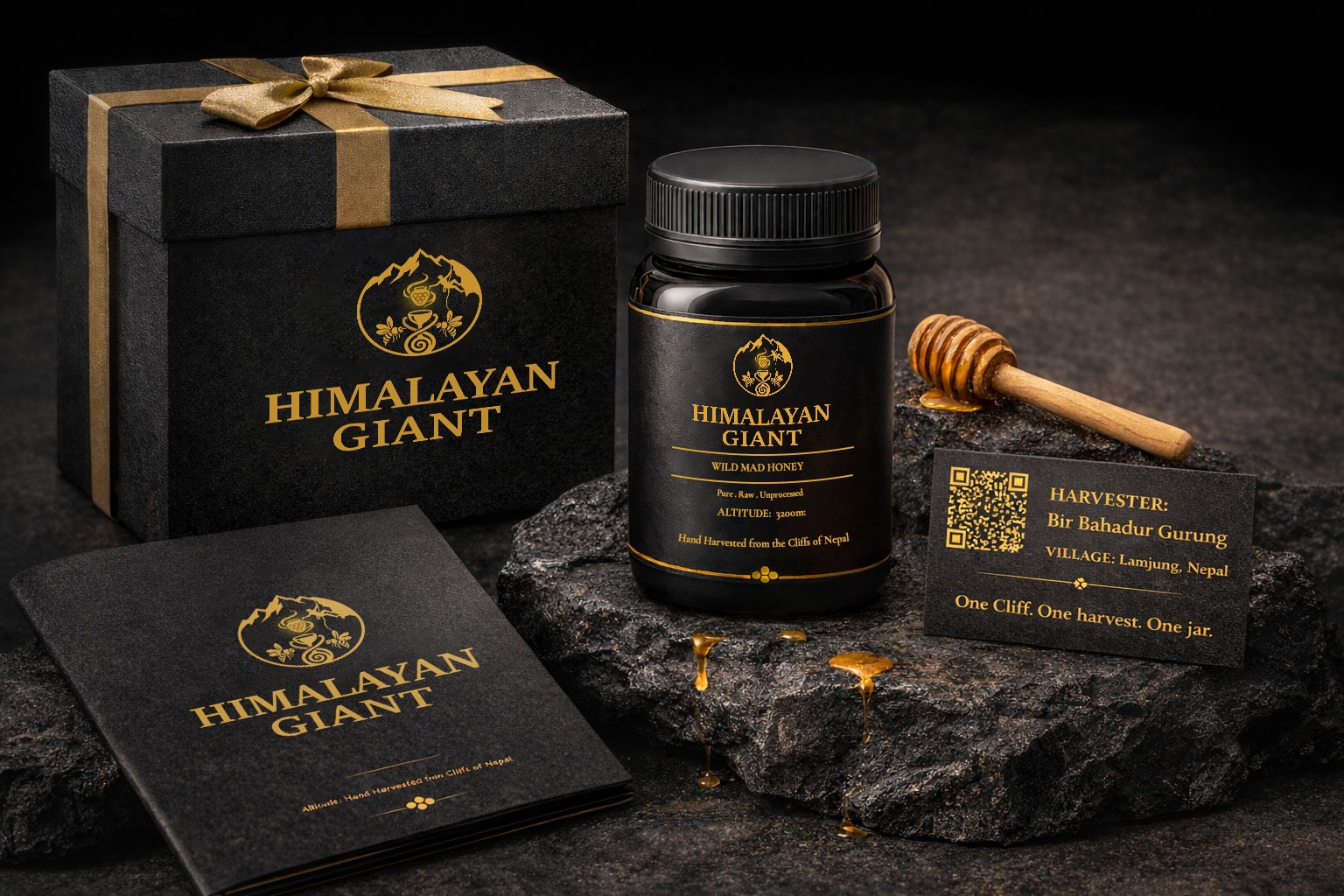
Himalayan Giant mad honey jar — rare spring harvest from Nepal

⁶ Gunduz, A., Turedi, S., Russell, R.M., & Ayaz, F.A. (2008). “Clinical review of grayanotoxin/mad honey poisoning past and present.” Clinical Toxicology, 46(5), 437-442.

Is Mad Honey Legal?

Mad honey is legal to buy, sell, possess, and consume in both the United States and throughout Europe.

United States

Mad honey is not classified as a controlled substance under any federal or state law in the US. The FDA does not regulate mad honey differently from other varieties of honey — it is treated as a food product. It can be legally imported, sold, and purchased without a prescription, a license, or any special permits. While there is no legal age restriction, we at Himalayan Giant recommend mad honey exclusively for adults aged 18 and older.

Europe

Mad honey is legal throughout the European Union and the United Kingdom. It is sold openly and without restriction in Turkey, where it has been a recognized market product for centuries. It can be purchased online and shipped to the UK, Germany, the Netherlands, France, Scandinavia, and other EU member states without legal issues. Standard food safety and labeling regulations apply to sellers — which Himalayan Giant fully complies with for all European shipments.

The Key Distinction

Mad honey is not a drug, a controlled substance, or a regulated psychoactive product under any existing national or international framework. It is a naturally occurring food — a type of honey — that happens to contain a compound with mild psychoactive properties. No country currently classifies it as a controlled substance.

At Himalayan Giant, we ensure all shipments to the US and Europe comply with applicable food import regulations, customs requirements, and labeling standards.

How to Try Mad Honey for the First Time: A Beginner’s Guide

Trying mad honey for the first time should feel like an occasion — not an experiment. Here’s exactly how we recommend approaching it, based on years of personal experience and feedback from thousands of first-time customers.

Step 1: Source Authentic Honey

This matters more than anything else. Only buy from trusted sources that provide traceable products with clear origin information — specific harvest regions, specific seasons, and transparent dosage guidance. The mad honey market has its share of diluted and outright fake products. That’s exactly why we built Himalayan Giant the way we did — every jar traces directly to our Gurung harvesting partners in Nepal’s Annapurna and Lamjung regions.

Step 2: Start Small

Begin with half a teaspoon — approximately 3 to 5 grams. This is a conservative starting dose suitable for virtually all healthy adults. The golden rule of mad honey is simple: you can always take more next time. You can’t take less.

Step 3: Choose the Right Setting

Pick a relaxed evening at home. No driving planned, no important tasks ahead, no obligations. Treat it with the same mindfulness you’d give a glass of good wine — create the space to actually notice and enjoy how it feels.

Step 4: How to Take It

The best way to experience mad honey is straight off a spoon. Let it rest on your tongue for a moment and notice the flavor progression — the sweetness first, then the subtle bitterness, then the tingling. Alternatively, stir it into warm (not boiling — heat above 40°C/104°F can degrade grayanotoxin) tea, or drizzle it over toast or yogurt.

Step 5: Wait Patiently

Effects take 15 to 45 minutes to begin. This is the single most important step: do not take more because you “don’t feel anything yet.” The onset is gradual and gentle. Be patient. It will come.

Step 6: Notice and Enjoy

Pay attention to the warmth spreading through your chest. Notice the softening of tension in your shoulders, your jaw. Many people describe a deep, quiet sense of calm and well-being — some tell us it’s the most naturally relaxed they’ve felt in months.

Step 7: Know Your Response

After your first experience, you’ll understand your personal sensitivity level. Next time, you can adjust your dose upward if desired — to a maximum of two teaspoons per session. Everyone’s body responds slightly differently, and your first session is about learning yours.

Pro tip from our team: We always recommend first-timers try mad honey about an hour before bedtime. The relaxation pairs beautifully with winding down for sleep — and there’s no grogginess or hangover in the morning.

Ready to try it yourself? Our Rare Spring Harvest Mad Honey ships with clear dosage guidelines and everything you need for a confident first experience.

How to Spot Real Mad Honey (And Avoid Fakes)

As mad honey has gained global popularity — fueled by social media, documentaries, and podcast mentions — the market has been flooded with counterfeit products. Regular honey dyed with food coloring. Honey mixed with unknown herbal extracts. Cheap, mass-produced honey repackaged in artisanal-looking jars and sold at a ten-times markup. We’ve seen it firsthand — customers who come to us after spending good money on products that turned out to be nothing more than ordinary honey in a fancy label. The problem is real, and it’s growing.

Here are six red flags to watch for before you buy:

  1. No specific origin information. Authentic sellers know exactly where their honey comes from — the region, the altitude range, the community. Vague descriptions like “Himalayan honey” or “imported from Asia” with no further detail is a major warning sign.
  2. Unrealistically low prices. If it costs less than $40–60 per 100 grams, question its authenticity seriously. Real mad honey is harvested by hand from cliff faces at extreme altitudes by small teams. The price reflects genuine rarity and real human risk — there are no shortcuts.
  3. Mass marketplace listings with no verified seller history. While some authentic sellers operate on platforms like Amazon, these marketplaces are notorious for counterfeit natural products. Direct-from-source purchasing is significantly safer.
  4. No tingling sensation. This is the simplest test of all. Real mad honey produces a distinctive tingling on the tongue and the back of the throat within minutes of tasting — even in small amounts. If it tastes exactly like regular honey — uniformly sweet and nothing more — it almost certainly is regular honey.
  5. Wrong color or consistency. Authentic Himalayan spring harvest mad honey is dark amber to reddish-brown with a notably thick, viscous texture. Pale, thin, easily pourable honey is almost never genuine.
  6. No verifiable customer reviews. Look for detailed, specific customer reviews that describe the actual experience — the taste, the tingling, the effects. Generic five-star reviews with no detail are easy to fabricate.

What Himalayan Giant Does Differently

Every jar we sell comes with traceable origin information — harvest region, season, and the specific Gurung community that harvested it. We’re not a middleman buying wholesale from anonymous suppliers. We’re not a white-label operation putting our name on someone else’s product. We work directly with the harvesters who climb those cliffs, and we’ve stood on those cliffs beside them.

Our product looks, tastes, and feels like authentic mad honey — because it is.

Frequently Asked Questions About Mad Honey

What is mad honey?

Mad honey is a rare, naturally occurring honey produced by bees that forage on the nectar of specific rhododendron species containing grayanotoxin, a plant-based neurotoxin. Found primarily in Nepal’s Himalayas and Turkey’s Black Sea region, it has been used for centuries for its mild psychoactive and relaxing effects. Unlike synthetic substances, its properties come entirely from the flowers the bees visit.

Is mad honey legal in the United States?

Yes, mad honey is fully legal in the United States. It is not classified as a controlled substance under federal or state law, and the FDA does not restrict its sale, importation, or consumption. No prescription is needed. You can legally purchase, possess, and consume mad honey anywhere in the country, just as you would any specialty food product.

Is mad honey safe to eat?

Mad honey is safe for most healthy adults when consumed in small, controlled amounts — typically half a teaspoon to two teaspoons per session. It is not recommended for individuals with heart conditions, low blood pressure, or those taking cardiovascular medication. Pregnant or nursing women and children should avoid it entirely. Start with a low dose and respect your body’s response.

What does mad honey taste like?

Mad honey tastes noticeably different from regular honey. The initial impression is a rich, earthy sweetness with deep floral notes, followed by a subtle wave of bitterness. Then comes the signature experience: a gentle tingling and warming sensation that spreads across the tongue and into the throat. The flavor is darker, more complex, and far more memorable than conventional honey. Its color — a deep, reddish amber — hints at the intensity before you even taste it.

How much mad honey should I take?

Beginners should start with half a teaspoon — roughly 5 grams — and wait at least 60 minutes before considering more. The maximum recommended amount is two teaspoons per session. Individual sensitivity varies based on body weight, tolerance, and stomach contents, so a cautious first experience is always the right approach. You can increase gradually once you understand how your body responds.

What does mad honey feel like?

Most people describe the effects as a gentle warmth spreading through the chest and limbs, followed by a calm, full-body relaxation and mild lightheadedness. There is often a subtle tingling sensation and a general feeling of well-being — somewhere between a glass of red wine and a strong cup of chamomile tea. Effects typically begin within 15 to 45 minutes and last two to six hours, depending on dose and individual metabolism.

How long does mad honey last?

This question has two answers. The effects of mad honey typically last two to six hours after consumption, depending on dose, body weight, and sensitivity. As for shelf life, properly stored mad honey remains potent and safe for two years or more. Store it in a sealed container in a cool, dark place — honey is one of the most shelf-stable natural foods on Earth, and mad honey is no exception.

Does mad honey show up on a drug test?

No, mad honey does not show up on any standard drug test. Grayanotoxin — the active compound in mad honey — is not included in 5-panel, 10-panel, 12-panel, or expanded drug screening panels. It is not classified as a controlled substance or recreational drug by any federal agency. Standard workplace, military, and athletic drug tests do not screen for it and have no mechanism to detect it.

Can mad honey kill you?

Fatal cases from mad honey consumption are essentially absent from modern medical literature. Extremely large doses can cause serious but temporary symptoms, including significant drops in blood pressure and heart rate. However, a comprehensive clinical review by Gunduz et al. (2008) — the most cited study on grayanotoxin poisoning — found no fatalities in their data spanning decades of documented cases. Responsible dosing, starting at half a teaspoon, eliminates any meaningful risk.

Where can I buy authentic mad honey?

Buy directly from specialty suppliers who provide verified origin documentation, batch-specific lab reports, and clear dosage guidance. Avoid unverified marketplace listings — counterfeit and diluted products are common. Himalayan Giant sources premium spring-harvest mad honey directly from Gurung honey hunters in Nepal’s Himalayas, with full traceability, independent lab testing for grayanotoxin content, and detailed usage instructions included with every order.

Why Himalayan Giant’s Spring Harvest Mad Honey Is Different

If you’ve read this far, you now understand more about mad honey than 99% of people on Earth. You know the science behind grayanotoxin, the ancient history that stretches back millennia, the precise ecological conditions required to produce authentic Himalayan mad honey, and the safety considerations that actually matter. That knowledge puts you in a rare position — you can make an informed decision about whether this is something you want to experience for yourself.

We’re not a middleman, a white-label brand, or a marketplace reseller. We work directly with Gurung honey hunting families in the Himalayas of Nepal — the same communities that have harvested this honey for generations. Our premium spring harvest mad honey is collected during the peak rhododendron bloom at 2,500 to 3,500 meters, the most potent and sought-after window of the year. Every batch is lab-tested for grayanotoxin concentration, traceable to its specific harvest site, and shipped directly to your door. We don’t cut it, dilute it, or blend it. When you buy mad honey from Himalayan Giant, you’re getting real mad honey — authentic Nepal honey from the source — and you’re supporting the communities and traditions that make it possible.

Ready to experience the world’s most extraordinary honey for yourself? Our rare spring harvest mad honey is available now, with free shipping to the US and Europe, and a complete beginner’s dosage guide included with every order.